








Circle Ventures Invests in Flutterwave as Fintech Adds USDC Settlement Across Africa

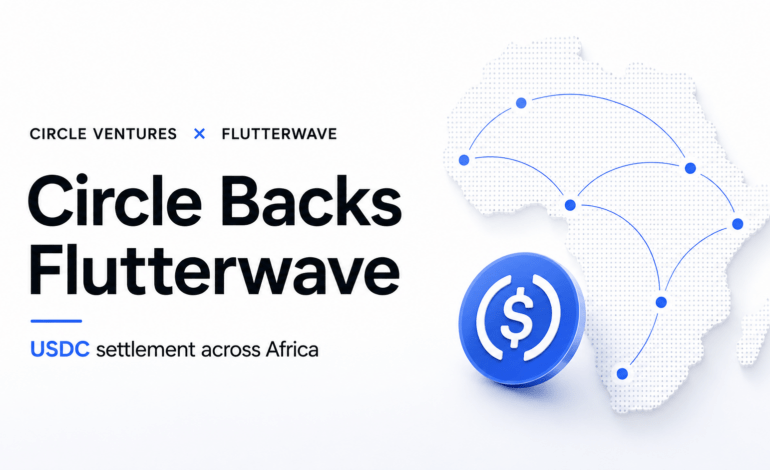
Circle Ventures has made a strategic investment in African payments company Flutterwave as the fintech expands its stablecoin infrastructure and introduces USDC settlement across its platform.
Flutterwave announced the investment on July 7, 2026, describing it as part of a broader plan to give businesses faster and more flexible ways to move money between African and international markets. The company did not disclose the size of the investment or the valuation attached to the transaction.
The deal will allow eligible businesses using Flutterwave to collect payments in African local currencies and, where appropriate, receive settlement in USDC, the dollar-backed stablecoin issued through Circle’s regulated affiliates.
Rather than replacing Flutterwave’s existing banking, card and mobile-money infrastructure, USDC will become another settlement option within what the company calls a multi-rail payments platform.
What Circle Ventures Is Investing In
Circle Ventures is Circle’s venture-investment operation. It backs companies building blockchain infrastructure, payments applications and other products that can expand the use of digital currencies such as USDC.
Beyond providing capital, Circle Ventures says it supports portfolio companies with product strategy, go-to-market assistance, infrastructure and potential commercial collaboration with Circle.
Flutterwave already operates a payments platform connecting banks, cards, mobile-money networks and domestic payment systems across multiple African markets.
The company says it has processed more than one billion transactions worth over $50 billion during its first decade of operation. Its infrastructure allows businesses to collect and distribute money across different countries without building a separate payment integration for every market.
The investment from Circle Ventures strengthens the relationship between the two companies while giving Circle a closer connection to one of Africa’s largest payment infrastructures.
How USDC Settlement on Flutterwave Could Work
The integration does not necessarily mean that customers will be required to pay merchants using cryptocurrency.
A business could continue accepting payments through familiar local methods, including bank transfers, cards or mobile money. Flutterwave would process those payments through its existing infrastructure, while the business could select USDC as its preferred settlement asset where the service is available.
For example, an international company collecting payments in naira, Kenyan shillings or Ghanaian cedis could potentially receive the final settlement in USDC instead of waiting for settlement through a conventional foreign-currency bank account.
Flutterwave says this model can reduce settlement delays, support transactions outside traditional banking hours and give companies more flexibility when managing treasury operations and cross-border payments.
The exact experience will depend on Flutterwave’s final product design, regulatory approvals, supported markets and eligibility requirements.
The July 7 announcement did not provide a complete list of countries where USDC settlement will launch, the blockchain networks Flutterwave will use, the transaction fees involved or a detailed rollout timetable.
What Is USDC?
USDC is a privately issued stablecoin designed to maintain a value equivalent to one United States dollar.
Circle states that USDC is backed by highly liquid cash and cash-equivalent reserves and can be redeemed for US dollars on a one-to-one basis through supported institutional channels. The company publishes reserve information and uses independent third-party attestations as part of its transparency framework.
Unlike bank transfers that may depend on clearing hours, correspondent banks and market-specific cut-off times, blockchain-based transfers can operate continuously.
Circle markets USDC as infrastructure for near-instant, always-on settlement, international payments and institutional liquidity management. However, moving USDC on-chain is only one part of the payment process.
Businesses still require compliant systems for converting local currencies into stablecoins, verifying customers, managing foreign exchange, screening transactions and converting USDC back into bank money where necessary.
Flutterwave’s value in the arrangement is its network of local payment methods, banking relationships and regulatory infrastructure across African markets.
The Partnership Did Not Begin in 2026
The investment builds on an earlier relationship between Flutterwave and Circle.
When Circle announced the Circle Payments Network in April 2025, Flutterwave was listed among its initial design partners alongside other payment companies, digital-asset businesses and financial infrastructure providers.
Circle said the network was designed to connect banks, payment service providers, digital wallets and other regulated institutions for cross-border settlement using USDC, EURC and other regulated stablecoins.
Flutterwave later said its participation in the Circle Payments Network was intended to provide enterprise merchants with faster and more reliable settlement options.
The 2026 investment therefore represents a deepening of an existing infrastructure relationship rather than the companies’ first collaboration.
USDC Will Not Be Flutterwave’s Only Stablecoin
Despite the Circle Ventures investment, Flutterwave is not adopting an exclusively USDC-based strategy.
The company says it is building a multi-rail platform combining fiat currencies, bank transfers, cards, mobile money, blockchain networks and multiple stablecoins.
Flutterwave also has a strategic partnership with Ripple. Under that arrangement, Ripple’s RLUSD is expected to serve as the default stablecoin across Flutterwave’s stablecoin products, supported by Ripple Payments and the XRP Ledger.
USDC will be offered alongside RLUSD for businesses that already use USDC for settlements, liquidity or treasury management.
This distinction is important.
Circle Ventures’ investment does not mean USDC has replaced RLUSD or that all Flutterwave transactions will move onto a Circle-controlled system.
Instead, Flutterwave appears to be positioning itself as an orchestration layer that can select or support different payment rails depending on the customer, market, currency and transaction type.
Questions That Remain Unanswered
Flutterwave’s announcement confirms the investment and the addition of USDC settlement, but several important commercial details remain undisclosed.
The company has not publicly confirmed:
- How much Circle Ventures invested.
- Whether the investment forms part of a wider funding round.
- Which African countries will receive the service first.
- Which Flutterwave customers will initially qualify.
- The blockchain network or networks that will carry settlements.
- How much USDC settlement will cost.
- Whether businesses will hold USDC directly or through a managed account.
- When the integration will become generally available.
These details will determine whether the product becomes a widely used payment rail or remains primarily an enterprise settlement option.