



Crypto Hacker Learns a $5 Million Lesson About Liquidity

Imagine having nearly $5 million worth of cryptocurrency in your wallet. You decide to sell it, expecting to walk away with millions of dollars.
You complete the transaction, check your balance, and discover something almost unbelievable.
You received just $71.
Not $71,000. Not $710,000. Just seventy-one dollars.
That is exactly the kind of situation that unfolded after the massive Binance hack of October 29, 2026.
And the person on the losing end was not an ordinary investor who had just discovered cryptocurrency. The wallet involved was linked by blockchain investigators to the hackers responsible for one of the biggest thefts in crypto history.
In a strange twist, the attackers who had reportedly stolen billions of dollars appeared to have made a costly mistake while trying to convert part of their stolen cryptocurrency.
The incident has left the crypto community with an important lesson: having millions of dollars worth of tokens does not necessarily mean you can sell them for millions of dollars.
How $5 Million in Crypto Became Just $71
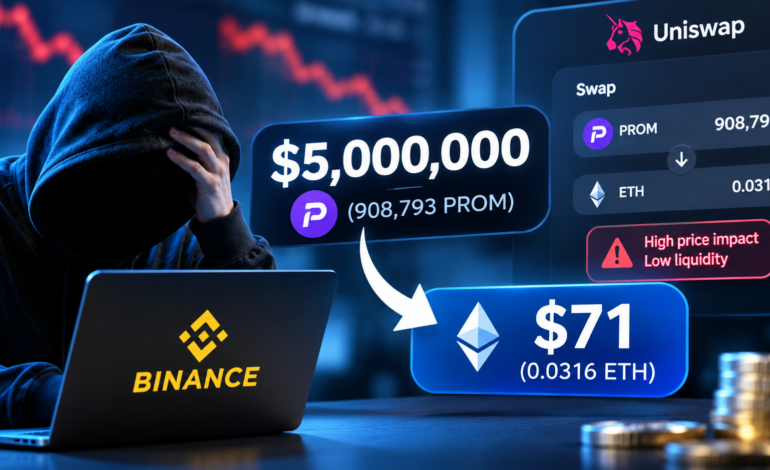
On October 31, a cryptocurrency wallet linked to the Binance attackers executed a transaction on Uniswap, a decentralized cryptocurrency exchange.
The wallet sold approximately 908,793 PROM tokens, which had an estimated market value of around $5 million.
PROM is a cryptocurrency token, and like other digital assets, its quoted market price can change depending on where and how it trades.
At first glance, the transaction should have been worth millions.
But when the swap was completed, the wallet received only 0.0316 ETH, worth approximately $71 at the time.
That is almost the entire estimated value of the tokens gone in a single transaction.
Blockchain analytics platform Lookonchain reported the unusual trade, linking it to the wallet associated with the Binance hack.
The transaction is also publicly identifiable on Etherscan, Ethereum’s blockchain explorer.
Anyone can use the transaction record to examine the amount of cryptocurrency transferred and received.
The transaction itself is real. The wallet’s connection to the Binance attack comes from blockchain investigators’ attribution of the address.
But there is a question worth asking.
How can a transaction involving nearly $5 million worth of tokens return only $71?
The answer comes down to something many cryptocurrency traders overlook: liquidity.
What Is Liquidity, and Why Does It Matter?
Let’s forget about cryptocurrency for a moment.
Imagine you own 100 expensive smartphones, each valued at KSh 100,000.
On paper, your stock is worth KSh 10 million.
Now imagine you travel to a small village where almost nobody can afford these phones. You urgently need to sell all 100 before leaving.
The phones have not suddenly become worthless. But finding someone willing and able to buy them at the advertised price is another matter entirely.
You might have to reduce your prices significantly to attract buyers.
That is the basic idea behind liquidity.
Liquidity describes how easily an asset can be bought or sold without significantly affecting its price.
Bitcoin, for example, generally has deep liquidity on major exchanges. Large amounts are traded every day, and there are usually many buyers and sellers.
Smaller cryptocurrencies can be very different.
A token might show a market price of $5, giving someone holding one million tokens an apparent balance of $5 million.
However, if there are not enough buyers or funds available at that price, selling all those tokens could produce much less money.
That is the problem the Binance hacker-linked wallet encountered.
The Uniswap Pool That Had Almost Nothing to Give
The PROM transaction happened through Uniswap V2.
Unlike traditional cryptocurrency exchanges that match buyers with sellers using an order book, Uniswap uses something called a liquidity pool.
Think of a liquidity pool as a digital container holding two cryptocurrencies.
For example, a PROM/ETH pool allows people to exchange PROM for ETH or ETH for PROM.
Users deposit cryptocurrency into the pool, making it possible for others to trade. The pool’s smart contract calculates the exchange rate based on the tokens available.
Here is where the hacker-linked trade went wrong.
According to Lookonchain, the PROM tokens were sold into a Uniswap pool that had almost no ETH available.
The wallet was attempting to sell an enormous amount of PROM into a pool that could not provide anything close to its quoted market value.
As the sale went through, the trade pushed the price sharply against the seller.
The result was devastating.
Approximately $5 million worth of PROM went in.
Around $71 worth of ETH came out.
The incident illustrates what traders call price impact, which is closely related to slippage.
Slippage: The Expensive Surprise Every Crypto Trader Should Understand
You may have noticed the word slippage while exchanging cryptocurrencies.
It sounds technical, but the idea is fairly simple.
Slippage occurs when the price at which a transaction executes differs from the price expected or quoted earlier.
Price impact, meanwhile, refers specifically to how much a trade itself moves the market price.
The two concepts are closely related, especially when trading through decentralized exchanges.
Imagine you want to exchange $1,000 worth of a cryptocurrency into USDT.
You expect to receive approximately 1,000 USDT.
But if the market changes or your trade moves the price significantly, you might receive only 980 USDT.
With a larger transaction and very little liquidity, the difference could be much worse.
In fact, Uniswap’s own documentation explains that larger trades in low-liquidity pools can experience significant price impact.
In the PROM incident, the difference was extreme.
The wallet received only a tiny fraction of the tokens’ estimated market value.
And because blockchain transactions are generally irreversible once confirmed, there was no simple button to undo the trade.
Did the Hacker Really Lose $5 Million?
This is where the story needs some context.
The transaction involved PROM tokens valued at approximately $5 million based on their quoted trading price.
However, that does not mean the attacker could realistically have sold the entire position for $5 million.
A cryptocurrency’s market price and the amount someone can actually receive when selling a large quantity are not always the same.
For instance, if the last recorded trade valued a token at $5, a wallet holding one million tokens might display a balance of $5 million.
But that balance is only an estimate.
If there is insufficient demand, converting the entire holding into cash or another cryptocurrency might be impossible at that price.
In the PROM transaction, the wallet gave up tokens with a reported market value of nearly $5 million and received approximately $71.
That is an extraordinary difference, but it should not automatically be described as losing $5 million in money that was guaranteed to be available.
There is another interesting detail.
Bitquery’s investigation found that trading bots bought the PROM tokens out of the pools in the same block as the sale and subsequently traded them elsewhere.
In other words, the tokens did not simply disappear.
Other market participants were positioned to benefit from the enormous price difference.
The case highlights how costly a poorly executed cryptocurrency trade can become, particularly when automated trading systems are involved.
What Can Ordinary Crypto Investors Learn From This?
It would be easy to laugh at the idea of a sophisticated hacker turning millions of dollars in cryptocurrency into just $71.
But there is a serious lesson here, especially for people buying new or lesser-known tokens.
The number shown in your crypto wallet does not always represent the amount you can withdraw.
A coin can rise by 500%, 1,000%, or even more, making early holders appear incredibly wealthy.
But what happens when those holders try to sell?
If the token has very little liquidity, they may discover that their profits exist mainly on paper.
This is particularly important in the world of meme coins and newly launched cryptocurrencies.
Some tokens attract enormous attention because their prices rise rapidly. Investors rush to buy, hoping to make quick profits.
Yet some of these tokens trade in very shallow liquidity pools.
A few large transactions can move their prices dramatically.
And when everyone tries to sell at once, the available liquidity may disappear quickly.
Before buying or selling a cryptocurrency, it is worth checking how much liquidity is available, how much you are likely to receive, and how much your transaction will move the market.
Trading interfaces often display an estimated output, price impact and slippage settings. These warnings should not be ignored.
For larger trades, comparing available pools, choosing routes with deeper liquidity and avoiding unnecessarily large single swaps can help reduce costs.
The important point is that a profitable-looking price means very little if you cannot actually sell at that price.
Even Crypto Hackers Cannot Escape Market Rules
The Binance incident shows two very different sides of cryptocurrency.
On one side, attackers managed to exploit systems protecting billions of dollars in digital assets.
On the other, a wallet linked to those attackers reportedly made a remarkably poor transaction involving a relatively small portion of the stolen funds.
The same market rules that affect everyday traders also affect wallets holding stolen cryptocurrency.
Liquidity does not care where the tokens came from.
A blockchain smart contract does not automatically give someone a better price because they control millions of dollars in assets.
And a token’s displayed value is not a promise that someone will buy it for that amount.
The $71 trade did not erase the broader Binance theft or mean the hackers lost everything they stole.
But it created one of the most memorable examples of liquidity risk in the crypto market.
Sometimes, the difference between being a millionaire on paper and having actual money available comes down to one simple question:
Is there enough liquidity for you to sell?
Blockwisely Take
There is something deeply ironic about a wallet linked to a multibillion-dollar cryptocurrency hack losing almost the entire quoted value of a token position in a single trade.
But beyond the irony, this incident should serve as a warning to every crypto investor.
Many beginners focus almost entirely on the price of a cryptocurrency. They look at charts, percentage gains and how much their wallets appear to be worth.
Few stop to ask whether they could actually sell their holdings at those prices.
That is a dangerous mistake.
A token can have an impressive market valuation, an exciting community and a price that keeps rising. But without enough liquidity, converting large holdings into real money can become extremely difficult.
The lesson is simple: do not just look at how much your crypto is worth. Look at how much you can actually sell it for.
Frequently Asked Questions (FAQs)
1. Did the Binance hacker really exchange $5 million for $71?
A wallet attributed to the Binance attackers swapped approximately 908,793 PROM tokens, estimated to be worth nearly $5 million, for about 0.0316 ETH, worth $71. The $5 million figure was an estimated token valuation rather than a guaranteed cash value.
2. Why did the hacker receive so little ETH?
The wallet sold the tokens into a Uniswap liquidity pool containing very little ETH. The enormous trade relative to the pool’s available liquidity caused extreme price impact, leaving the seller with a very small payout.
3. What is liquidity in cryptocurrency?
Liquidity is how easily a cryptocurrency can be bought or sold without causing a significant price change. High liquidity generally makes it easier to execute large trades at competitive prices.
4. What is the difference between slippage and price impact?
Price impact is the movement in a token’s price caused by the trade itself. Slippage is the difference between an expected or quoted execution price and the actual execution price. Both can affect how much cryptocurrency a trader receives.
5. Can ordinary crypto traders experience the same problem?
Yes. Anyone trading a cryptocurrency with insufficient liquidity can receive far less than expected, especially when selling large quantities through decentralized exchanges.
6. Did the hackers lose all the money stolen from Binance?
No. The PROM transaction involved only a small part of the wider stolen assets. The approximately $6.3 billion Binance hack involved many cryptocurrencies and blockchain networks, and investigators continue to track the stolen funds.
7. How can I avoid losing money because of low liquidity?
Check the liquidity available in the trading pool, review the estimated amount you will receive, examine the price impact and slippage settings, and compare trading routes before confirming a transaction. Do not assume that your wallet’s displayed valuation is the amount you can withdraw.