








Decentralized AI Marketplaces: How Blockchain Is Changing Who Owns Artificial Intelligence

Artificial Intelligence is no longer a future idea. It is already part of daily life. From chat tools to content creation, AI is everywhere.
At the same time, blockchain technology is quietly reshaping how digital systems work. It has already changed how we think about money. Now, it is starting to change how we think about intelligence itself.
This is where decentralized AI marketplaces come in.
They are still new, but they are solving a very important problem. Today, most AI systems are controlled by a few large companies such as OpenAI and Google. These companies own the data, the models, and the infrastructure.
That means access is limited, costs can be high, and control is centralized.
Decentralized AI marketplaces are trying to change that.
What Are Decentralized AI Marketplaces?
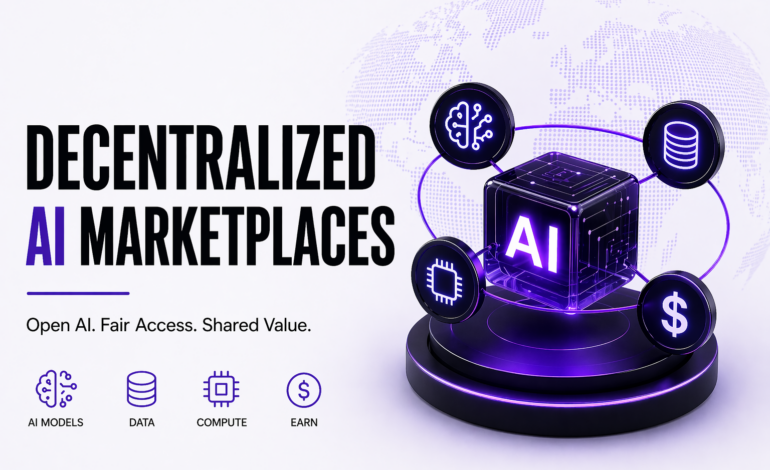
A decentralized AI marketplace is a platform where people can share and use AI tools without relying on a central company.
Instead of one company owning everything, the system is powered by blockchain and a network of participants.
In simple terms, it allows people to:
- Upload AI models and earn when others use them
- Rent out computing power such as GPUs
- Share and sell datasets
- Access AI tools from anywhere in the world
All of this happens using crypto payments and smart contracts.
It is similar to how marketplaces like Uber or Airbnb connect people, but in this case, it connects AI resources.
Why This Shift Is Important
Right now, AI is powerful but highly controlled.
A small number of companies decide:
- Who can access AI
- How much it costs
- What data is used
- What rules apply
This creates a gap between those who control AI and those who use it.
Decentralized AI marketplaces are built on a different idea. They aim to make AI open and accessible to anyone with an internet connection.
This matters even more in regions like Africa, where access to advanced technology is often limited or expensive.
If these systems grow, they could lower the barrier to entry and allow more people to build, experiment, and earn from AI.
How These Marketplaces Work in Practice
The concept may sound complex, but the idea is simple once you break it down.
Developers can upload AI models to the network. These models can be used by others who pay a small fee. The developer earns from every use.
People with powerful computers can rent out their unused GPU power. Instead of sitting idle, their machines can process AI tasks and earn crypto.
Data owners can also participate. Instead of giving data away for free to large companies, they can share it on their own terms and get paid when it is used.
Payments are handled using blockchain, which means they are fast, transparent, and do not require a middleman.
Real Projects Already Building This
This is not just an idea. Several projects are already working in this space.
- Fetch.ai is building a system of autonomous AI agents that can perform tasks and interact with each other
- SingularityNET focuses on creating a global marketplace for AI services
- Render Network allows people to rent out GPU power for AI and graphics work
- Ocean Protocol is focused on data sharing and monetization
Each of these projects is tackling a different part of the ecosystem. Together, they are building the foundation of decentralized AI.
What Makes Decentralized AI Different
The biggest difference is ownership.
In traditional systems, companies own everything. Users simply access services.
In decentralized systems, ownership is shared.
Developers own their models.
Users control their data.
Providers earn from their resources.
This creates a more balanced system where value is distributed instead of concentrated.
Challenges That Still Exist
Despite the promise, this space is still early.
There are real challenges that need to be solved.
The technology can be difficult for beginners to understand. Performance may not yet match centralized systems. Regulations are still unclear in many countries.
There is also the issue of trust. Not all data or models in open marketplaces will be high quality.
These challenges mean adoption will take time.
Why This Could Be a Major Trend
Decentralized AI sits at the intersection of two powerful forces: blockchain and artificial intelligence.
Both are already transforming industries on their own. When combined, they create entirely new possibilities.
If this model succeeds, it could redefine:
- How AI is built
- Who owns AI systems
- How people earn from data and computing power
It could also open opportunities for developers, creators, and everyday users in ways that were not possible before.
FAQ
What is a decentralized AI marketplace?
It is a platform where AI tools, data, and computing power are shared and traded using blockchain instead of centralized companies.
Why are decentralized AI marketplaces important?
They reduce control by large tech companies and allow more people to access and earn from AI.
Are there real projects in this space?
Yes, projects like Fetch.ai, SingularityNET, and Ocean Protocol are already building decentralized AI ecosystems.
Is this a good opportunity to explore?
It is still early, but many believe it could become one of the most important trends in both AI and crypto.