








The Future of Money Is AI-Agentic. Africa May Be Building It First.

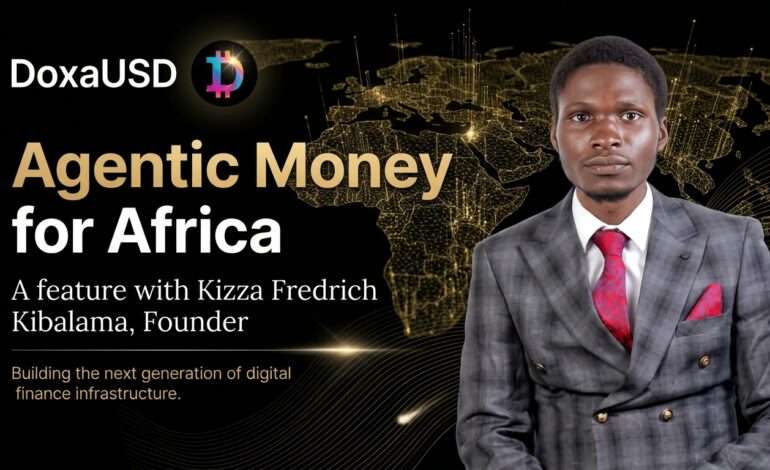
For Kizza Fredrich Kibalama, the idea behind DoxaUSD did not start with a project.
It started with a problem.
Across Africa, millions of people live with currencies that can lose value quickly. Businesses struggle with foreign exchange shortages. Cross-border payments can take longer than they should, and accessing dollars is not always easy.
Fredrich saw these problems around him in Uganda and began asking a simple question:
What if Africans could access digital dollars without depending entirely on traditional financial systems?
That question became the starting point for DoxaUSD.
Today, Fredrich is the Founder and CEO of the Doxa Foundation in Kampala, Uganda. He is also a software engineer and the lead architect behind the wider Doxa ecosystem, which includes DoxaUSD and the DOXA governance token.
His goal is not simply to launch another cryptocurrency.
He wants to build financial infrastructure that can serve people, businesses and, increasingly, artificial intelligence.
A Problem Fredrich Could See Around Him
Living and building in Africa gave Fredrich a close view of how currency problems affect everyday life.
When a local currency weakens, the effects can show up almost everywhere.
Imported goods become more expensive. Businesses that need to pay international suppliers face higher costs. People saving in local currency can watch their purchasing power fall.
Then there is the challenge of accessing foreign currency.
For businesses operating across borders, getting dollars at the right time and moving money between countries can be frustrating, expensive or slow.
These are not abstract economic problems for Fredrich.
They are part of the reality that pushed him to think about DoxaUSD.
“If you live in Uganda, Kenya, Nigeria, or many other African countries, you understand the reality,” he says.
Instead of asking how to build another crypto product, Fredrich and his team began with a different question.
What would digital money look like if it were designed around some of these African realities from the beginning?
The Idea Behind DoxaUSD
DoxaUSD is being developed as a dollar-denominated digital asset that can be used for payments, digital commerce and cross-border transactions.
The attraction of the dollar is easy to understand.
Across many African markets, it is already widely recognised as a store of value and a common currency for international trade.
Fredrich wants to take that familiarity and make it programmable.
That is where DoxaUSD begins to move beyond the idea of simply holding digital dollars.
The team is building toward what Fredrich describes as an agentic financial system.
In simple terms, this means creating money that software can use.
Imagine an AI assistant that needs to pay for cloud computing.
Or an autonomous business application that needs to purchase data.
Or software that needs to settle a small invoice automatically after completing a task.
Today, many of those transactions still require a person to step in and approve the payment.
Fredrich believes that will change.
“We are building toward an agentic financial system where money can move, settle and interact with applications autonomously,” he says.
For him, DoxaUSD is partly about preparing for that future.
Two Assets, Two Different Roles
The Doxa ecosystem has two major components.
The first is DoxaUSD.
This is the digital dollar side of the project. It is being designed for payments, commerce, cross-border settlement and transactions involving autonomous software.
The second is Doxa ($DOXA).
According to the project, DOXA has a fixed maximum supply of 10 million tokens.
Its role is different from DoxaUSD.
Rather than being positioned mainly as the currency people use for everyday payments, DOXA is intended to support governance and participation within the wider Doxa ecosystem.
The basic idea is straightforward.
DoxaUSD is intended to help move value.
DOXA is intended to help the community participate in decisions about the network.
Why Doxa Is Building on the Internet Computer
To build this system, the team chose the Internet Computer, commonly known as ICP.
ICP is a Layer 1 blockchain that allows developers to run application logic, data and user-facing services on-chain.
That technical architecture matters to Fredrich because of one particular problem in blockchain applications: complexity.
Many crypto applications require users to first understand wallets, network tokens and gas fees before they can do something as simple as make a transaction.
That is a major barrier if the goal is to reach ordinary users.
ICP uses a reverse-gas model where application developers can cover the computing costs instead of requiring every user to hold tokens just to interact with the application.
For Fredrich, that can help make blockchain applications feel more like normal internet services.
“We want financial applications to be accessible to ordinary users, not just people already familiar with blockchain,” he says.
That philosophy is important to Doxa.
If digital finance is going to become mainstream in Africa, the user experience cannot assume that everyone already understands crypto.
From Fredrich’s Project to a Community Protocol
Fredrich may have started Doxa, but he does not want to control it forever.
That is where the Service Nervous System, or SNS, becomes important.
SNS is the Internet Computer’s framework for decentralized governance.
It allows a project to move areas such as protocol upgrades, treasury decisions and governance away from a small founding team and toward a decentralized community.
For Doxa, this is supposed to be a major transition.
“We are moving from a founder-led project toward a community-owned financial protocol,” Fredrich says.
Community members can follow and participate in that process through the official NNS Launchpad.
For Fredrich, the transition is about more than fundraising.
It is about answering a much bigger question.
Who should control the financial infrastructure people depend on?
His preferred answer is not a single founder or company.
He wants the people who use, build and contribute to Doxa to increasingly have a say in where it goes.
Building for an Africa That Trades Across Borders
One of DoxaUSD’s biggest potential use cases is cross-border commerce.
African businesses are increasingly selling goods, services and digital products beyond their home countries.
But payments have not always kept pace.
A company in Uganda might have a customer in Kenya, a supplier elsewhere in Africa and a software provider in Europe.
Moving money between all those parties can involve different currencies, banks, mobile-money networks and payment processors.
Every additional layer can add cost and delay.
Fredrich sees programmable digital dollars as one possible way of reducing that friction.
DoxaUSD is being designed as a settlement layer that businesses and applications could potentially use across borders.
The same infrastructure could also support remittances, merchant payments and digital commerce.
The goal is not necessarily to replace every existing financial system.
It is to give businesses and developers another way to move value.
Then Comes AI
The part of Fredrich’s vision that makes DoxaUSD more unusual is artificial intelligence.
AI systems are becoming increasingly capable of doing work that once required constant human involvement.
They can research, write code, analyse information, communicate with customers and manage parts of business processes.
But an autonomous system eventually runs into a simple problem.
It needs money.
If an AI agent can identify the data it needs but cannot pay for it, it is not fully autonomous.
If it can book computing resources but still needs a human to approve every small transaction, the process remains limited.
Fredrich thinks programmable digital money could help close that gap.
Imagine an AI agent receiving a budget from a business.
It could pay for computing power, purchase information, settle invoices or make other approved payments within limits established by the company.
That is the kind of economy Doxa wants to prepare for.
Fredrich calls this the autonomous economy.
It is still an emerging idea, but he believes the financial infrastructure for it needs to be built now.
Why Build It From Kampala?
There is another part of the Doxa story that matters to Fredrich.
Where it is being built.
The project is being developed from Kampala, not Silicon Valley, London or another traditional financial centre.
For Fredrich, that is significant.
African developers and founders often work with financial systems that were designed elsewhere and later adapted to their markets.
He wants Doxa to take the opposite approach.
Build from Africa first.
The team understands mobile money because they use it.
They understand foreign-exchange shortages because they operate in markets where those shortages happen.
They understand the difficulty of cross-border payments because African businesses deal with it every day.
That experience influences the kind of product Fredrich wants Doxa to become.
“This is not someone else’s financial infrastructure being brought to Africa,” he says. “This is infrastructure we helped build and govern.”
Scarcity, Transparency and Community Ownership
Fredrich points to three principles that he believes should define the project.
The first is scarcity.
The project says the DOXA governance token has a hard maximum supply of 10 million tokens.
The second is transparency.
Doxa wants important parts of the protocol, including governance and treasury activity, to be visible on-chain.
Instead of participants simply trusting what a company says it is doing, the long-term goal is to make important actions verifiable.
The third is community ownership.
That is where the SNS transition becomes especially important.
If Doxa succeeds in moving from founder-led control to meaningful decentralized governance, people participating in the ecosystem would have a direct role in decisions about its future.
That transition will also be an important test of the project’s wider philosophy.
Building a community-owned protocol is easier to promise than to achieve.
For Doxa, the coming governance process will show how much control ultimately moves from the founding team to the people participating in the network.
How People Can Get Involved
People interested in the project can start by exploring the official Doxa website, where the team shares more information about DoxaUSD, DOXA and its wider roadmap.
Those interested in the project’s decentralized governance process can also follow the Doxa SNS process through the NNS Launchpad.
DOXA holders can participate in SNS governance by locking tokens into what the Internet Computer ecosystem calls neurons and using them to vote on proposals.
Fredrich also wants developers and businesses to experiment with the technology.
That could mean integrating DoxaUSD into merchant payment systems, digital applications, cross-border payment flows or AI agents that need the ability to make transactions.
For people who are not developers, Fredrich says supporting the project can be as simple as introducing it to businesses, Web3 communities and other people interested in the future of African financial technology.
Africa as a Builder, Not Just a Market
Ultimately, Fredrich’s story is about something bigger than DoxaUSD.
It is about where Africa fits in the next generation of financial technology.
Stablecoins are growing.
Artificial intelligence is becoming more autonomous.
Software is increasingly able to perform tasks that once needed humans.
And money itself is becoming more programmable.
Fredrich believes Africa should not wait for all of that infrastructure to be built elsewhere and then imported.
He wants African engineers, founders and communities to participate in building it.
That is the larger bet behind Doxa.
A digital dollar is the starting point.
The bigger ambition is to build financial infrastructure that people, businesses and machines can use, and to build it from Africa.