








Gate Makes Polymarket Easier to Use by Removing Web3 Wallet Barriers

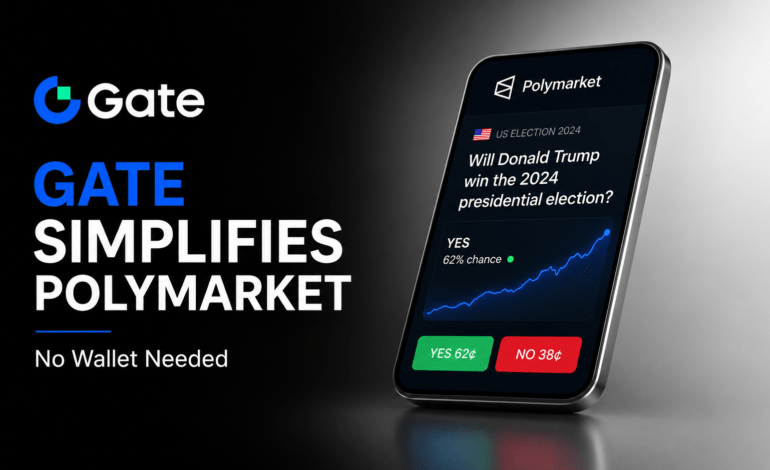
Gate has integrated Polymarket into its app, giving users a simpler way to access prediction markets without directly managing Web3 wallets, private keys, gas fees, or network switching.
The move matters because prediction markets are becoming one of the most active areas in crypto. They allow users to trade on the outcome of real-world events, including crypto prices, elections, sports, economic data, and global news.
Polymarket is one of the best-known platforms in this category. It describes itself as a prediction market where users buy and sell shares in real-world outcomes. A share price also acts like a market-based probability. For example, if a “Yes” share trades at $0.75, the market is roughly pricing that outcome as having a 75% chance of happening.
However, using Polymarket directly can still feel complicated for many beginners. Even with gasless trading, users may still need to understand wallets, signing transactions, funding accounts, Polygon-based assets, and on-chain approvals.
Gate’s integration tries to remove much of that friction by letting users access Polymarket-style prediction markets from inside a centralized exchange account.
Why Prediction Markets Are Growing in Crypto
Prediction markets are useful because they turn opinions into tradable prices.
Instead of only asking people what they think will happen, prediction markets let users put money behind their views. That creates a live market price that reflects the crowd’s collective expectation.
This is why prediction markets have become popular for events such as:
- Crypto price movements
- Political elections
- Sports results
- Interest rate decisions
- Inflation data
- Geopolitical developments
- Major business and technology events
Polymarket says its markets cover politics, sports, crypto, finance, geopolitics, culture, and more. It also explains that users can buy or sell shares before a market resolves, meaning they do not always have to hold until the final outcome.
During the 2024 U.S. election cycle, prediction markets attracted major attention. Polymarket said it recorded more than $100 million in predictions in June 2024 alone, showing that demand for event-based trading had moved far beyond a small crypto niche.
The Problem: Direct On-Chain Participation Can Be Confusing
Polymarket has made major progress in improving user experience.
Its documentation says the platform’s Relayer Client enables gasless transactions. Instead of requiring users to hold POL for gas, Polymarket’s infrastructure pays transaction fees.
That is a major improvement. But it does not remove every barrier.
Polymarket’s own documentation still shows that the relayer process involves user signing, wallet execution, and on-chain settlement. It also lists prerequisites such as a user’s private key or signer and a pUSD balance for trading.
Polymarket USD, or pUSD, is the collateral token used for trading on Polymarket. According to Polymarket’s documentation, pUSD is an ERC-20 token on Polygon backed by USDC.
For experienced crypto users, this may be normal. For beginners, it can still be intimidating.
A new user may need to understand:
- What a Web3 wallet is
- How to protect a seed phrase
- How Polygon works
- How USDC or pUSD is used
- How approvals and signatures work
- How to avoid malicious contracts
- How to manage funds safely on-chain
This is the gap Gate is trying to solve.
How Gate Simplifies Access to Polymarket
Gate has integrated Polymarket into its app, becoming one of the first centralized exchanges to offer direct access to the prediction market platform. Bitcoin.com reported that Gate’s integration allows users to access Polymarket through the Gate app and trade on global events across crypto, finance, and sports.
The key difference is that Gate users can participate through their existing exchange account.
According to Bitcoin.com, users with Gate accounts can access the Polymarket module and use USDT from their spot balances without handling on-chain steps. The same report says Gate also supports a Web3 route for users who prefer wallet-based access through Polygon and USDC.
This gives Gate users two possible paths:
Centralized exchange path: Use a Gate account and spot USDT.
Web3 path: Connect a wallet and interact through Polygon-based infrastructure.
For many retail users, the centralized path will feel easier because it removes the need to manage private keys, bridge assets, switch networks, or pay attention to blockchain transaction details.
The uploaded source document also describes Gate’s approach as a wallet-free and on-chain-free participation model where users can access Polymarket-style markets through Gate’s centralized account system using USDT balances.
What Users Can Trade Through Gate’s Polymarket Integration
Gate’s Polymarket integration gives users access to event-based markets where they can buy “Yes” or “No” shares.
These markets may include topics such as:
- Crypto price predictions
- Sports outcomes
- Economic data
- Political events
- Global news
- Market-related trends
Gate’s Polymarket section includes markets across sports, finance, crypto, and other major topics. It also noted that prices update in real time and reflect market-implied probabilities.
This means users are not simply placing a normal bet. They are trading outcome shares whose prices change as the market reacts to new information.
For example, if a crypto market asks whether Bitcoin will reach a certain price before a deadline, users may buy “Yes” if they believe it will happen or “No” if they believe it will not. The price of those shares may rise or fall as new information enters the market.
Prediction Mode vs Trading Mode
Gate’s integration reportedly offers two main ways to participate.
The first is a simpler prediction mode. This is designed for users who want a more straightforward experience. They choose an event, pick an outcome, enter an amount, and hold their position.
The second is trading mode. This is aimed at users who want more control, including tools such as order books, charts, probability movements, and more active position management. Bitcoin.com reported that Gate added features such as candlestick charts, probability charts, order book depth, and market and limit orders.
This structure makes sense because prediction markets attract different types of users.
Some people want simple participation. Others want active trading based on changing odds, news flow, liquidity, and price movement.
Why This Is Important for Mainstream Adoption
The biggest benefit of Gate’s integration is not just convenience. It is accessibility.
Many crypto users already keep funds on centralized exchanges. They understand spot balances, order placement, trade history, and account dashboards. But they may not be comfortable using a Web3 wallet or signing blockchain transactions.
By bringing Polymarket access into a familiar exchange environment, Gate lowers the learning curve.
That could help prediction markets reach users who are interested in event-based trading but do not want to manage on-chain tools directly.
This is similar to what happened with many other crypto products. In the early days, users needed more technical knowledge. Over time, exchanges and fintech apps simplified the experience until more people could participate.
Gate’s Polymarket integration follows the same pattern.
Risks Users Should Understand Before Participating
Prediction markets are not risk-free.
The biggest risk is being wrong about the event outcome. If a user buys shares in an outcome that does not happen, those shares may expire worthless.
Liquidity risk is also important. Some markets may have thin trading activity. If there are not enough buyers or sellers, users may struggle to exit a position at the price they expect.
Users should also pay close attention to each market’s resolution rules. These rules explain how the final outcome will be determined, what data sources will be used, and when settlement will happen.
Regulatory risk is another factor. Prediction markets have attracted increasing legal and regulatory attention in different jurisdictions. Reuters reported that the U.S. CFTC recently sued to block Minnesota’s prediction market ban, highlighting the ongoing debate over whether some event contracts fall under federal derivatives rules or state-level gambling restrictions.
This means users should not treat prediction markets as guaranteed income. They are high-risk products based on uncertain real-world outcomes.
FAQ
What is Polymarket?
Polymarket is a prediction market platform where users buy and sell shares based on the outcomes of real-world events. Prices act like market-implied probabilities.
What did Gate do with Polymarket?
Gate integrated Polymarket into its app, allowing users to access prediction markets through a centralized exchange interface. Bitcoin.com reported that users can trade through Gate using USDT from spot balances, while Web3 users can also connect through Polygon and USDC.
Do users still need a Web3 wallet on Gate?
For the centralized Gate account route, users can participate with their Gate account and spot USDT, reducing the need to manage a separate Web3 wallet.
Is Polymarket gas-free?
Polymarket’s documentation says its Relayer Client enables gasless transactions and that Polymarket’s infrastructure pays transaction fees instead of requiring users to hold POL for gas.
What is pUSD on Polymarket?
pUSD is Polymarket’s collateral token used for trading. Polymarket says it is an ERC-20 token on Polygon backed by USDC.
Can prediction market shares lose all value?
Yes. If the outcome you bought does not happen, your shares can become worthless. Users should treat prediction markets as risky and only participate with funds they can afford to lose.