




Google Runs AI Model in Space for the First Time Using Orbiting TPU Satellite

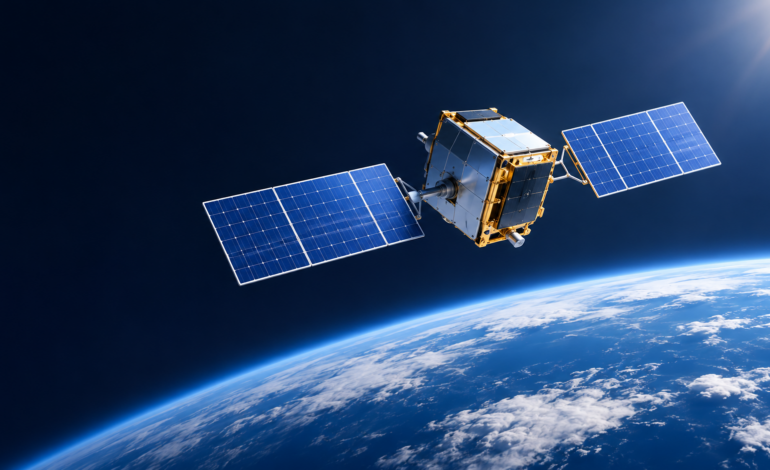
Google has successfully generated an artificial intelligence response using a data-center-class AI processor aboard a satellite in orbit, marking an important milestone in its effort to explore whether future AI computing infrastructure could operate in space.
The achievement is part of Project Suncatcher, Google’s research initiative investigating how satellites powered by solar energy might support demanding artificial intelligence workloads.
In an official announcement published on October 30, 2026, Google confirmed that its prototype satellite had successfully run early machine-learning tests.
The team sent a prompt from Earth to an onboard Gemma 4 AI model and received a response generated in orbit.
However, Google has not launched a commercial space-based data centre.
The development is an early experiment intended to test whether AI hardware can operate reliably in the difficult conditions of space.
What Did Google Achieve With Project Suncatcher?
Google’s researchers confirmed that a satellite equipped with a Tensor Processing Unit, commonly called a TPU, successfully ran an AI model while orbiting Earth.
A TPU is a specialized computer processor developed by Google to accelerate artificial intelligence calculations.
TPUs are commonly used in AI infrastructure to train and run machine-learning models.
For Project Suncatcher, Google installed a data-center-class TPU aboard a prototype satellite.
On October 30, the company announced that it had successfully generated its first AI response from the orbiting processor.
The milestone followed several weeks of technical checks after the satellite launched on October 1.
These checks included powering up the satellite’s host systems, activating its TPU hardware, and testing whether the computing equipment operated correctly.
The successful response demonstrated that the onboard AI system could receive a prompt, process it, and return generated text to Earth.
What Did Google’s AI Model Say From Space?
For the first major test, Google’s researchers sent a simple request to the satellite.
They asked its onboard Gemma 4 model to generate a short poem about being in space.
The satellite received the instruction while passing over a ground station.
It then generated a response and transmitted the result back to Earth.
According to Google, the response included a haiku describing Earth and the experience of processing data in orbit.
The company subsequently tested additional poetry prompts and technical questions related to the satellite’s systems.
These were relatively small AI tasks, not complex training jobs or large-scale commercial workloads.
Nevertheless, the tests showed that Google’s AI software and specialized hardware could work together in orbit.
That is an important early step toward more advanced experiments.
What Is Project Suncatcher?
Project Suncatcher is a Google Research initiative exploring whether space could eventually become a practical location for large-scale AI computing infrastructure.
Today, most AI systems run in data centres on Earth.
These facilities contain servers, processors, networking equipment, cooling systems, and electrical infrastructure.
They require considerable investment and, for large AI workloads, substantial amounts of electricity.
Project Suncatcher examines a different possibility.
Instead of locating all AI computing infrastructure on Earth, future systems might operate aboard satellites in low Earth orbit.
Such satellites could potentially use solar energy to power AI processors.
Google is also researching how groups of satellites could communicate and operate together.
The goal is not simply to put one computer in space.
It is to investigate whether a connected network of orbiting computing systems could support useful AI workloads at scale.
When Did Google Launch the Satellite?
Google launched the prototype satellite on October 1, 2026.
According to Google’s original launch announcement, the satellite was developed in partnership with space technology company Planet.
It reached orbit aboard a SpaceX Transporter-18 rideshare mission.
After launch, Google confirmed that it had established communication with the spacecraft and that the satellite was operating as expected.
The researchers then began testing its computing systems.
The October 30 announcement marked the successful completion of the first AI-response milestone.
It is important to distinguish these two developments.
The satellite was launched on October 1, while Google announced its successful AI-generated response on October 30.
Why Does Google Want to Run AI in Space?
One of the biggest challenges facing AI companies is the growing demand for computing power.
Training and running advanced AI models requires specialized processors and substantial infrastructure.
As demand increases, companies must build or expand data centres.
This can increase pressure on electricity supplies, cooling systems, land, and other resources.
Google is investigating whether some of these challenges could be addressed using infrastructure in orbit.
Could solar energy power space-based AI?
Satellites in suitable orbits can receive sunlight for long periods.
Google says some orbital arrangements could provide access to substantially more solar energy than typical installations on Earth’s surface.
Unlike terrestrial solar farms, satellites do not experience clouds or weather in the same way.
However, they still pass through changing illumination conditions depending on their orbit.
They also require solar panels, power management systems, batteries, and other equipment.
The possibility of accessing abundant solar energy is one reason Google is exploring space-based computing.
But receiving solar energy does not automatically make operating a satellite data centre cheap or environmentally sustainable.
Launch costs, hardware manufacturing, thermal management, communications, and maintenance would all need to be considered.
What Makes Running AI in Space Difficult?
Space creates several technical challenges that do not exist in ordinary data centres.
1. Radiation
Satellites are exposed to radiation that can affect electronic components.
Radiation may cause errors, damage hardware, or reduce the reliability of processors.
This is particularly important for AI computing because complex calculations must be performed accurately.
Google plans to study how its TPUs behave under radiation exposure over time.
2. Cooling
AI processors generate heat when operating.
On Earth, data centres use air cooling, liquid cooling, or other thermal systems to remove heat from equipment.
In the vacuum of space, there is no surrounding air to carry heat away through ordinary convection.
Satellites must rely heavily on thermal conduction and radiation to move and release heat.
That creates difficult engineering requirements for powerful processors.
3. Communication
Data must move between satellites and Earth.
Future space-based AI systems might also need to transfer enormous amounts of information between satellites.
Google is exploring high-bandwidth optical communication using lasers.
However, maintaining precise links between satellites moving at orbital speeds is technically demanding.
4. Launch and maintenance costs
Building a large computing network in orbit would require launching substantial amounts of hardware.
Repairs and upgrades could be much more difficult than replacing equipment in a terrestrial data centre.
A successful prototype does not demonstrate that such a network would be economically competitive.
5. Reliability
A commercial AI computing system would need to operate consistently over long periods.
Researchers must establish whether processors can survive radiation, thermal cycling, and other conditions without unacceptable failure rates.
These questions remain central to Project Suncatcher.
What Is a Google TPU?
A TPU, or Tensor Processing Unit, is a specialized processor designed for machine-learning calculations.
Ordinary computer processors, commonly called CPUs, are designed to handle a wide variety of general computing tasks.
Graphics processing units, or GPUs, are particularly useful for parallel calculations and are widely used in AI.
TPUs are Google’s specialized processors designed to accelerate certain machine-learning operations.
For example, when an AI chatbot generates an answer, its hardware performs large numbers of mathematical calculations.
A TPU can help perform those calculations efficiently.
Project Suncatcher is testing whether such hardware can function in orbit.
The achievement is not that an ordinary satellite computer displayed a chatbot response.
It is that a processor intended for data-centre AI workloads successfully generated a response in space.
What Is Gemma 4?
Gemma 4 is an AI model in Google’s Gemma family.
Gemma models are designed to provide developers and researchers with AI capabilities that can be used in different applications.
In Project Suncatcher, Google used an onboard Gemma 4 model for its first successful prompt-response test.
The model generated text in response to instructions transmitted from Earth.
This demonstrated a basic form of AI inference.
What is AI inference?
AI inference happens when an already-trained AI model processes new information and produces an output.
For example, when someone asks a chatbot a question and receives an answer, that is an inference task.
Training an AI model is different.
Training involves adjusting the model’s parameters using large amounts of data and computing resources.
Google’s satellite milestone involved inference, not the training of a new large AI model in orbit.
This distinction matters because demonstrating small inference workloads does not establish that a satellite can support the full computing demands of a major AI training operation.
Is Google Building a Space Data Centre?
Google is researching the possibility, but it has not demonstrated a commercial space data centre.
The current satellite is a prototype.
Its main purpose is to collect information about hardware performance and test early AI workloads in orbit.
In its October 30 announcement, Google said the next planned milestone involves two interconnected satellites in 2027.
The future experiment would help researchers evaluate communications and distributed computing capabilities.
This is a planned test, not a confirmed operational deployment.
There is no established date for when Google might offer commercial AI computing services from orbit.
The project must overcome substantial technical and economic barriers before that becomes possible.
Could Space-Based AI Reduce Electricity Demand on Earth?
Potentially, but the answer is not yet known.
Using solar energy in orbit could allow some computing tasks to operate without drawing power directly from terrestrial electrical grids.
However, the infrastructure would still require energy and resources to manufacture and launch.
Satellites also need systems for thermal management, communications, and power storage.
A complete environmental assessment would need to consider the full lifecycle of the infrastructure.
That includes manufacturing emissions, launch activities, replacement schedules, and the amount of useful computing work performed.
It would therefore be premature to describe space-based AI computing as automatically greener or cheaper than data centres on Earth.
Google’s research is intended to investigate whether the technology can eventually become practical.
What Could Project Suncatcher Mean for Africa?
Africa faces significant opportunities and challenges in developing AI infrastructure.
Reliable electricity, internet connectivity, affordable computing services, and access to skilled professionals are important requirements for building AI applications.
Space-based computing could eventually become another component of global AI infrastructure.
If it becomes commercially viable, it might influence how cloud computing services are delivered and priced.
That could indirectly affect African startups, researchers, and developers using international AI platforms.
However, several limitations remain.
A satellite-based system would still require dependable communication links to users and ground infrastructure.
The cost of accessing its computing resources would depend on the business model, not simply the location of the processors.
Latency, regulation, data protection requirements, and service reliability would also matter.
There is currently no confirmed Project Suncatcher product or programme specifically targeting African customers.
For African developers, the immediate relevance is understanding the technological direction rather than expecting access to space-based AI services soon.
What Happens Next?
Google says it will continue testing the satellite’s AI hardware.
The upcoming experiments will focus on how the system behaves under thermal stress and radiation exposure.
The company also plans to study the reliability of AI workloads over time.
Its proposed 2027 milestone involves two interconnected satellites that could help test distributed computing and communications.
These experiments may help Google determine whether larger networks of orbiting AI processors are technically practical.
However, future success is not guaranteed.
The current milestone proves that a specific early AI task was completed successfully in orbit.
It does not establish that large-scale orbital computing is economically or operationally viable.
Frequently Asked Questions
Has Google successfully run AI in space?
Yes. Google confirmed on October 30, 2026, that its prototype satellite generated an AI response using a data-center-class TPU while in orbit.
Which AI model did Google use?
Google used Gemma 4 for its initial prompt-response tests.
When did Google launch the satellite?
The prototype launched on October 1, 2026, aboard a SpaceX Transporter-18 rideshare mission.
What is Project Suncatcher?
Project Suncatcher is a Google Research initiative exploring whether AI computing infrastructure could operate aboard solar-powered satellites.
What is a TPU?
A Tensor Processing Unit is a specialized computer processor developed by Google for machine-learning calculations.
Is Google already operating a commercial data centre in space?
No. The current project is an experimental prototype and does not provide commercial space-based AI computing services.
Could running AI in space be cheaper?
It is possible in the future, but Google has not demonstrated that orbital computing is cheaper than equivalent terrestrial infrastructure.
What is Google’s next planned experiment?
Google plans to test two interconnected satellites in 2027, subject to the project’s technical progress and launch plans.
Could African developers use space-based Google AI services?
There is no announced commercial service or confirmed availability for African developers. Any future access would depend on the technology and Google’s service arrangements.
Key Takeaways
- Google launched its Project Suncatcher prototype satellite on October 1, 2026.
- On October 30, the company confirmed its first AI-generated response from a data-center-class TPU in orbit.
- The onboard model was Gemma 4.
- The successful test involved AI inference, not large-scale model training.
- Google is researching solar-powered orbital computing and satellite communications.
- A two-satellite experiment is planned for 2027.
- Commercial space-based AI data centres remain a future possibility, not a demonstrated reality.