








Nigeria Recorded $59B in Crypto Inflows Between July 2023 and June 2024

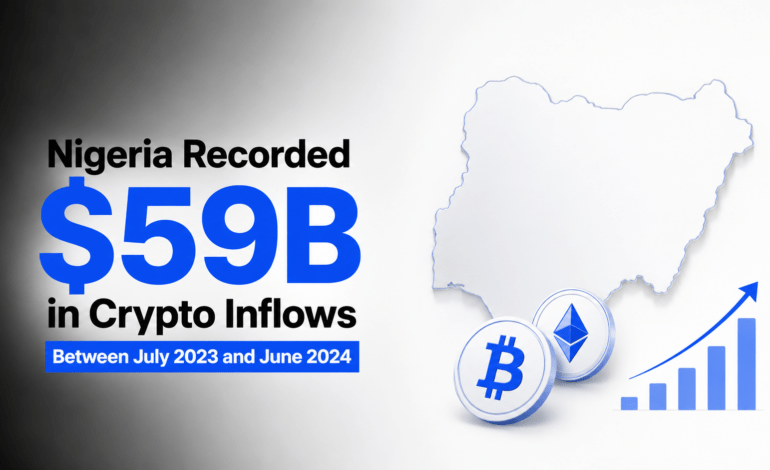
Nigeria received an estimated $59 billion in cryptocurrency value between July 2023 and June 2024, reinforcing its position as the largest crypto market in sub-Saharan Africa and one of the world’s leading countries for grassroots digital-asset adoption.
The estimate comes from blockchain analytics company Chainalysis, which said Nigeria ranked second in its 2024 Global Crypto Adoption Index, behind India. Nigeria also ranked second for retail activity through centralised crypto services and second for overall decentralised finance activity.
The International Monetary Fund later repeated the $59 billion estimate in a June 2026 analysis of stablecoin use in Nigeria, describing digital assets as an increasingly important channel for cross-border payments by households and small businesses.
However, the figure does not mean that $59 billion in fresh investment entered Nigeria or that Nigerian crypto users collectively made $59 billion.
It represents the estimated dollar value of cryptocurrency received on-chain by services and users attributed to Nigeria during the 12-month measurement period.
What does $59 billion in crypto inflows mean?
Chainalysis estimates the value of cryptocurrency received by users of centralised exchanges, decentralised protocols and other blockchain services associated with a country.
The company assigns activity geographically using information including web-traffic patterns linked to crypto platforms. It acknowledges that this methodology is imperfect because some users may employ virtual private networks or other tools that obscure their location.
The $59 billion figure can include activity such as:
- buying and selling cryptocurrencies;
- moving assets between wallets and exchanges;
- receiving remittances;
- cross-border business payments;
- stablecoin transfers;
- decentralised finance transactions;
- merchant payments; and
- transfers between professional traders and institutions.
The same crypto assets can move several times during the year, with each qualifying transfer contributing to the overall value received.
The figure should therefore be understood as estimated transaction activity, not net wealth created or money permanently retained in Nigeria.
Nigeria accounted for almost half of the region’s activity
Sub-Saharan Africa received approximately $125 billion in on-chain crypto value between July 2023 and June 2024, according to Chainalysis.
Nigeria’s estimated $59 billion represented close to half of the region’s total, placing it far ahead of other major African crypto markets. South Africa, the region’s next-largest market during the period, received approximately $26 billion.
Despite Nigeria’s scale, sub-Saharan Africa remained the smallest regional crypto economy globally, accounting for approximately 2.7% of worldwide transaction volume during the measurement period.
This means Nigeria’s strength is more visible in adoption relative to its population and economy than in its share of total global institutional crypto volume.
Most Nigerian crypto activity involved smaller transactions
Nigeria’s crypto market was not driven exclusively by multinational institutions or wealthy investors.
Chainalysis found that approximately 85% of the value received by Nigeria came through transfers worth less than $1 million. These include retail transactions below $10,000 and professional-sized transfers between $10,000 and $1 million.
That pattern supports the argument that crypto in Nigeria is frequently used for practical financial needs rather than only large-scale institutional speculation.
Common use cases include:
- protecting savings from naira depreciation;
- obtaining exposure to US dollar-linked assets;
- paying foreign suppliers;
- receiving money from abroad;
- trading digital assets;
- purchasing goods or services; and
- moving money when conventional banking channels are expensive or unavailable.
Chainalysis cited Nigerian exchange Busha as saying that crypto was increasingly being used for everyday activities such as bill payments, airtime purchases and retail transactions.
Stablecoins play a central role
Stablecoins are among the most important drivers of Nigeria’s crypto economy.
These are blockchain-based tokens designed to maintain a relatively stable value, usually by tracking a conventional currency such as the US dollar.
Chainalysis estimated that Nigeria accounted for approximately 40% of stablecoin inflows into sub-Saharan Africa during the July 2023-to-June 2024 period.
The IMF’s later analysis placed Nigeria’s share at roughly 60% of cumulative sub-Saharan African stablecoin inflows since 2019, although the two percentages cover different time periods and should not be treated as contradictory.
Stablecoins are attractive to Nigerian users because they can combine the relative stability of the US dollar with the speed and accessibility of blockchain transfers.
Common dollar-linked stablecoins include USDT and USDC.
Why Nigerians use stablecoins
Nigeria’s economic conditions during 2023 and 2024 created strong demand for alternatives to the naira.
The IMF identified several key drivers:
- sharp naira depreciation;
- high inflation;
- restricted access to foreign currency;
- expensive cross-border payments; and
- limited access to some formal financial services.
Stablecoins allow users to hold dollar-linked value without necessarily opening a foreign bank account.
They can also help businesses pay overseas suppliers and allow families to receive remittances through digital wallets.
According to the IMF, users can often complete stablecoin-based cross-border transactions within minutes and at a lower cost than traditional payment channels.
The IMF noted that sending $200 to sub-Saharan Africa through conventional remittance services costs approximately 9% of the transaction value on average, compared with a global average of around 6%.
Chainalysis estimated that stablecoin-based remittances could be approximately 60% cheaper than conventional fiat-based alternatives for a $200 transfer to the region.
Actual costs still depend on the exchange, blockchain network, liquidity provider and method used to convert stablecoins into local currency.
Stablecoin activity approached $3 billion in one quarter
Chainalysis found that stablecoin activity became particularly significant during the first quarter of 2024 as the naira weakened.
Among Nigerian transactions below $1 million, stablecoin value approached $3 billion during the quarter, becoming the largest category of crypto activity within that transaction range.
Bitcoin and other cryptocurrencies still accounted for billions of dollars in value, but stablecoins increasingly became the preferred option for smaller and medium-sized transfers.
This reflects an important shift in how crypto is used in Nigeria.
While Bitcoin is often associated with investment and long-term savings, stablecoins function more like digital dollars for payments, working capital, remittances and short-term value storage.
Cross-border payments are a major use case
International payments remain slow and costly for many Nigerian individuals and businesses.
Traditional transfers may involve commercial banks, correspondent banks, currency conversions and multiple compliance checks.
Stablecoins can reduce the number of intermediaries by allowing value to move directly between blockchain wallets.
A Nigerian importer, for example, may buy USDT or USDC locally and send it to a foreign supplier or payment partner. A remittance company may use stablecoins behind the scenes to settle obligations before paying the recipient in naira.
Chainalysis said stablecoins were widely used for remittances in Nigeria because they could be faster and less expensive than conventional options.
The IMF similarly described stablecoins as a meaningful cross-border payments channel for Nigerian households and small firms.
DeFi accounted for more than $30 billion
Nigeria was also one of the world’s leading countries for decentralised finance usage.
Chainalysis estimated that Nigerian users received more than $30 billion through DeFi services during the July 2023-to-June 2024 period.
DeFi refers to financial applications that operate through blockchain-based smart contracts rather than relying entirely on banks or centralised exchanges.
Users may access DeFi platforms to:
- exchange tokens;
- provide liquidity;
- borrow assets;
- lend crypto;
- earn returns;
- trade derivatives; and
- interact with dollar-linked stablecoins.
Nigeria ranked second globally for overall DeFi value received and third for retail DeFi activity in Chainalysis’s 2024 adoption index.
However, DeFi carries significant risks, including smart-contract vulnerabilities, unstable returns, token-price volatility and limited options for recovering funds after mistakes or exploits.
Nigeria ranked second globally for crypto adoption
Chainalysis’s Global Crypto Adoption Index is designed to measure grassroots use rather than simply identify which countries process the highest absolute transaction volume.
The index combines four categories:
- total crypto value received through centralised services;
- retail value received through centralised services;
- value received through DeFi protocols; and
- retail DeFi activity.
The results are adjusted using population and purchasing-power measures so that adoption in lower-income countries is not overshadowed by the large financial markets of richer economies.
Nigeria ranked:
- second overall;
- fifth for total centralised-service value;
- second for retail centralised-service activity;
- second for DeFi value; and
- third for retail DeFi activity.
The country fell to sixth position in Chainalysis’s 2025 index, according to the IMF, but remained one of the world’s largest grassroots crypto markets.
Does $59 billion mean crypto is replacing banks?
Not necessarily.
Crypto and stablecoins remain small compared with Nigeria’s entire financial system and are frequently used alongside banks, mobile-money operators and fintech platforms.
Users often need a bank transfer or payment provider to buy crypto and another local service to convert it back into naira.
However, the size of Nigeria’s activity shows that digital assets have become a meaningful alternative rail for specific needs, especially cross-border payments, dollar access and online trading.
The relationship between crypto and banking is therefore increasingly complementary as well as competitive.
Banks and fintechs may eventually integrate regulated stablecoin settlement, custody or payment services rather than leaving the market entirely to crypto-native exchanges.