









Nigeria Gives Crypto Businesses Until November 30 to Register on New Tax Portal

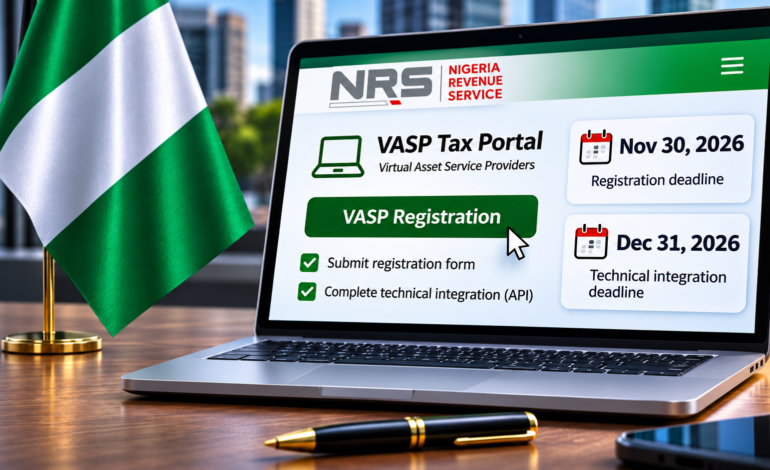
Nigeria has given cryptocurrency exchanges, payment providers, custodians and other covered virtual asset businesses until November 30, 2026, to register on a new government tax portal. Companies must also connect their systems to the platform by December 31 as the country strengthens oversight of digital asset transactions.
The directive comes from the Nigeria Revenue Service (NRS) and Joint Revenue Board (JRB).
In an official public notice, the authorities instructed businesses providing virtual asset services in Nigeria, or to Nigerian residents, to complete registration on the newly deployed Virtual Asset Service Providers (VASP) Tax Portal.
The rules also apply to foreign companies serving Nigerian residents, even if those businesses have no physical office in Nigeria.
The NRS says the portal is designed to administer existing tax obligations and support registration for anti-money laundering compliance.
For cryptocurrency companies, the immediate concern is meeting two important deadlines.
What Has Nigeria Announced?
The Nigeria Revenue Service has launched a dedicated online portal for businesses involved in virtual asset activities.
The portal is intended to help the authorities manage tax registration, reporting and certain financial crime compliance requirements.
Companies within the scope of the public notice must complete two steps:
| Requirement | Deadline |
|---|---|
| Submit the VASP registration form | November 30, 2026 |
| Complete technical integration with the portal | December 31, 2026 |
Businesses that fail to comply may face penalties or other enforcement measures under applicable laws.
The notice does not announce one fixed monetary penalty that applies to every violation.
Instead, the consequences depend on the relevant legal provisions and circumstances.
The NRS also makes clear that existing tax obligations continue during the registration period.
In other words, businesses cannot stop filing tax returns or paying applicable taxes simply because the new portal is still being implemented.
Which Cryptocurrency Businesses Must Register?
The new requirements cover a broad range of virtual asset services.
According to the official notice, the registration obligation can apply to companies and other persons providing services involving:
- Exchanges between cryptocurrencies and conventional currencies.
- Exchanges between different virtual assets.
- Cryptocurrency transfers performed as a service.
- Custody and administration of customers’ digital assets.
- Cryptocurrency trading platforms and other market infrastructure.
- Stablecoin and cryptocurrency payment processing.
- Cross-border payments and remittances involving virtual assets.
- Virtual asset issuance, distribution and redemption.
- Staking, lending and borrowing services provided to customers.
Other covered virtual asset activities may also fall within the rules.
The authorities emphasize that the substance of the business matters, regardless of what the company calls itself.
For example, a business describing itself as a payment technology platform may still fall within the requirements if it provides regulated virtual asset transfer or settlement services.
Does This Apply to Foreign Crypto Exchanges Such as Binance?
Potentially, yes.
The official notice specifically includes businesses providing virtual asset services to Nigerian residents, even when they are physically located outside Nigeria.
This means foreign incorporation does not automatically exempt an exchange or other covered service provider from the registration requirements.
For example, an overseas cryptocurrency platform serving Nigerian customers may need to assess whether its activities fall within the notice.
However, the notice does not identify Binance, Bybit, OKX or any other specific international exchange as newly registered, approved or non-compliant.
A company’s actual position would need to be confirmed separately.
The NRS also explains that businesses registered with other regulators are not automatically exempt.
A company may hold a separate operating licence and still need to complete tax portal registration.
Do Ordinary Nigerians Who Buy Bitcoin Need to Register?
Not simply because they own or trade cryptocurrency for personal purposes.
This is one of the most important distinctions in the new rules.
According to the NRS’s official FAQs, individuals who buy, hold or sell cryptocurrency as personal investments do not automatically need VASP registration.
The same generally applies to people transferring their own cryptocurrency between personal wallets.
Someone accepting cryptocurrency as payment for their own goods or services is also not automatically a virtual asset service provider simply because of that payment.
The determining issue is whether a person is providing covered virtual asset services to others.
What about P2P cryptocurrency traders?
Peer-to-peer trading requires closer attention because people participate in different ways.
Imagine two individuals exchanging cryptocurrency for their personal investment purposes.
That activity is different from operating a commercial service that regularly exchanges cryptocurrency for customers.
A person using their own cryptocurrency to provide exchange, payment or other covered services to customers may fall within the registration requirement.
The NRS specifically says that using one’s own virtual assets does not create an exemption when the activity amounts to providing a virtual asset service.
Therefore, it would be misleading to say that every Nigerian P2P trader must register.
It would also be misleading to claim that commercial P2P operators are automatically exempt.
The nature of the activity determines which rules apply.
Ordinary personal trading may still create tax obligations, even where VASP registration is not required.
Does the New Portal Introduce a Cryptocurrency Tax?
No.
The NRS explicitly states that the VASP Tax Portal does not create any new tax or tax obligation.
Instead, it provides a technology system for administering requirements that already exist under Nigerian law.
The relevant legal framework includes the Nigeria Tax Act, 2025, and the Nigeria Tax Administration Act, 2025.
In its July 2026 Guidelines on the Taxation of Virtual Assets, the NRS explained how different cryptocurrency activities are treated for tax purposes.
For example, income or gains from cryptocurrency trading may be taxable where the law provides for it.
Businesses earning revenue from exchange fees, custody, brokerage or other services may also have applicable tax obligations.
However, the treatment depends on the transaction, the taxpayer and the relevant legal provisions.
The November registration announcement does not establish a new universal tax rate on every cryptocurrency transfer.
That is an important distinction because the new portal should not be confused with an entirely new tax law.
What Taxes Can Apply to Cryptocurrency Activities?
Nigeria’s existing framework covers different types of income and transactions involving virtual assets.
Examples include income tax on taxable cryptocurrency gains or business profits, VAT on certain services, and stamp duty on specified transactions.
The treatment can differ depending on whether a person is an individual investor, a company, or a service provider.
For example, an exchange may earn income by charging customers transaction fees.
Those fees can form part of the company’s taxable business income.
A person earning staking rewards may face a different tax treatment.
A business receiving cryptocurrency for services may also need to account for the value received.
However, owning cryptocurrency does not automatically mean tax is payable merely because its market price increases.
The legal treatment depends on the applicable taxable event and relevant rules.
Readers should distinguish the tax treatment of an asset from the separate obligation to register as a service provider.
How Does the New VASP Tax Portal Work?
The NRS has published a registration process on its official website.
Businesses begin by visiting the VASP Tax Portal and providing the relevant identification information.
The process includes validating the company’s tax identification details.
The portal then requires information about the business and the virtual asset activities it provides.
According to the NRS, registration involves the following stages.
1. Verify business information
A Nigerian business starts by entering its Tax ID or relevant Corporate Affairs Commission registration details.
The portal validates the information.
Foreign companies without a Nigerian Tax ID must follow the tax authority’s registration process for non-resident businesses.
2. Submit the registration form
The company provides information about its legal identity and virtual asset activities.
It must also supply details relevant to its compliance with financial crime prevention obligations.
The NRS says businesses should use the legal name of the entity providing the service, rather than relying solely on a brand name.
3. Complete technical integration
After submitting the form, the business receives onboarding guidance.
Its technical team must then complete the required integration and testing with the VASP Tax Portal.
The NRS says this process includes API integration.
An API, or application programming interface, allows two software systems to exchange information.
For example, a cryptocurrency exchange may need to connect its internal reporting systems to the tax authority’s platform.
However, the public notice does not establish that the NRS can automatically inspect every private cryptocurrency wallet.
The integration requirement concerns covered businesses and their applicable reporting and administration obligations.
4. Complete registration
The NRS says registration is complete after both the form submission and the required integration and testing have been completed.
Submitting the form alone is therefore not the entire process.
The two deadlines give businesses time to complete those separate stages.
What Happens if a Company Misses the Deadline?
The NRS warns that businesses failing to comply may face penalties and other enforcement measures under the relevant laws.
However, its published FAQs provide an additional clarification.
A business that misses the November 30 registration deadline should still submit its form as soon as possible.
The obligation to register does not disappear when the deadline passes.
Similarly, missing the December 31 integration deadline does not eliminate the requirement to connect to the portal.
Companies experiencing technical or validation problems are advised to contact the NRS support team promptly.
The authority has not announced that every business missing a deadline will automatically have its entire cryptocurrency operation permanently shut down.
Consequences must be assessed under the applicable legal framework.
Is Tax Registration the Same as a Crypto Licence?
No.
The NRS explicitly states that registration on its tax portal does not itself authorize a company to provide virtual asset services.
This is especially important because Nigeria has several authorities supervising different aspects of its cryptocurrency industry.
For example, the Securities and Exchange Commission oversees regulated capital market activities, including relevant digital asset services.
The Central Bank of Nigeria has also introduced rules covering specified non-security virtual assets and stablecoin-related activities.
The NRS is responsible for administering applicable federal tax obligations.
These responsibilities are related, but they are not identical.
A company might therefore need to meet requirements involving tax registration, financial crime compliance, business licensing and other regulatory approvals.
Completing one does not automatically satisfy all the others.
Frequently Asked Questions
What is Nigeria’s new cryptocurrency registration deadline?
Covered virtual asset service providers must submit their registration forms by November 30, 2026.
What happens on December 31, 2026?
That is the deadline for completing required technical integration with the NRS VASP Tax Portal.
Who must register?
Businesses and other persons providing covered virtual asset services in Nigeria or to Nigerian residents, including certain foreign providers.
Does every Nigerian who owns Bitcoin need to register?
No. Simply buying, holding or selling cryptocurrency for personal investment does not, by itself, require VASP registration.
Do P2P traders need to register?
People operating covered exchange or other virtual asset services for customers may need to register. Personal transactions are treated differently.
Does this introduce a new cryptocurrency tax?
No. The NRS says the portal does not create new taxes or tax obligations.
Does registration give a company a cryptocurrency licence?
No. The NRS specifically states that portal registration is not an operating licence or authorization.
Can foreign cryptocurrency exchanges be affected?
Yes. The notice includes covered businesses providing virtual asset services to Nigerian residents even without a physical presence in Nigeria.
What happens if a company misses the deadline?
The registration obligation remains, and penalties or other enforcement measures may apply under relevant laws. The NRS advises affected businesses to complete outstanding steps as soon as possible.
Where can businesses register?
The official registration service is available at https://vasp.nrs.gov.ng/register.
Who can businesses contact for support?
The NRS provides support through vasp-support@nrs.gov.ng.
Key Takeaways
- Nigeria has introduced a dedicated VASP Tax Portal.
- Covered businesses must submit registration forms by November 30, 2026.
- Technical integration must be completed by December 31, 2026.
- The requirements can apply to foreign businesses serving Nigerian residents.
- Cryptocurrency exchanges, custody providers, payment businesses and other covered service providers are included.
- Ordinary personal cryptocurrency ownership and trading do not automatically require VASP registration.
- The portal does not introduce a new tax.
- Tax portal registration is not the same as receiving a cryptocurrency operating licence.
- Businesses that miss the deadlines may face penalties under applicable laws.
- The NRS says the system will support tax administration and financial crime compliance.
Editor’s note: This article is based on the Nigeria Revenue Service and Joint Revenue Board’s official public notice, the NRS VASP Tax Portal, and the authority’s published registration FAQs. It distinguishes confirmed regulatory requirements from possible future effects on businesses and users.