








OKX Removes Ethiopian Birr From P2P Trading as Ethiopia Tightens Crypto Rules

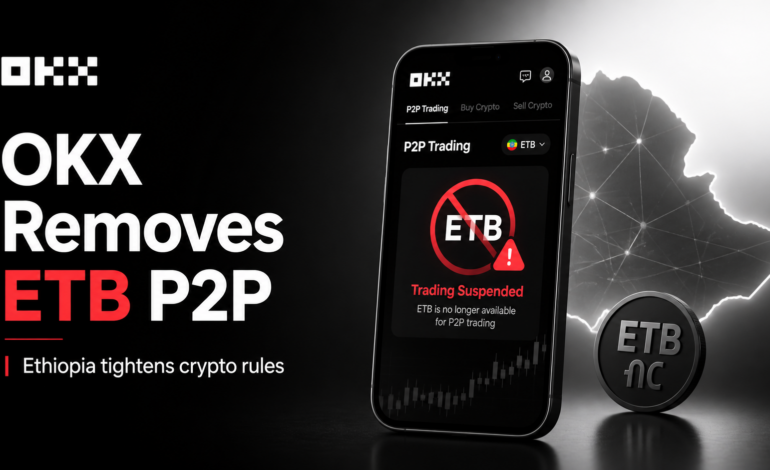
OKX has announced that Ethiopian Birr trading will no longer be available on its P2P marketplace from 10:00 on May 4, 2026, UTC+1. The exchange said the change affects four ETB trading pairs: USDT/ETB, ETH/ETB, BTC/ETB, and USDC/ETB.
The announcement does not mean OKX is completely leaving Ethiopia. A more accurate reading is that OKX is removing ETB-based peer-to-peer trading from its platform. According to the company, existing ETB ads on the P2P marketplace will be taken offline, while pending ETB orders will remain active until they are either completed or canceled.
OKX Pulls ETB P2P Trading After Ethiopia’s Central Bank Warning
The move comes just weeks after the National Bank of Ethiopia warned against Birr-paired peer-to-peer transactions on trading platforms, exchanges, and similar services.
In a public notice issued on February 27, 2026, the central bank said that the use of Birr-paired P2P arrangements is not permitted unless explicitly authorized by the National Bank of Ethiopia. It also stated that any form of Birr-denominated P2P trading or exchange involving cryptocurrencies is prohibited under the current regulatory framework.
This makes OKX’s decision part of a wider shift in Ethiopia’s crypto market. Global exchanges are now adjusting their local currency services as Ethiopia moves to control how its national currency interacts with digital assets.
What This Means for Ethiopian Crypto Users
For Ethiopian users, the most immediate impact is on people who used OKX P2P to buy or sell crypto with ETB.
The affected pairs are:
- USDT/ETB
- ETH/ETB
- BTC/ETB
- USDC/ETB
This means users will no longer be able to place new ETB-based P2P trades on OKX after the deadline. Merchants who had active ETB ads will see those ads taken offline. Users with pending ETB orders will still be able to complete or cancel them.
This is important because P2P trading has been one of the easiest ways for people in many African markets to access crypto using local currency. Instead of using a bank card or international payment service, users could trade directly with other people using local payment methods.
When ETB is removed from P2P marketplaces, that local access becomes harder.
Is OKX Leaving Ethiopia?
Not exactly.
The headline may sound like OKX is exiting the Ethiopian market completely, but the official notice is narrower. OKX specifically says ETB trading will no longer be available on OKX P2P. It does not say all OKX services are being shut down for Ethiopian users.
That distinction matters because users may still be able to access other parts of the platform, depending on availability, local rules, and account restrictions. The main change is the removal of ETB from OKX’s P2P marketplace.
Ethiopia Is Taking a Harder Line on Birr-Based Crypto Trading
Ethiopia’s central bank has made it clear that Birr-based crypto P2P trading is not allowed without approval.
The National Bank of Ethiopia said digital and virtual asset markets can expose users to risks such as price volatility, fraud, scams, foreign exchange manipulation, operational risks, and weak safeguards against money laundering and terrorist financing.
In simple terms, Ethiopia appears concerned that informal crypto trading can move money outside the regulated financial system. P2P platforms can make it difficult for authorities to monitor foreign exchange activity, protect consumers, and enforce financial rules.
The central bank also said it is working on a more comprehensive regulatory framework for emerging digital asset technologies. Until that framework is introduced, Birr-paired P2P crypto transactions remain prohibited.
A Wider Pattern After Binance’s ETB Suspension
OKX is not the only major exchange making changes around the Ethiopian Birr.
Binance has also reportedly moved to suspend Ethiopian Birr trading from May 15, 2026, following the same regulatory pressure around Birr-based crypto activity.
This suggests the issue is not limited to one exchange. Ethiopia’s regulatory position is now affecting how major global crypto platforms offer local currency access in the country.
For Ethiopian crypto users, the message is clear: ETB-based P2P trading is becoming increasingly difficult on major exchanges.
Why This Matters for Africa’s Crypto Market
The OKX update is part of a larger African crypto regulation trend.
Across the continent, governments are trying to balance crypto adoption with financial stability, consumer protection, anti-money laundering controls, and foreign exchange management.
Ethiopia’s case is especially important because the country is not just dealing with crypto speculation. It is also managing foreign exchange pressure, national payment system rules, and digital asset activity at the same time.
By removing ETB from P2P trading, OKX is effectively aligning its marketplace with Ethiopia’s current regulatory position.
What Happens Next?
The next key date is May 4, 2026, when ETB trading is expected to stop being available on OKX P2P.
After that, Ethiopian users will likely watch for two things.
First, whether other exchanges also remove ETB trading pairs from their P2P platforms.
Second, whether the National Bank of Ethiopia introduces a formal crypto framework that allows licensed companies to offer approved digital asset services in the future.
For now, Ethiopia’s crypto market is moving away from informal Birr-based P2P trading and toward a more controlled regulatory environment.
Conclusion
OKX’s removal of Ethiopian Birr trading from its P2P marketplace marks another major shift for Ethiopia’s crypto users.
The change does not necessarily mean OKX is fully leaving Ethiopia. But it does mean that one of the most direct ways to buy and sell crypto using ETB on OKX is being removed.
Combined with Ethiopia’s central bank warning and Binance’s reported ETB suspension, the trend is becoming clear. Ethiopia is tightening control over Birr-based crypto activity, and global exchanges are responding.
For users, this may reduce convenience in the short term. For regulators, it is part of a broader effort to bring digital asset activity under formal oversight.