



Only in Crypto: People Are Begging Hackers to Share Their Stolen Bitcoin

Imagine stealing billions of dollars, only to discover that complete strangers are sending you more money. Not because they want their stolen funds back, but because they are hoping you might share some of your loot.
It sounds like something from a comedy movie. But this is actually happening on the Bitcoin blockchain.
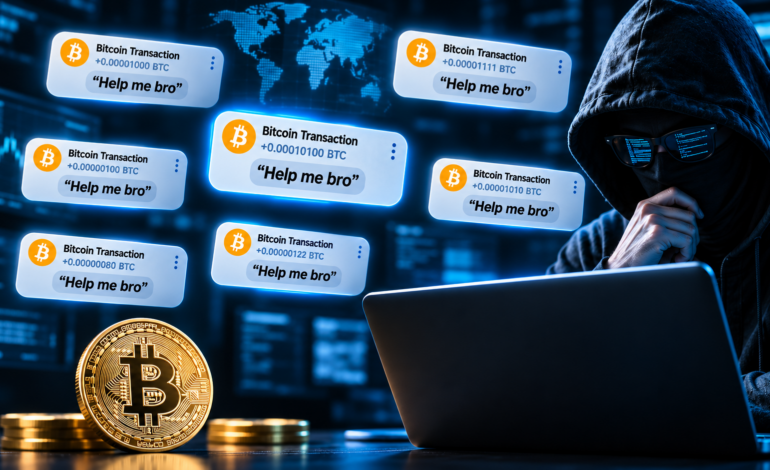
Following the massive $6.34 billion hack of cryptocurrency exchange Binance, an unusual group of people has emerged. Instead of helping investigators track down the stolen funds, some individuals have started sending tiny amounts of Bitcoin to wallets linked to the hackers, accompanied by messages asking for money.
One particularly hopeful sender kept things simple.
“Help me bro.”
Three words. No lengthy explanation. No complicated business proposal. Just a request for financial assistance directed at someone accused of stealing billions.
And the person did not send the message once. They sent it repeatedly to 19 different Bitcoin wallets associated with the theft.
Welcome to crypto, where even hackers apparently have people asking them for handouts.
From a $6.34 Billion Hack to an Unexpected Begging Campaign
The story begins on October 29, 2026, when Binance suffered one of the largest cryptocurrency thefts ever recorded.
According to Binance’s official investigation, attackers gained unauthorized access to internal systems used to approve cryptocurrency transactions.
They then transferred approximately $6.34 billion worth of digital assets from the exchange’s wallets.
Among the stolen assets were 18,270 Bitcoin, along with Ethereum, XRP, Solana, stablecoins and other cryptocurrencies.
Binance said approximately $2.85 billion of the affected assets had been frozen or intercepted by November 3. The company also promised to cover customer losses.
The FBI attributed the attack to TraderTraitor, a cybercrime operation linked to North Korea.
Investigators and blockchain intelligence companies began tracking the stolen funds across different networks.
But while law enforcement was trying to follow the money, some members of the crypto community apparently had a completely different idea.
If the hackers had billions of dollars, perhaps they could spare a little.
“Help Me Bro”: Someone Actually Paid to Beg the Hackers
Someone started sending small Bitcoin transactions to 19 wallets holding stolen Bitcoin.
Each transaction carried the same three-word message: “Help me bro.”
On October 30, the sender sent 1,000 satoshis to each wallet.
A few hours later, they repeated the process.
Then, on November 1, they tried again, this time sending 1,111 satoshis to each address.
For beginners, a satoshi is the smallest unit of Bitcoin. One Bitcoin contains 100 million satoshis.
These transfers were worth less than a dollar per wallet, per round.
In total, the sender spent approximately $46 worth of Bitcoin, plus transaction fees, delivering the messages.
Think about that for a moment.
Someone spent actual money asking alleged criminals to give them money.
And not just any criminals. The messages were directed at wallets associated with a multibillion-dollar theft that international investigators have linked to North Korean hackers.
Whether the sender was genuinely desperate, joking or simply hoping to get lucky remains unknown.
What is clear is that they were persistent.
Unfortunately for the hopeful sender, there was no reported response till now.
The Hackers Also Received Advertising and Some Strange Advice
The begging campaign was not limited to one person.
Other individuals apparently saw an opportunity to get the attention of whoever controlled the stolen Bitcoin.
Some wanted donations. Others wanted to promote their businesses.
One person claiming to be a Turkish cryptocurrency influencer used a blockchain message to promote a token project called NST. Rather than simply requesting free Bitcoin, the sender suggested that donations could help develop the token’s ecosystem.
Essentially, someone attempted to pitch a crypto project to suspected criminals holding billions in stolen assets.
Another sender took a different approach.
Instead of asking for money, they encouraged the attackers to use a cryptocurrency swapping service to move the stolen funds and advised them not to return the assets to Binance founder Changpeng Zhao, popularly known as CZ.
The message included a link to a website presented as a crypto swapping service. Such unsolicited links should not be trusted.
And because the events unfolded around Halloween, someone else decided to join the occasion with a playful request for satoshis as treats.
The strange collection of messages reveals just how unpredictable public blockchain activity can become when a major theft attracts worldwide attention.
Some people want justice. Some want their money back. Others apparently see a chance to market their next cryptocurrency project.
How Can Someone Send a Message to a Hacker on Bitcoin?
This is where the story becomes particularly interesting.
Most people think of Bitcoin as a way to send and receive digital money.
However, Bitcoin transactions can also carry small amounts of additional information.
One way to do this is through a feature called OP_RETURN.
In simple terms, OP_RETURN allows someone to include data, such as a short text message, in a Bitcoin transaction.
That data becomes part of the blockchain’s public record.
For example, someone can create a transaction containing a small Bitcoin payment alongside an OP_RETURN output carrying the words “Help me bro.”
Once confirmed on the blockchain, the message can be viewed through a Bitcoin blockchain explorer.
This does not mean Bitcoin has suddenly become WhatsApp. The person controlling the receiving wallet would need to inspect the blockchain transaction to find the message.
There is also no guarantee that the recipient will read it or respond.
In this case, the messages are attached to real Bitcoin transactions, and anyone interested can inspect the public records.
CoinDesk identified several examples, including transactions made on October 30 and November 1.
The same technology that allows investigators to trace stolen cryptocurrency also allows strangers to leave unusual messages in its transaction history.
But Why Would Anyone Beg a Hacker for Money?
That is perhaps the most fascinating question in this entire story.
Nobody has publicly established the identities or real intentions of the people sending these messages.
Some might be joking. Others might genuinely believe that a person holding billions of dollars could afford to give away a small amount.
And some could simply be looking for attention.
After all, the blockchain is public. Anyone who knows where to look can see these messages, including journalists, crypto researchers and social media users.
There is also an important psychological difference between ordinary wealth and stolen cryptocurrency.
Someone with a large legitimate fortune might be expected to have rules, responsibilities and reasons for refusing unsolicited donation requests.
But a hacker who has just taken billions of dollars might appear to some people as someone who could give away money without caring about the consequences.
Of course, that assumption makes little sense.
The stolen funds are being tracked, law enforcement agencies are involved, and whoever controls the wallets has strong reasons to avoid unnecessary transactions.
Sending Bitcoin to a wallet associated with a major theft does not create any obligation for the recipient to return the money or send a donation.
It may simply leave the sender poorer.
There is also a serious side to this story. The stolen funds are not free money. They represent assets taken without authorization, and giving them away would not make their origins legitimate.
The Irony of Bitcoin’s Public Blockchain
For years, cryptocurrency has been associated with financial freedom, privacy and the ability to transfer money without relying on traditional banks.
But Bitcoin is also remarkably transparent.
Transactions are recorded on a public ledger that anyone can inspect.
That is why investigators can follow funds moving between wallets. It is also why journalists can discover something as strange as people sending donation requests to alleged hackers.
A bank robber might receive an anonymous letter in the post.
A crypto hacker can receive a message permanently recorded on a blockchain.
The important distinction is that blockchain transparency reveals transactions, not necessarily the real identities or motives of the people behind them.
And a message attached to a transaction does not prove the hacker actually saw it.
Frequently Asked Questions (FAQs)
1. Are people really begging Binance hackers for Bitcoin?
Yes. CoinDesk reported that small Bitcoin transactions carrying donation requests and other messages were sent to wallets associated with the October 29, 2026 Binance hack.
2. What does “Help me bro” mean in this story?
It is a short message repeatedly sent through Bitcoin transactions to addresses linked to the attackers. The sender appeared to be asking for financial assistance, although their actual motives are unknown.
3. How much money did the sender spend?
According to CoinDesk, the sender spent approximately $46 in Bitcoin, plus transaction fees, across three rounds of messages to 19 wallets.
4. Can you send messages using Bitcoin?
Yes. Bitcoin transactions can include small amounts of data through mechanisms such as OP_RETURN. The data can be viewed publicly on the blockchain.
5. Did the Binance hackers give anyone free Bitcoin?
As of the November 2 report, there was no verified evidence that the messages had received a response or that the hackers had rewarded the senders.
6. Who was responsible for the Binance hack?
The FBI attributed the October 29, 2026 attack to TraderTraitor, a North Korean cybercrime operation. Binance and blockchain intelligence companies have also investigated the theft.
7. Is it safe to send Bitcoin to a hacker’s wallet?
No. Sending cryptocurrency to wallets associated with criminal activity can expose you to financial loss and potential compliance or legal risks. There is no guarantee that you will receive anything in return.