


Kenya Could Get Its Own Shilling-Backed Stablecoin as Supercoin Targets 2027 Launch

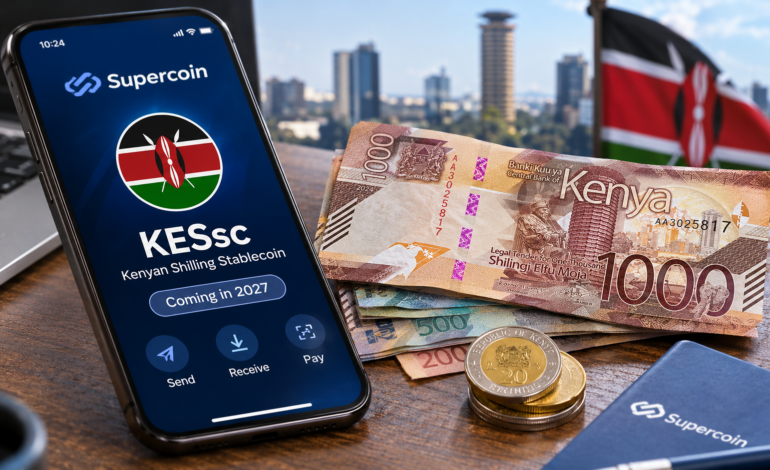
Kenya could receive a new cryptocurrency designed to maintain the value of the Kenyan shilling after stablecoin company Supercoin disclosed plans to introduce KESsc in 2027. The company says it has submitted a licence application in Kenya as it works to expand its local-currency stablecoin services beyond South Africa.
Supercoin Managing Director Gideon Greaves discussed the company’s plans during the Africa Stablecoin Summit in Cape Town, South Africa, in November 2026.
According to The Star’s November 19 report, the company has applied for regulatory authorization to introduce a stablecoin backed by Kenyan shillings.
The proposed token, KESsc, would be designed to represent shilling-denominated value on blockchain infrastructure.
Its launch remains subject to regulatory approval.
Supercoin already operates ZARsc, a South African rand-backed stablecoin. The company describes the existing product and its reserve arrangements on its official website.
However, KESsc has not been confirmed as operational, and no Kenyan regulator approval has been independently established.
So, what would a Kenyan-shilling stablecoin actually do?
What Is Supercoin Planning in Kenya?
Supercoin wants to introduce KESsc, a stablecoin whose value would be linked to the Kenyan shilling.
For example, one KESsc would be designed to represent one Kenyan shilling.
This is different from USDT or USDC, which are designed to track the US dollar.
According to reports of Greaves’ remarks, Supercoin wants to create a system that allows businesses to transfer local-currency value using blockchain technology.
The company is targeting a 2027 launch, subject to approval from the Central Bank of Kenya and satisfaction of applicable requirements.
The reported plan includes backing KESsc with Kenyan-shilling reserves held through a local bank.
However, no independently verified KESsc reserve statement, issuance contract, or public proof that tokens are circulating was available for this article.
The proposed reserve structure is therefore a company plan, not an independently audited operating arrangement.
What Is a Kenyan-Shilling Stablecoin?
A stablecoin is a digital asset designed to maintain a relatively stable value against another asset.
Most popular stablecoins are linked to the US dollar.
For example:
- USDT is designed to track the US dollar.
- USDC is designed to track the US dollar.
- Supercoin’s ZARsc is designed to track the South African rand.
- The proposed KESsc would track the Kenyan shilling.
Imagine a business holding KSh10,000.
If an approved issuer offered a fully redeemable KESsc stablecoin at a one-to-one exchange rate, the business could exchange that amount for 10,000 tokens.
It could then transfer those tokens through a supported blockchain wallet.
The recipient could potentially redeem the tokens for Kenyan shillings through an authorized provider.
However, successful redemption would depend on the issuer’s reserves, liquidity, redemption rules, and operational reliability.
A stablecoin’s target price is not a guarantee that it will always trade at that value on every platform.
How Is KESsc Different From M-Pesa?
Kenya already has one of Africa’s most established digital payment systems: M-Pesa.
That raises an obvious question.
Why would Kenyans need a shilling stablecoin when they can already send money using mobile money?
The answer lies in the underlying infrastructure.
M-Pesa transfers balances through a regulated mobile money system.
A blockchain-based stablecoin can potentially be held in compatible digital wallets and transferred between applications using a supported blockchain.
Developers may also be able to integrate it into programmable payments and other blockchain applications.
For example, a business could potentially use a stablecoin for automated settlement between two authorized financial service providers.
But blockchain technology does not automatically make payments cheaper, faster, or safer than M-Pesa.
Mobile money already works well for many domestic Kenyan transactions.
A new stablecoin would need to offer clear advantages in particular applications, such as international settlement, business treasury operations, or programmable financial services.
How Could KESsc Help Cross-Border Payments?
One potential application involves payments between Kenya and South Africa.
Supercoin already operates ZARsc, which is designed to track the South African rand.
The company envisions a system in which shilling-backed and rand-backed stablecoins could help businesses settle transactions between the two countries.
Consider a Kenyan importer paying a South African supplier.
Today, the payment may involve foreign exchange conversion, banking intermediaries, and settlement delays.
In a future stablecoin arrangement, a payment provider could receive Kenyan shillings, convert them into KESsc, arrange the necessary foreign exchange transaction, and settle through a supported rand-denominated system.
The supplier could then receive South African rands.
This is an illustration of the proposed infrastructure, not confirmation that Supercoin already offers a functioning KESsc-to-ZARsc payment corridor.
Costs would still depend on exchange rates, liquidity, compliance, transaction fees, and local payout arrangements.
What Has Supercoin Already Built in South Africa?
Supercoin’s existing product is ZARsc.
According to the company’s November 2025 announcement, the token is designed to be backed by rand-denominated reserves.
The company says its reserve assets are held through arrangements involving Absa.
Its published product information also identifies Solana as the blockchain used for ZARsc.
In September 2026, Supercoin announced ZARsc availability on Orca, a decentralized exchange and liquidity platform operating on Solana.
That development allows compatible applications and users to interact with the token through supported blockchain infrastructure.
However, the existence of an operating rand stablecoin does not establish that its Kenyan counterpart has received approval.
The two products are distinct and subject to different regulatory requirements.
Has Kenya Approved KESsc?
No approval was independently confirmed during preparation of this article.
Supercoin says it has submitted a licence application.
Submitting an application and receiving a licence are different events.
Kenya’s Virtual Asset Service Providers Act, 2025, established a legal framework for covered cryptocurrency businesses.
On November 13, 2026, the Central Bank of Kenya and Capital Markets Authority confirmed that covered service providers must apply for authorization under the operational regulations.
The two regulators supervise different types of virtual asset activities.
Stablecoin issuance falls within the Central Bank of Kenya’s regulatory responsibilities under the framework.
The Central Bank of Kenya’s official website provides regulatory announcements and licensing information.
Any company seeking to issue a stablecoin must satisfy the requirements applicable to its particular business and token.
Regulatory approval cannot be assumed simply because a product has been announced.
How Would KESsc Be Backed?
Supercoin’s reported proposal involves one-to-one backing with Kenyan-shilling reserves.
In a straightforward example, issuing one million KESsc tokens would require sufficient eligible assets to support the corresponding KSh1 million redemption obligation, subject to any additional regulatory requirements.
However, reserve arrangements can be complicated.
Important questions include which institution holds the assets, whether the funds are segregated, how redemptions are handled, and whether independent professionals verify the reserves.
It is also important to know who has a legal claim against the issuer.
A reserve-backed token can still face risks involving fraud, operational failure, custody, or liquidity.
Before treating KESsc as a fully backed stablecoin, users should look for authorization details, published terms, and credible reserve disclosures.
Those details have not yet been confirmed for the proposed Kenyan token.
Would KESsc Replace the Kenyan Shilling?
No such plan has been announced.
KESsc is intended to represent the shilling, not replace Kenya’s national currency.
It would be privately issued digital value, assuming the product receives approval.
It should also not be confused with a central bank digital currency, commonly called a CBDC.
A CBDC would be issued by a central bank.
KESsc is being proposed by a private company.
Even if approved, it would not automatically become legal tender.
Frequently Asked Questions
What is KESsc?
KESsc is a proposed stablecoin from Supercoin designed to maintain a value linked to the Kenyan shilling.
Has KESsc launched?
No operational launch has been independently confirmed.
When will KESsc launch?
Supercoin is targeting 2027, subject to regulatory approval.
Has the Central Bank of Kenya approved it?
A licence application has been reported, but approval has not been independently confirmed.
Is KESsc the same as M-Pesa?
No. M-Pesa is a mobile money service. KESsc is proposed as a blockchain-based stablecoin.
Is KESsc a government cryptocurrency?
No. It is a privately proposed token, not a Kenyan central bank digital currency.
What blockchain will KESsc use?
The final KESsc network and technical specifications have not been independently confirmed. Supercoin’s existing ZARsc token operates on Solana.
Can I buy KESsc today?
A public launch and active trading arrangements have not been confirmed.
Key Takeaways
- Supercoin is planning a Kenyan-shilling stablecoin called KESsc.
- The company says it has applied for Kenyan regulatory authorization.
- The targeted launch year is 2027.
- No CBK licence approval or independently verified KESsc reserves have been confirmed.
- Supercoin already operates the rand-backed ZARsc token in South Africa.
- The main potential use cases include business settlement and cross-border payments.
- KESsc would not automatically become legal tender or replace M-Pesa.