









Swift Tests 24/7 Cross-Border Payments With 17 Global Banks

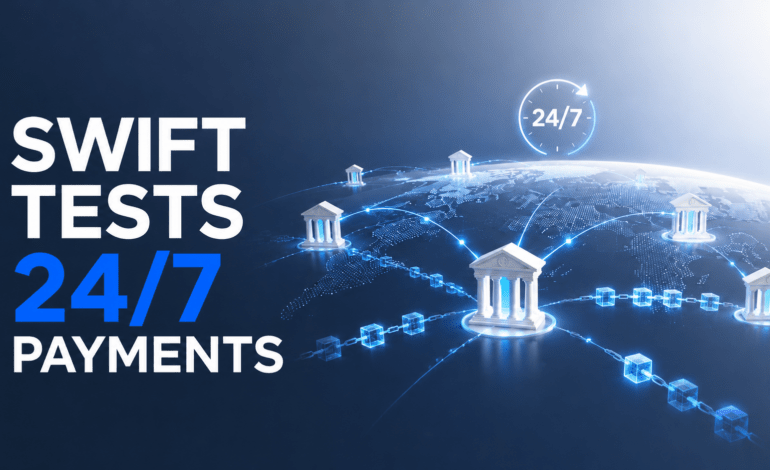
Swift has activated a blockchain-based shared ledger that will allow 17 major banks to test round-the-clock cross-border payments using tokenised commercial-bank deposits.
The financial messaging network announced on July 9, 2026, that the ledger was ready for initial use after moving from concept to activation in nine months. Banks across six continents are now preparing to pilot live transactions, including payments made overnight and on weekends.
The project is one of the banking sector’s most significant attempts to use blockchain technology for international payments while preserving the compliance, credit, risk and operational controls used in conventional banking.
However, the development is still an early-stage pilot. It does not mean that all payments sent through Swift are now processed on a blockchain or that customers at the participating banks already have access to instant 24/7 international transfers.
Which banks are participating?
The 17 institutions preparing to pilot live transactions are:
- ANZ
- BNP Paribas
- BNY
- Citi
- DBS
- First Abu Dhabi Bank
- FirstRand Bank
- HSBC
- Itaú Unibanco
- Lloyds Bank
- Mashreq
- MUFG Bank
- OCBC
- Standard Chartered
- UBS
- UOB
- Wells Fargo
The group includes banks from Africa, Asia, Australia, Europe, the Middle East, North America and South America. South Africa’s FirstRand is the only African bank included in the initial list of 17 pilot institutions.
Swift had previously worked with more than 30 financial institutions from 16 countries during the ledger’s design phase. The smaller group of 17 banks will now participate in the first live transaction pilots.
How Swift’s blockchain ledger works
The shared ledger is designed to coordinate transactions involving tokenised deposits issued by participating banks.
A tokenised deposit is a digital representation of money held in a conventional commercial bank account. The token moves through blockchain-based infrastructure, but the underlying claim remains against the bank that issued it.
Swift’s ledger will act as an orchestration layer connecting the participating banks’ individual tokenised-deposit systems. It will maintain a shared record of transactions, sequence and validate payment instructions, and apply agreed rules through smart contracts.
The process could work as follows:
- A customer instructs their bank to send an international payment.
- The sending bank uses a tokenised version of its commercial-bank deposit.
- Swift’s shared ledger records and coordinates the transfer between the participating institutions.
- The receiving institution recognises the transaction and makes funds available according to the agreed process.
- Final settlement is completed through existing banking systems.
Swift says the ledger allows banks to move funds for customers outside conventional operating hours before completing final settlement through existing infrastructure.
This means the blockchain layer is being added to the banking system rather than completely replacing the accounts, settlement arrangements and regulatory processes already used by financial institutions.
Why 24/7 payments matter
Most blockchain networks operate continuously. Traditional cross-border banking systems, by comparison, can be affected by weekends, public holidays, currency-market hours and the operating schedules of intermediary banks.
A payment initiated late on a Friday may not be fully processed until the following business week. Transactions involving several countries can face additional delays when the institutions involved operate in different time zones.
Swift’s shared ledger is intended to allow tokenised value to move continuously, including overnight and during weekends.
For multinational companies, that could improve:
- access to working capital;
- cash-flow visibility;
- cross-border treasury management;
- liquidity distribution between subsidiaries;
- payment predictability; and
- settlement outside local banking hours.
HSBC said connecting its Tokenised Deposit Service to Swift’s ledger could give corporate clients greater liquidity efficiency, stronger cash-flow visibility and a more seamless 24/7 payment experience.
Swift is not transferring every payment on-chain
Swift is best known for providing the secure messaging network that banks use to exchange payment instructions.
It does not generally hold customer deposits or operate as the bank sending the underlying money. Instead, it provides the communication standards and infrastructure that financial institutions use to coordinate transactions.
The new ledger extends that role into blockchain-based payments. It creates a common digital layer through which banks can coordinate tokenised transactions while retaining their own deposit ledgers and established settlement arrangements.
Swift says the technology complements its existing platform and is designed to interoperate with both traditional payment rails and emerging digital systems.
The pilot should therefore not be interpreted as Swift abandoning its conventional network or moving all international banking activity onto one blockchain.
Is this a public blockchain?
No. Swift’s shared ledger is intended for regulated financial institutions rather than unrestricted public participation.
Unlike Bitcoin or Ethereum, where anyone can generally create a wallet and submit transactions, access to Swift’s ledger is limited to approved banks and financial institutions.
The platform is designed around requirements including:
- customer identification;
- sanctions screening;
- anti-money-laundering controls;
- transaction monitoring;
- credit-risk management;
- regulatory reporting; and
- operational resilience.
Swift says its objective is to bring the trust, security and compliance standards associated with established finance into digital-money infrastructure.
Tokenised deposits are not stablecoins
The first pilot transactions will use tokenised commercial-bank deposits rather than privately issued stablecoins such as USDT or USDC.
Both can represent digital forms of traditional currency, but they have different structures.
A stablecoin is normally issued by a specialised company and backed by reserves such as cash, bank deposits or government securities. A tokenised deposit represents an existing claim against a regulated commercial bank.
For example, a token representing one dollar held at HSBC remains an HSBC deposit liability. It is not a separate digital currency issued by Swift.
This distinction could make tokenised deposits more attractive to banks because they remain inside the established commercial-banking framework, including existing customer relationships and compliance processes.
However, tokenised deposits can be fragmented when each bank issues tokens on its own technology platform. Swift’s ledger is intended to address that problem by helping the different bank-issued systems communicate with one another.
Competing with stablecoin payment rails
Stablecoins have demonstrated that dollar-linked value can move across borders continuously and settle without waiting for conventional banking hours.
This has increased pressure on banks and international payment networks to develop comparable capabilities.
Reuters described Swift’s initiative as one of the largest attempts by mainstream banking to use blockchain while preserving the operational and compliance controls expected by regulators. The report also linked the project to growing competition from the stablecoin sector.
Stablecoins may have an advantage in open accessibility and blockchain interoperability. Tokenised bank deposits may offer advantages in regulatory familiarity, institutional trust and integration with corporate banking services.
Swift is positioning itself as the common infrastructure that could allow banks to offer always-on digital payments without surrendering the customer relationship to stablecoin issuers or crypto-native payment companies.
What the blockchain records
Swift describes the ledger as a secure, real-time record of transactions between financial institutions.
It is designed to:
- record payment instructions;
- sequence transactions;
- validate activity;
- enforce agreed rules through smart contracts;
- give institutions shared visibility; and
- connect different tokenised-deposit systems.
A shared record can reduce the need for banks to maintain separate and potentially inconsistent versions of the same transaction.
In conventional correspondent banking, several institutions may independently update their systems and later reconcile the results. A shared ledger could allow them to see a coordinated version of the transaction as it progresses.
That does not eliminate every source of delay. Banks will still need to perform compliance checks, manage currency conversion, maintain sufficient liquidity and meet local regulatory requirements.
Final settlement will still use existing systems
One of the most important limitations is that the initial model does not appear to place every stage of settlement on the blockchain.
Swift says banks will be able to move tokenised funds for customers through the ledger before completing final settlement using existing systems.
The pilot is therefore testing whether tokenised deposits and a shared ledger can improve payment coordination and availability while remaining connected to conventional central-bank and commercial-bank settlement arrangements.
This hybrid approach may be easier for regulators and banks to adopt than replacing existing financial infrastructure in one step.
It also means that the speed experienced by customers could still depend on how quickly participating banks complete compliance, foreign-exchange and final-settlement processes.
From prototype to initial use in nine months
Swift first announced plans to add a blockchain ledger to its infrastructure in September 2025.
At the time, it said more than 30 financial institutions were helping design the system and that Consensys would support development of the conceptual prototype.
The initial design focused on:
- 24/7 cross-border payments;
- regulated tokenised value;
- interoperability between financial systems;
- real-time transaction records; and
- programmable rules enforced through smart contracts.
By July 2026, Swift said the system had moved from concept to activation in nine months and was ready for its first live transaction pilots.
That is a significant technical milestone, but further testing will be needed before the ledger can operate at the scale of Swift’s wider network.
Potential applications beyond payments
The first use case is cross-border payments using tokenised deposits, but Swift says the same infrastructure could eventually support other forms of regulated digital value.
Possible future applications include:
- programmable money;
- tokenised securities;
- automated corporate treasury transactions;
- digital-asset settlement;
- delivery-versus-payment systems; and
- agentic commerce.
Agentic commerce refers to transactions initiated by authorised software or artificial-intelligence agents acting within rules set by individuals or businesses.
Swift says the ledger could provide a foundation for such automated payments because smart contracts can enforce conditions before a transaction is completed.
For example, an AI procurement agent could theoretically release a payment once agreed delivery conditions are confirmed.
These possibilities remain future applications rather than services currently available through the pilot.
What the banks will be testing
The participating institutions are expected to evaluate whether the ledger can securely connect their tokenised-deposit systems and support real-world international payments.
Key areas of evaluation are likely to include:
- transaction speed;
- liquidity efficiency;
- interoperability;
- system availability;
- regulatory compliance;
- transaction visibility;
- integration with existing banking systems; and
- operational risk.
MUFG said its participation would focus on evaluating practical use cases and determining how distributed-ledger technology could be integrated into existing financial ecosystems safely and at scale.
DBS similarly said that interoperability with existing payment rails and application to real-world use cases would be critical if tokenised money is to achieve wider adoption.
Why interoperability is the central challenge
Many large banks have already developed their own tokenised-deposit or blockchain payment systems.
The problem is that one bank’s tokens may not automatically work with another institution’s platform.
Without interoperability, the market risks developing isolated digital-payment networks that repeat the fragmentation of traditional correspondent banking.
Swift’s advantage is its existing relationship with thousands of financial institutions and its role in establishing common messaging and transaction standards.
UBS said interoperability would be essential for scaling tokenised deposits beyond individual banks and described Swift’s ledger as a potential connector between digital-money networks.
The project’s long-term value may therefore depend less on creating another blockchain and more on providing a common layer through which different bank-issued tokens can interact.
What this could mean for Africa
FirstRand’s participation gives Africa representation in the first group of live pilots.
African businesses frequently face high cross-border payment costs, long settlement times and limited access to correspondent banking relationships.
If Swift’s ledger eventually expands beyond the initial group, African banks could use tokenised deposits to move funds across time zones and settle international transactions outside conventional banking hours.
Potential use cases could include:
- regional trade payments;
- corporate treasury transfers;
- remittance settlement;
- payments to international suppliers;
- movement of liquidity between African subsidiaries; and
- settlement between banks and fintech companies.
However, the pilot is initially focused on institutional banking rather than low-value consumer remittances.
There is also no confirmation that FirstRand customers can currently initiate live blockchain-based payments through the project. The bank is participating in testing, and wider availability will depend on the pilot’s results and regulatory approvals.
The pilot still faces major obstacles
The technology may be ready for initial use, but several challenges remain.
Regulatory coordination
A transaction involving several countries may be subject to different rules on digital assets, data protection, foreign exchange and financial reporting.
Liquidity
Banks must maintain sufficient funds or tokenised deposits in the right currencies and jurisdictions.
Interoperability
The participating banks’ internal systems must communicate consistently with Swift’s shared ledger.
Legal recognition
Jurisdictions must determine how tokenised deposits are treated in insolvency, settlement finality and customer-protection rules.
Cybersecurity
A shared international ledger would become critical financial infrastructure and a valuable target for attackers.
Adoption
The network becomes more useful as more banks, currencies and payment corridors join. An initial group of 17 institutions is significant but small compared with Swift’s global membership.
This is not yet a global launch
Swift has described the ledger as ready for initial use, while the participating banks are preparing to pilot live transactions.
Those phrases are more precise than saying Swift has already introduced blockchain payments throughout the global banking system.
The company has not announced:
- a general commercial launch date;
- the transaction volumes expected during the pilot;
- which currency corridors will be tested first;
- customer pricing;
- universal availability to corporate clients; or
- when additional banks will gain access.
A broader rollout will depend on technical performance, regulatory approval, commercial demand and the ability of more banks to issue or connect tokenised deposits.