







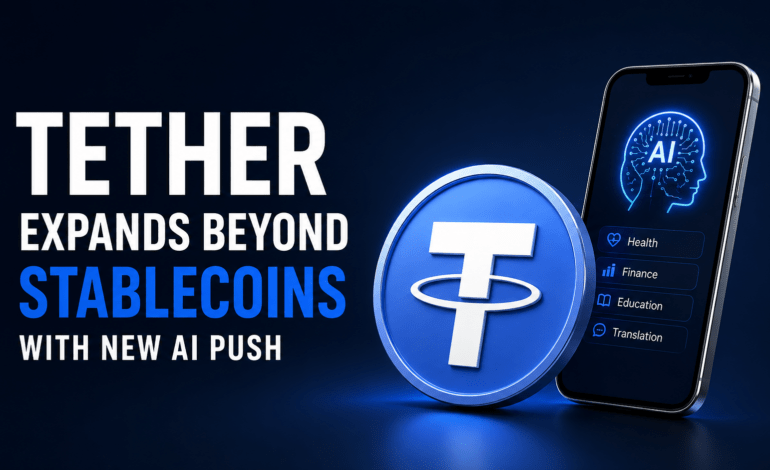
Tether Expands Beyond Stablecoins With New AI Push

Tether built its name around USDT, the world’s largest stablecoin.
Now the company increasingly wants to be known for something much broader.
Tether CEO Paolo Ardoino says the company is accelerating its expansion into artificial intelligence, with a focus on lightweight AI tools that can run directly on ordinary smartphones rather than depending entirely on expensive cloud infrastructure.
In an August 17 interview with Fortune, Ardoino said Tether now has more than 650 million users worldwide and that many of them are concentrated in regions such as Africa and South America. He said the company sees an opportunity to bring basic AI services to those same markets.
The strategy could eventually place Tether in an unusual position.
A company best known for providing digital dollars could also become a provider of AI infrastructure, local smartphone models, healthcare tools and other technology designed for emerging markets.
But Tether’s AI push did not begin yesterday.
The company has been quietly building AI infrastructure for several years. What is changing now is the ambition: rather than treating AI as a side investment, Tether increasingly appears to see it as one of the pillars of its long-term business.
Tether Wants to Become More Than a Stablecoin Company
For most people in crypto, the Tether name means one thing:
USDT.
USDT is a stablecoin designed to track the value of the US dollar and is widely used for crypto trading, savings, payments and cross-border transfers.
But Tether has been deliberately broadening its identity.
As far back as 2024, the company reorganised its operations around several divisions, including Tether Finance, Tether Data, Tether Power and Tether Edu. Artificial intelligence was specifically placed inside its technology-focused Tether Data division.
The company said at the time that it wanted to expand beyond stablecoins into areas including AI, peer-to-peer communications, Bitcoin mining, education and other infrastructure.
That expansion has accelerated since then.
Tether has invested in AI companies, robotics, energy infrastructure and decentralized communications while simultaneously developing its own AI software stack.
The latest comments from Ardoino make clear that the company now sees AI as a potential consumer-facing opportunity as well.
The Target Is Not Necessarily Another ChatGPT
One of the most important things about Tether’s AI strategy is what the company is not trying to build.
Ardoino did not describe a plan to compete directly with OpenAI, Google or Anthropic by creating the biggest possible frontier AI model.
Instead, he told Fortune that Tether sees an opportunity in basic, practical AI applications that can run on devices people already own, particularly smartphones.
The potential applications could cover areas such as:
- health;
- personal finance;
- sports;
- translation;
- productivity;
- education; and
- everyday information services.
The idea is that someone should not necessarily need a high-end computer, constant broadband connection or expensive cloud subscription to access useful AI.
That approach could be particularly relevant in parts of Africa, Latin America and other emerging markets where smartphone adoption is high but reliable high-speed internet and expensive computing infrastructure are less universal.
Tether Wants AI to Run on Your Phone
The technology behind much of this strategy is called QVAC.
Tether describes QVAC as a local-first AI platform designed to allow artificial intelligence models to operate directly on devices rather than constantly sending data to remote cloud servers.
In April, Tether launched the open-source QVAC SDK, a software development kit designed to let developers build and run AI across smartphones, laptops, desktop computers and servers.
The same framework is designed to work across:
- Android
- iOS
- Windows
- macOS
- Linux
The company says applications built with QVAC can handle tasks such as text generation, translation, voice transcription, text-to-speech, image processing, search and personal financial assistance directly on users’ devices.
That matters because much of today’s consumer AI relies on cloud computing.
You type something into an app.
Your request is sent over the internet to a large data centre.
Powerful servers process it.
The answer is sent back to your device.
Tether wants more of that computation to happen locally.
Tether Has Already Demonstrated AI Running on Smartphones
This is not just a future concept.
Tether has already demonstrated its QVAC technology running and even fine-tuning AI models on consumer smartphones.
In March, the company announced a BitNet-based QVAC framework designed to train and customise AI models directly on devices including Samsung and Apple smartphones.
Tether said its engineers successfully fine-tuned a one-billion-parameter model on a Samsung Galaxy S25 and demonstrated larger models on an iPhone 16.
The broader goal is to reduce the assumption that useful AI always needs Nvidia data-centre hardware or access to powerful cloud infrastructure.
If the technology works at scale, an ordinary phone could potentially perform tasks that currently require repeated connections to remote AI servers.
Healthcare Is Already One of Tether’s AI Targets
One of the clearest examples of Tether’s AI ambitions is healthcare.
In May, Tether’s AI Research Group released QVAC MedPsy, a family of medical language models designed to operate directly on smartphones, wearables and other low-powered devices.
Tether says the smaller models performed competitively against significantly larger medical AI systems across several benchmark tests.
The company also tested the models using AfriMedQA, a medical-question benchmark designed around healthcare contexts that include underserved regions.
That does not mean a phone running Tether AI should replace a doctor.
It does, however, show why the company is interested in smaller models.
Medical AI could be particularly useful in places where specialist healthcare workers are scarce, provided the tools are used carefully and with appropriate medical oversight.
Finance Is an Obvious Next Step
Finance is another natural area for Tether.
The company already has hundreds of millions of people interacting with its stablecoin ecosystem.
A local AI assistant could theoretically help users:
- understand transactions;
- track spending;
- organise personal finances;
- translate financial information;
- search transaction histories;
- learn about savings; or
- navigate digital payments.
Tether’s QVAC documentation already lists personal accounting and daily finance planning among the types of applications that could operate directly on-device.
That creates an obvious link between the company’s existing financial network and its new AI infrastructure.
Someone who already stores or sends USDT could eventually interact with financial AI services built around the same broader ecosystem.
Tether Says It Now Has More Than 650 Million Users
The scale of Tether’s existing distribution is important to the AI story.
Ardoino told Fortune that the company now has more than 650 million worldwide users, with a large proportion in regions including Africa and South America.
That figure should be understood carefully.
It is Tether’s reported estimate, not an independently verified count of 650 million individual people actively using an AI or stablecoin application every month.
Tether’s own methodology has historically combined estimates of people using USDT through on-chain wallets with users holding the stablecoin through centralized services such as exchanges.
For example, Tether’s Q4 2025 market report estimated 534.5 million USDT users at the end of 2025. The company said this estimate included both qualifying on-chain wallet users and people estimated to hold USDT through centralized platforms.
By March 2026, Tether was publicly reporting more than 570 million users.
The newer 650 million figure therefore reflects continued growth according to the company’s own estimates.
The important takeaway is less the exact individual-user count and more the size of Tether’s existing distribution network.
Few companies attempting to launch emerging-market AI services already have financial products used at that kind of reported scale.
But Tether Has Not Announced a Full Consumer AI Product Yet
Tether has real AI infrastructure.
It has released QVAC software.
It has published AI models.
It has invested in AI-related companies.
But Ardoino’s latest comments about everyday AI applications are still partly a statement of future direction.
There is not yet a single global Tether consumer app offering a full suite of health, finance and sports AI tools to 650 million people.
Fortune also noted that Ardoino did not provide a detailed business model for how those services would eventually be monetized.
So headlines saying:
“Tether Launches AI for 650 Million Users”
would go too far.
A more accurate description is:
Tether is building AI infrastructure and plans to expand those capabilities into practical consumer applications, particularly in emerging markets.
Why Would a Stablecoin Company Want to Build AI?
The answer may come down to distribution.
Tether has already built a global network for moving digital dollars.
Now imagine adding services on top of that network.
A user could theoretically:
- receive USDT,
- store value,
- make a payment,
- access an AI financial assistant,
all using technologies connected to the same ecosystem.
That could make Tether less dependent on simply issuing stablecoins and more involved in the wider digital infrastructure used by its customers.
The company has already followed a similar strategy in other areas.
Its investments now span energy, Bitcoin mining, peer-to-peer communications, agriculture, education, tokenisation and robotics.
AI fits into that broader effort to become an infrastructure company rather than merely a token issuer.
There Is Also a Decentralisation Argument
Tether frames its AI strategy around more than cost.
It repeatedly emphasises local control.
Most modern AI products require users to send information to centralized cloud providers.
That can include:
- personal conversations,
- financial information,
- medical questions,
- documents,
- voice recordings,
- other private data.
Tether’s QVAC model is designed around keeping more processing on the user’s device.
The company describes the philosophy as intelligence that should belong to the person using it rather than being continuously rented from a centralized provider.
That philosophy is closely aligned with ideas that have long existed in cryptocurrency around self-custody and decentralisation.
Just as Bitcoin supporters argue that users should be able to control their own money, Tether is effectively arguing that users should have greater control over their own AI.
Whether consumers ultimately value that enough to switch from established cloud AI platforms remains to be seen.
Smaller AI Models Come With Trade-Offs
There is a reason companies such as OpenAI, Google and Anthropic spend enormous amounts of money building large models.
Larger systems generally have access to much more computational capacity and can perform a wider range of sophisticated tasks.
A model designed to run efficiently on a smartphone may not match the capabilities of a frontier model running in a giant data centre.
Ardoino acknowledged this distinction.
Tether’s objective is not necessarily to deliver the most powerful AI model available.
The company appears more interested in delivering good-enough intelligence cheaply, privately and locally to a much larger group of people.
That trade-off may make sense for tasks such as translation, budgeting or basic information retrieval.
It may matter much more for complex reasoning, advanced coding or high-stakes medical decisions.