







Visa and Onafriq Test Stablecoin-Powered Mobile Money Settlement in the DRC

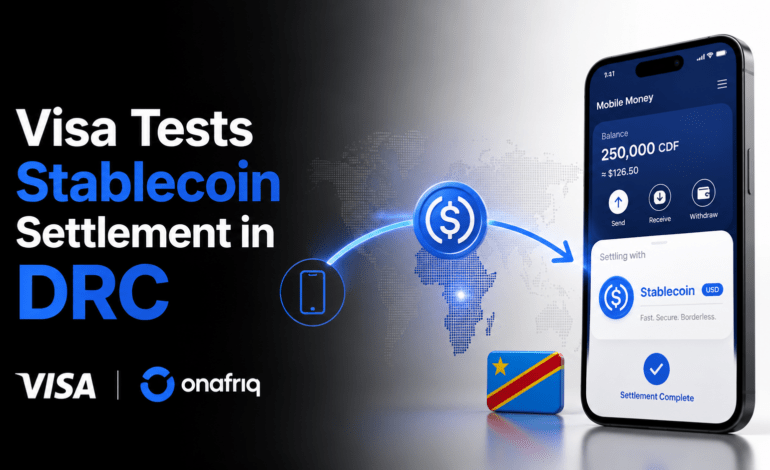
Visa and African payments company Onafriq are testing the use of stablecoins to settle mobile-money transactions in the Democratic Republic of Congo, marking another step toward bringing blockchain-based settlement into everyday African payment systems.
The initiative reportedly uses stablecoins in the background to settle mobile-money wallet top-ups connected to Visa Pay. Customers continue using familiar mobile-money services, while the stablecoin element operates behind the scenes between the participating payment companies.
The pilot does not mean Congolese consumers are being asked to buy, hold or manage stablecoins directly. Instead, Visa and Onafriq are exploring whether stablecoins can improve the settlement layer that connects mobile-money networks with cross-border payment infrastructure.
How the DRC stablecoin pilot works
Godfrey Sullivan, Visa’s senior vice president and head of product and solutions for Central and Eastern Europe, the Middle East and Africa, said the company has a use case in the DRC where mobile-money top-ups are being settled with stablecoins through its partnership with Onafriq.
According to Sullivan, when a user tops up an M-Pesa wallet through Visa Pay, the customer sees a normal mobile-money transaction, while the corresponding settlement takes place using stablecoins in the background.
The reported process can be understood in four stages:
- A customer initiates a mobile-money wallet top-up.
- Visa Pay handles the customer-facing payment experience.
- Onafriq connects the participating mobile-money and payment networks.
- Stablecoins are used to settle the value between the relevant financial institutions or payment providers.
The arrangement is designed to preserve the familiar experience of using mobile money while introducing blockchain technology into the less visible back-end settlement process.
Stablecoins remain invisible to the customer
The most important feature of the pilot is that the consumer does not necessarily need to know that a stablecoin is involved.
A user may fund or receive money in an ordinary mobile-money wallet, with balances still displayed in the relevant local or supported currency. The stablecoin is used by the payment providers to transfer and settle value rather than being delivered directly to the customer.
This differs from a conventional crypto payment in which a user opens a digital wallet, buys a stablecoin and sends it over a blockchain.
Visa’s approach reflects a broader industry view that blockchain adoption may happen largely behind the scenes. Customers may continue interacting with bank accounts, cards and mobile-money wallets while stablecoins support settlement underneath those services.
The pilot builds on Visa Pay’s DRC launch
Visa and Onafriq originally announced the launch of Visa Pay in the DRC in September 2025.
The service was introduced as a cloud-based payment platform designed to connect Visa’s card network with mobile-money accounts. Through Onafriq’s infrastructure, customers could fund Visa Pay from services including M-Pesa, Airtel Money and Orange Money.
Visa Pay was intended to give more Congolese consumers access to digital and online payments, including people who relied primarily on mobile money rather than conventional bank cards.
The stablecoin pilot appears to add a new settlement layer to that existing system. Visa Pay provides the customer-facing payment product, while stablecoins may be used to transfer value between the companies involved in processing the transaction.
Why Onafriq is important to the project
Onafriq, formerly known as MFS Africa, operates one of the continent’s largest digital-payment networks.
The company says its infrastructure connects almost one billion mobile wallets, hundreds of millions of bank accounts and thousands of cross-border payment corridors across African markets.
That network gives Onafriq the ability to connect international payment companies with Africa’s fragmented mobile-money ecosystem.
A single country may have several mobile-money operators, banks and fintech platforms that do not communicate directly with one another. Cross-border transactions become even more complicated when money must move between different currencies, telecom networks and regulatory systems.
Onafriq acts as an interoperability layer, allowing payment providers to reach multiple mobile wallets and financial institutions through one integration.
The company had already said it was exploring blockchain infrastructure and stablecoin integrations to support faster, programmable payments and more efficient cross-border trade.
Why stablecoins could improve settlement
Traditional cross-border payments may involve several banks, correspondent accounts, currencies and reconciliation processes.
Each additional intermediary can increase the cost and time required to complete a transfer. Settlement may also be limited by banking hours, weekends and public holidays.
Stablecoins can potentially address some of these problems because they move over blockchain networks that operate continuously.
Payment companies may use them to:
- settle obligations outside normal banking hours;
- reduce dependence on multiple correspondent banks;
- improve the speed of reconciliation;
- transfer dollar-linked value between markets;
- create more transparent transaction records; and
- provide liquidity across different payment systems.
A stablecoin can be sent across a blockchain within minutes, although the complete customer transaction may still depend on local banking, compliance and mobile-money systems.
The potential benefit is not simply that blockchain transactions are fast. It is that payment companies may be able to use one digital settlement asset across several otherwise disconnected networks.
Stablecoin settlement is different from sending remittances in crypto
The DRC pilot should not be described as a service that allows every consumer to send stablecoins directly across borders.
The reported use case concerns settlement between payment providers. The customer may still send or receive ordinary money through a mobile wallet.
For example, a person abroad could initiate a payment through a participating Visa-connected service. The recipient in the DRC may receive funds in a mobile-money wallet, while a stablecoin is used to settle the obligation between the companies handling the transaction.
This distinction matters because it removes some of the complexity that prevents many consumers from using crypto directly.
Users do not need to manage private keys, choose a blockchain network or understand the difference between USDC, USDT and other stablecoins. The payment providers manage the blockchain component.
Visa is rapidly expanding stablecoin settlement
The DRC initiative forms part of Visa’s wider stablecoin strategy.
Visa said in April 2026 that its stablecoin settlement pilot had grown by 50% quarter over quarter, reaching an annualised run rate of approximately $7 billion. The company also announced support for additional blockchains as it expanded settlement pilots across different markets and currencies.
Visa later said it had moved billions of dollars in stablecoins across VisaNet and was expanding its settlement pilots across multiple regions, blockchains and currencies.
The $7 billion figure represents Visa’s global annualised stablecoin settlement volume. It is not the value processed through the DRC pilot.
Visa first began testing stablecoin settlement several years ago and has since allowed selected clients to fulfil settlement obligations using assets such as Circle’s USDC.
Reuters reported that Visa’s annualised stablecoin settlement volume had risen from approximately $4.5 billion in January 2026 to $7 billion by the end of March.
Why the DRC is a meaningful test market
The DRC has a large population but relatively limited access to traditional banking services. Mobile money therefore plays an important role in transferring funds, paying merchants and accessing digital financial services.
At the same time, moving money into and out of the country can be expensive and operationally difficult.
A stablecoin-supported settlement model could help connect the country’s mobile-money users to regional and international payment networks without requiring every user to obtain a traditional bank account or cryptocurrency wallet.
The DRC is also a useful market for testing interoperability because several mobile-money providers operate in the country.
Visa Pay’s integration with M-Pesa, Airtel Money and Orange Money demonstrates how one payment platform can connect multiple wallet providers.
Adding stablecoin settlement may make it easier for the companies behind these services to move and reconcile value across borders.
The service remains a pilot
The stablecoin arrangement should not be treated as a nationwide commercial launch.
Available reports describe it as a use case or pilot being tested through the existing Visa Pay and Onafriq partnership. Visa has not publicly disclosed the transaction volume, the stablecoin being used, the blockchain network involved or the number of customers covered by the test.
There is also some uncertainty around the regulatory status of parts of the broader arrangement.
The EastAfrican included an editor’s note stating that one planned Visa partnership was still awaiting regulatory approval, although the report did not clearly identify which specific part of the initiative the note covered.
The safest interpretation is that Visa and Onafriq are testing the technology while any broader rollout would remain subject to regulatory and partner approval.
Stablecoins may become invisible financial infrastructure
The Visa and Onafriq pilot reflects a wider shift in the way financial companies are approaching stablecoins.
Early crypto adoption focused on persuading consumers to hold tokens in self-custody wallets. Payment companies are increasingly using stablecoins as infrastructure instead.
In this model, a consumer may never see or interact with the token. The stablecoin simply helps banks, fintechs and mobile-money operators settle transactions more efficiently.
That could prove especially relevant in Africa, where mobile money is already widely adopted but cross-border interoperability remains difficult.
Rather than replacing mobile money, stablecoins may help connect mobile wallets across countries and financial networks.