









South Africa’s ZARU Can Now Trade Against USDC 24/7 Through Circle’s StableFX

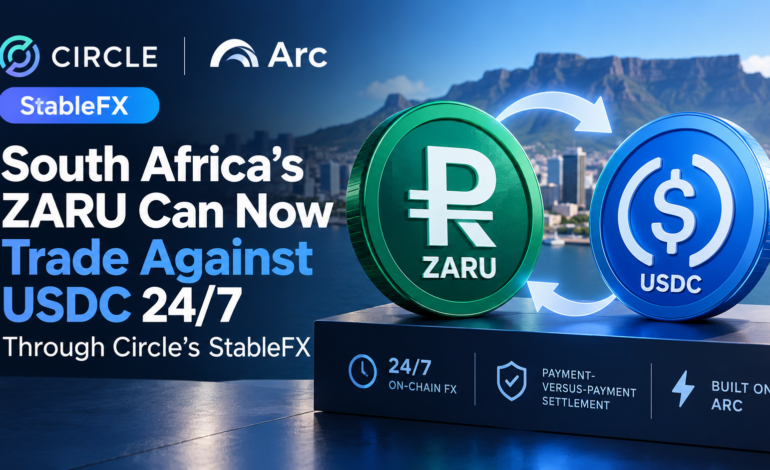
South Africa’s rand-backed stablecoin ZARU can now participate in 24/7 on-chain foreign-exchange settlement against USDC through Circle StableFX, giving the South African rand a new route into always-on digital currency markets.
The development follows two launches within days of each other.
On September 16, 2026, ZARU went live on Arc, Circle’s new Layer-1 blockchain built for financial markets and real-time money movement. Six days later, on September 22, Circle switched on StableFX, an institutional foreign-exchange system that uses stablecoins and Arc for round-the-clock settlement. ZARU’s Arc launch announcement Arc’s StableFX launch announcement
Circle currently lists ZARU as the supported South African rand stablecoin on StableFX alongside USDC, its dollar-backed stablecoin. The system allows participating institutions to request FX quotes, execute trades and settle the two sides on-chain. Circle StableFX
What Is ZARU?
ZAR Universal, or ZARU, is a stablecoin designed to maintain a value of one South African rand.
It was launched in February 2026 as an institutional-grade digital representation of the rand and was initially deployed on Solana. ZARU’s original launch announcement
Unlike a cryptocurrency such as Bitcoin, whose market price can move considerably, ZARU is designed to stay pegged to the rand. According to the ZARU white paper, every token is intended to be backed by rand-denominated reserve assets and redeemable at a 1 ZARU to R1 ratio.
The issuer is BlockTower South Africa, an authorised Financial Services Provider under the Financial Sector Conduct Authority. The company says ZARU reserves are held separately from its operating funds, with Standard Bank serving as its primary banking and custody partner and Sanlam Specialised Asset Management overseeing reserve management. Independent reserve attestations are provided by Moore Johannesburg.
So ZARU is not trying to create a replacement for the rand. It is trying to give the rand blockchain rails.
ZARU Has Now Expanded Beyond Solana
ZARU originally launched on Solana, but its architecture was designed to expand to additional blockchain networks. That expansion has now reached Arc.
ZARU announced on September 16 that the stablecoin was live on Arc, describing the move as a way to connect rand-denominated settlement with a broader international ecosystem of markets, payment companies and financial applications. The timing is significant because September 16 was also the day Circle officially launched Arc’s public mainnet.
Circle describes Arc as an open Layer-1 network built specifically around areas such as payments, foreign exchange, tokenised assets and institutional financial settlement. Circle’s Arc mainnet announcement
Unlike many blockchains that require users to hold a separate volatile network token to pay transaction fees, Arc uses USDC for gas fees.
Circle also says Arc provides deterministic sub-second finality, meaning transactions are designed to reach final settlement extremely quickly.
For ZARU, joining Arc places a digital representation of the South African rand directly alongside Circle’s dollar infrastructure.
Then StableFX Went Live
The second piece arrived on September 22. Circle launched StableFX on Arc, positioning it as an always-on foreign-exchange engine for institutions using stablecoins.
Traditional FX markets are enormous, but they still operate around banking hours, cut-off times, weekends and holidays. Stablecoins do not. They can move 24 hours a day. Circle is attempting to bring those two worlds together.
StableFX allows institutions to exchange supported stablecoins using an RFQ, or Request-for-Quote, system and then settle the resulting transaction directly on Arc. Circle’s StableFX platform
ZARU is one of the supported currencies. USDC is another.
That creates an on-chain route between South African rand value and US dollar value.
How Would a ZARU-USDC Trade Work?
StableFX is not a traditional cryptocurrency exchange with an order book full of retail traders. It is designed more like institutional FX infrastructure.
A participant first sends a request for quote for a supported stablecoin pair. Liquidity providers respond with executable prices. The participant selects a quote. The trade is then recorded and ultimately settled on-chain.
So, for example, an institution holding ZARU could request a price for converting that rand exposure into USDC. Another institution or liquidity provider can quote the trade. Once both parties agree, settlement occurs through Arc.
All of this can happen outside normal banking hours. Circle explicitly describes StableFX as offering 24/7 FX settlement, including weekends and after-hours periods. That does not mean every person with ZARU automatically has access to StableFX. The service is primarily infrastructure for institutional participants and financial platforms.
But those platforms can eventually build services on top of it.
The Clever Part Is Payment-versus-Payment
One of the more important pieces of StableFX has little to do with flashy crypto terminology. It is called Payment-versus-Payment, or PvP.
In a normal foreign-exchange transaction, one party may send its currency before the other side of the trade has fully settled. That creates settlement risk. What happens if you send your money but the other side does not?
StableFX uses smart contracts so that, for eligible immediate-settlement trades, both sides settle together or neither side settles.
For a ZARU-USDC conversion, that means the rand-backed tokens and dollar-backed tokens can change hands atomically. One side does not have to spend an uncomfortable few minutes wondering whether the other side remembered to send the money. Blockchain, occasionally, can be useful for reducing anxiety.
This Is Not the First ZARU-USDC Market
ZARU trading against USDC itself is not new.
Luno introduced ZARU/USDC and ZARU/USDT trading pairs in August 2026, giving customers in South Africa, Nigeria, Kenya and Uganda a direct exchange route between ZARU and major dollar stablecoins. Luno’s ZARU/USDC trading announcement
So it would be inaccurate to say:
“ZARU can trade against USDC for the first time.”
What is new is the StableFX and Arc infrastructure.
Luno provides an exchange market. StableFX provides institutional FX execution and on-chain settlement infrastructure. These are related, but they are not the same thing.
StableFX Is Not a Bank
Circle StableFX itself is not acting as the counterparty that buys and sells the currencies.
Circle says StableFX is provided by Circle Technology Services as software consisting of APIs and on-chain smart contracts that allow counterparties to exchange information and settle transactions directly. Circle’s StableFX access information
Circle Technology Services says it does not accept or transmit assets on behalf of StableFX users. That means StableFX is better understood as infrastructure connecting market participants rather than Circle standing in the middle of every ZARU-USDC trade. The liquidity comes from participating counterparties.
The technology coordinates the quote and settlement.
The Reserves Still Matter More Than the Blockchain
Of course, putting R1 onto a blockchain does not magically make the R1 trustworthy. Someone still has to ensure the token is actually backed. This is where ZARU’s reserve model matters.
The ZARU white paper says tokens are minted only after equivalent rand value has been received into designated reserve accounts and are burned when redeemed.
Reserve assets can include cash, bank deposits and high-quality rand-denominated instruments.
ZARU also says its reserves are held in segregated accounts and subject to independent monthly attestations.
That is important because a stablecoin is ultimately only as useful as confidence that the asset behind the token actually exists.
The blockchain can show how many ZARU tokens are circulating. It cannot magically verify what is sitting in a bank account. That still requires traditional financial controls.
The future of finance, apparently, still involves auditors.
Arc Wants to Become Infrastructure for Global Money
ZARU is only one part of a considerably bigger Arc strategy.
When Circle launched Arc on September 16, it said more than 100 institutional and ecosystem builders were already participating across banking, asset management, payments, exchanges, custody, DeFi and other financial infrastructure.
Circle has designed the blockchain specifically around financial use cases. USDC is used to pay transaction fees.
StableFX handles foreign-exchange infrastructure.
Other applications can handle lending, trading, tokenised assets and payments.
Circle also listed ZARU among the local-currency stablecoins active or being onboarded into StableFX.