










The Real Reason Nigeria’s Crypto Revolution Works: It’s Not About the Blockchain

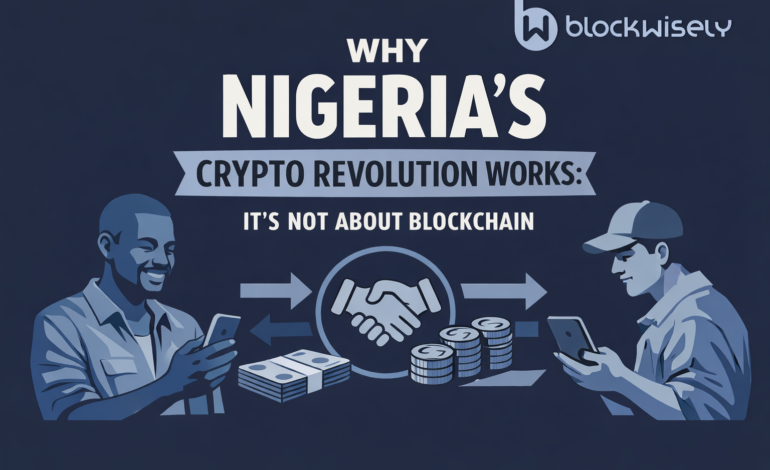
A phone trader in Lagos taps his screen a few times. Minutes later, his supplier in Guangzhou confirms that 500 devices are on the way.
No bank stress.
No paperwork.
No waiting for approval.
Just crypto, a phone, and a trusted contact.
A few years ago, this wouldn’t have been possible.
Back then, sending money abroad meant going to the bank, filling out forms, and waiting days or even weeks for approval. Sometimes, the approval never came. The black market was faster, but risky and expensive.
Today, things have changed.
Crypto now moves billions quietly across Nigeria, helping traders run their businesses without relying on slow systems.
But here’s the truth: this shift isn’t really about blockchain technology.
When Systems Don’t Work, People Find Another Way
Nigeria is one of the biggest crypto markets in the world. But if you visit Lagos Computer Village, what you’ll see isn’t a tech trend, it’s a solution to a problem.
Thousands of traders operate outside the traditional banking system, yet everything still works.
Why?
Because the system is built on trust.
- Traders know their brokers
- Brokers know their foreign partners
- Everyone depends on their reputation
Once a few transactions go smoothly, more people join in. The system grows naturally.
It may look informal, but it works like a proper financial system just faster and more flexible.
How It Works in Real Life
Here’s a simple breakdown:
A trader in Lagos wants to pay a supplier in China.
Instead of going through a bank, he contacts a crypto broker usually someone within the market he already trusts.
- The trader gives the broker naira
- The broker converts it to USDT (a stable cryptocurrency) using peer-to-peer platforms
- The broker sends the USDT to a trusted contact in China
- That contact converts it to yuan and pays the supplier through a local bank
The supplier receives the money like a normal bank transfer. No crypto involved on their end.
The whole process can take less than an hour.
Why Speed Matters More Than Fees
Yes, crypto is often cheaper than traditional methods. But that’s not the main reason people use it.
Speed is everything.
In markets like Lagos, prices change quickly. Goods sell out fast. If you delay payment, you can lose the deal completely.
Waiting days for a bank transfer isn’t just slow it can cost you business.
With crypto, traders act immediately. While others are still waiting for bank approval, their goods are already on the way.
Trust Is What Keeps It Running
The most important part of this system isn’t the technology, it’s trust.
Brokers don’t just process payments. They take responsibility.
If something goes wrong, they fix it even if it means losing their own money.
Why?
Because reputation is everything.
- A reliable broker gets more clients
- A dishonest one gets avoided permanently
The same applies internationally. Chinese partners only work with people they trust, often through referrals.
Without trust, this system would collapse.
It Keeps Working Even When Rules Change
When restrictions were placed on crypto-related banking, many people thought this system would stop.
It didn’t.
Instead, traders adjusted. They moved to peer-to-peer platforms and informal exchanges. The system became even stronger.
Why?
Because it solves a real problem.
When something works this well, people will always find a way to keep using it.
This Isn’t Just Nigeria
The same thing is happening in other countries where banking systems are slow or restrictive.
This isn’t about people rejecting banks completely. Most traders still have bank accounts.
The problem is simple: banks can’t keep up with their needs.
People need fast, reliable, and flexible ways to move money. If traditional systems can’t provide that, alternatives will grow.
The Real Lesson
Many people think crypto adoption is about technology.
It’s not.
It’s about solving real problems.
Nigerian traders aren’t thinking about blockchain or decentralization. They just want a system that works.
And right now, this works.
For anyone building products or policies, the lesson is clear:
Don’t start with theory. Start with how people already solve their problems.
The Bigger Picture
What’s happening in Lagos isn’t loud or flashy.
It’s practical.
Every day, traders make simple decisions to keep their businesses running. Over time, those decisions have built a powerful system.
Not because of the technology but because of the people using it.
Nigeria’s crypto growth isn’t about hype.
It’s about people finding a better way and sticking with what works.







2 Comments
This piece really highlights something crucial — the real power of crypto in Nigeria isn’t in the tech itself, but in how it bypasses broken systems. It’s a practical solution for people who’ve long been excluded from traditional finance, and that’s why it’s taken off so organically. Seeing traders move goods and money seamlessly without banks or paperwork is a testament to human ingenuity under pressure.
This perspective really resonates; it’s clear that for many Nigerian traders, crypto isn’t a tech trend but a survival mechanism against bureaucratic inefficiencies. The shift from waiting weeks for bank approvals to instant settlements via a phone in Lagos is a powerful testament to human ingenuity when traditional systems fail.