









What Goats, Grain, and Code Have in Common

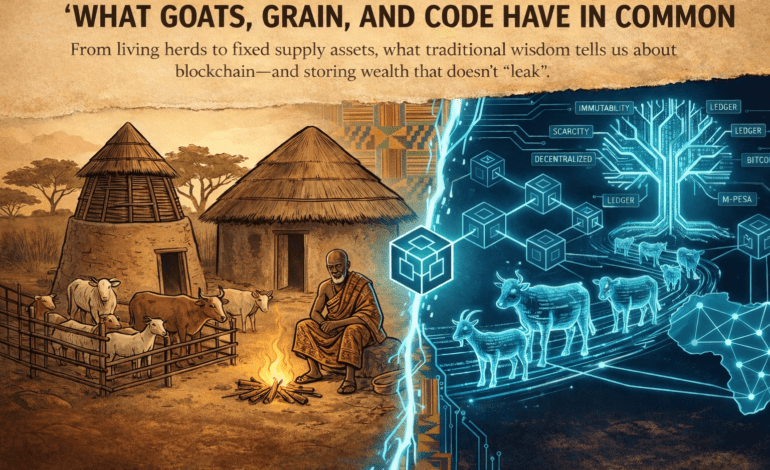
In many African homesteads, wealth was tangible and alive. It was measured in the cattle returning at dusk, multiplied in the goats within the pen, and rose in the granary standing firm beside the hut.
Our great grandparents trusted systems that breathed, grew, and resisted easy manipulation,not paper promises or distant decrees.Blockchain technology echoes this ancient wisdom in surprising ways.
The Leaking Granary
Picture storing your harvest in a granary with a hidden crack at the base. Each night, grain slips away unnoticed. By the next season, your hard-won surplus has quietly diminished.This silent theft is inflation.You labor today, deposit value in currency, yet over time those numbers buy less.
The account balance stays the same, but the purchasing power leaks away,like water seeping from a cracked clay pot.In countries like Nigeria, Congo, and Zimbabwe, where inflation has eroded savings year after year, millions are turning to digital alternatives to stem the loss.
The Ancestral Hedge
Our elders mastered wealth preservation through living systems.A cow calves. A goat multiplies. A herd grows through care, patience, and community oversight. No chief could wake one morning and declare a thousand new cattle into existence. Scarcity was enforced by biology and shared memory,everyone knew whose cows grazed which fields.Wealth lived in systems hard to manipulate, protected by collective trust rather than centralized power.
The Digital Herd Emerges
City life offers no space for herds or granaries. Yet the instinct to safeguard labor’s fruits endures.Blockchain provides a shared, tamper-resistant ledger distributed across thousands of computers worldwide. No single bank, government, or chief controls the record alone.
Imagine a village ledger etched into many stones simultaneously. Alter one, and the others reveal the falsehood.
This delivers three principles our ancestors would recognize:
Immutability: Once written, records resist change, like agreements carved in stone rather than scribbled on bark.
Scarcity: Assets like Bitcoin enforce fixed supplies,no council can inflate them overnight.
Community Sovereignty: Ownership resides in the network, not behind one institution’s gate.In traditional villages, shared knowledge guarded wealth. Blockchain scales that idea globally.
Why Blockchain Finds Fertile Ground in Africa
Blockchain is not a foreign import from distant labs,it revives an old instinct in new form.Mobile money platforms like M-Pesa already digitized community trust for tens of millions, enabling peer-to-peer transfers without banks. Recent partnerships, such as M-Pesa’s 2026 integration efforts with blockchain infrastructure (including stablecoin rails across Kenya, Ghana, Ethiopia, and beyond), build directly on this foundation,making cross-border remittances faster and cheaper than traditional channels.
In Nigeria, which led Sub-Saharan Africa with over $92 billion in crypto transaction value in the 2024–2025 period, stablecoins serve as practical hedges against currency devaluation and inflation. South Africa, Kenya, Ghana, and Ethiopia follow closely, with stablecoins now powering everyday remittances, commerce, and savings where fiat erodes trust.
Blockchain also tackles real-world challenges: tokenizing land titles to reduce disputes and fraud, securing supply chains, and enabling fractional ownership of assets.
Of course, no system is flawless. Blockchain networks face scalability hurdles, energy demands (though newer ones improve efficiency), volatility in early assets, and regulatory shifts in various countries.
Yet its core design resists the single points of failure, central printing presses, corrupt officials, or failing banks, that plague traditional stores of value.
A Familiar Future
Blockchain feels alien only until viewed through African eyes. It is simply a modern tool for an enduring goal: protecting the fruits of labor from quiet erosion.Where ancestors raised living herds and built solid granaries, today we cultivate digital ledgers and networks that grow beyond any single season or border.
The question is no longer whether these tools will reshape economies,they already are, from Lagos markets to rural Rwanda wallets.
The choice before us is clear: continue patching cracks in leaking granaries, or learn to tend digital herds that can multiply, endure, and belong to the many rather than the few?
In villages and cities alike, the seeds are planted. Now we decide what grows.