








What Is Total Value Locked (TVL) in Crypto and DeFi

If you spend time exploring decentralized finance, you will often come across the term Total Value Locked, commonly shortened to TVL.
You may see statements like:
“Protocol X has $2 billion in TVL.”
But what does that actually mean?
For beginners entering the cryptocurrency ecosystem, TVL is one of the most important metrics used to measure activity in decentralized finance. It helps investors, developers, and analysts understand how much value is currently being used inside blockchain based financial platforms.
Understanding TVL can help you better evaluate DeFi projects and understand the growth of the broader crypto ecosystem.
Let us break it down in simple terms.
What Is Total Value Locked (TVL)
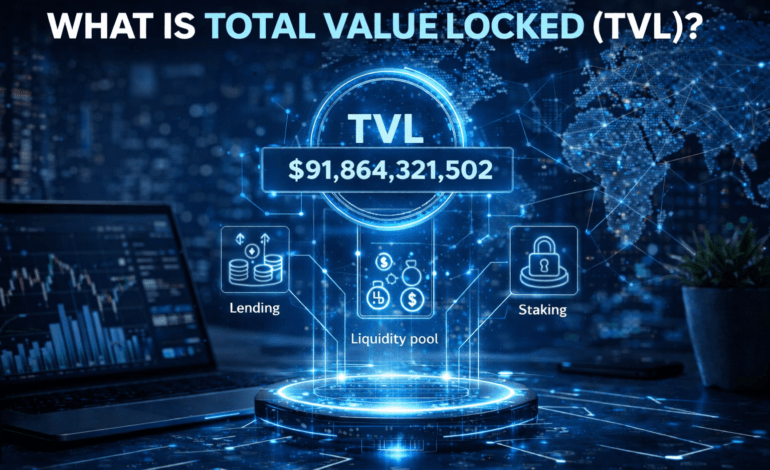
Total Value Locked (TVL) refers to the total value of cryptocurrency assets deposited into a decentralized finance protocol.
These assets are usually locked inside smart contracts, which power different DeFi services.
TVL represents the amount of money users have committed to a platform.
In simple terms, TVL answers one key question:
How much cryptocurrency is currently being used inside a DeFi protocol?
The higher the TVL, the more assets users have deposited into that system.
TVL typically includes funds used for activities such as:
- Lending
- Borrowing
- Liquidity pools
- Yield farming
- Staking
A Simple Example of TVL
Imagine a decentralized lending platform where users deposit cryptocurrency so others can borrow it.
Suppose users deposit:
- $10 million worth of Ethereum
- $5 million worth of stablecoins
- $3 million worth of other tokens
The total value of assets deposited into that platform would be:
$18 million TVL
That number represents the total value of funds currently locked inside the protocol’s smart contracts.
Why TVL Is Important in DeFi
Total Value Locked is often used as a health indicator for decentralized finance platforms.
When users deposit assets into a protocol, it usually signals that people trust the platform enough to commit their funds.
Higher TVL often suggests:
- Stronger liquidity
- Higher user participation
- Greater ecosystem activity
If users begin withdrawing funds from a protocol, the TVL decreases.
A falling TVL can sometimes signal issues such as:
- Loss of confidence
- Security concerns
- Market downturns
- Competition from other DeFi platforms
Because of this, investors and analysts frequently track TVL when evaluating blockchain ecosystems.
How TVL Is Calculated
TVL is calculated by adding together the value of all assets deposited into a protocol.
This may include:
- Cryptocurrency deposited into lending platforms
- Tokens used in liquidity pools on decentralized exchanges
- Assets staked in DeFi protocols
- Funds committed to yield farming strategies
Each asset is usually converted into a common value, most often US dollars, so the total can be easily compared across different platforms.
Because cryptocurrency prices change frequently, TVL values also change throughout the day.
For example, if the price of Ethereum rises, the TVL of many DeFi platforms may increase even if no new deposits are made.
TVL Across Entire Blockchain Ecosystems
TVL is not only used to evaluate individual DeFi platforms.
It is also used to measure the growth of entire blockchain ecosystems.
Analysts often compare TVL across networks such as:
- Ethereum
- Solana
- Arbitrum
- Polygon
- Avalanche
A blockchain network with higher TVL typically has more financial activity happening on its platform.
TVL across decentralized finance platforms can be tracked using analytics platforms such as
https://defillama.com
These platforms aggregate data from many protocols and provide real time insights into DeFi activity.
What High TVL Usually Indicates
When a DeFi platform has high TVL, it often suggests several positive factors.
First, users trust the protocol enough to deposit assets.
Second, it often indicates deeper liquidity. Liquidity is important because it allows users to trade, borrow, or lend assets more easily.
Third, high TVL may signal that the protocol is attracting developers and ecosystem growth.
However, TVL alone should never be the only factor used to evaluate a project.
Some platforms attract large deposits by offering very high rewards for a short period of time. Once those incentives end, users may quickly withdraw funds.
When TVL Drops
TVL can decline for many reasons.
Some of the most common include:
- Market crashes that reduce cryptocurrency prices
- Security exploits affecting a protocol
- Loss of user confidence
- Better yields offered by competing platforms
For example, if a DeFi platform experiences a hack, users often withdraw their assets quickly. This can cause a sudden drop in TVL.
Sharp TVL declines sometimes occur when projects shut down or experience major financial problems.
TVL and Liquidity in DeFi
TVL is closely related to liquidity.
Liquidity refers to how easily assets can be traded or borrowed within a platform.
Protocols with higher TVL usually have deeper liquidity pools.
This means users can trade larger amounts of cryptocurrency without dramatically affecting prices.
Platforms with low TVL may have limited liquidity, which can increase volatility and trading risk.
Limitations of TVL
Although TVL is a useful metric, it does not tell the full story about a DeFi platform.
TVL does not measure:
- The number of active users
- The security of the protocol
- The sustainability of the platform’s rewards
- The quality of the underlying technology
For example, a protocol may have high TVL because it offers very high rewards, even if the platform itself is risky.
Because of this, experienced investors often analyze TVL alongside other factors such as security audits, developer activity, and protocol revenue.
How Investors Use TVL
Investors and analysts often track TVL trends to understand how DeFi markets are evolving.
They look at factors such as:
- Which protocols are gaining TVL quickly
- Which platforms are losing liquidity
- How TVL changes during market cycles
Rising TVL can signal growing adoption of a platform.
Falling TVL may indicate users are leaving the ecosystem.
However, it is always important to analyze TVL trends over time rather than focusing on a single data point.
Frequently Asked Questions
What does TVL mean in crypto?
TVL stands for Total Value Locked. It refers to the total value of cryptocurrency assets deposited into a decentralized finance protocol.
Why is TVL important?
TVL helps measure how much activity and liquidity exists inside a DeFi platform. Higher TVL often indicates stronger user participation.
Does higher TVL mean a project is safe?
Not necessarily. While higher TVL can signal adoption, it does not guarantee security. Smart contract vulnerabilities and other risks may still exist.
Where can you track TVL?
TVL across decentralized finance platforms can be tracked using analytics platforms such as https://defillama.com.
Total Value Locked is one of the most important metrics used to evaluate decentralized finance platforms.
It measures the total value of cryptocurrency assets deposited inside DeFi protocols.
For beginners exploring blockchain and DeFi, TVL provides a simple way to understand how much financial activity is happening within a platform.
However, TVL should always be analyzed alongside other factors such as security, transparency, and long term sustainability.
Understanding how TVL works can help you make more informed decisions as you explore the rapidly growing world of decentralized finance.