








Kenya’s M-Pesa Eyes Blockchain Integration as MEXC Adds M-Pesa Support for P2P Crypto Trading

Kenya’s mobile money platform M-Pesa is exploring blockchain integration through a partnership with ADI Foundation, an Abu Dhabi-based blockchain organization behind the development of ADI Chain.
According to reporting by Semafor, M-Pesa is collaborating with ADI Foundation to explore how blockchain infrastructure can support and enhance its mobile money network across Africa. ADI Foundation has also confirmed the partnership, stating that the initiative is expected to extend blockchain infrastructure to M-Pesa’s 60+ million monthly users across eight African markets.
ADI Foundation is the organization behind ADI Chain, a blockchain network designed for institutional use cases, including governments, regulators, sovereign entities, and financial institutions. The foundation was founded by Sirius International Holding, the digital arm of International Holding Company, commonly known as IHC.
ADI Foundation and M-Pesa signed a memorandum of understanding to explore the integration of ADI Chain into the mobile money network, Semafor reported, citing Huy Nguyen Trieu, a council member at the foundation. Trieu said the partnership would seek to support M-Pesa’s next phase of growth beyond Kenya, where the platform already has strong reach.
“M-Pesa has been amazing in terms of financial inclusion. Our view is that we can push it further again by providing the right digital infrastructure, both for individuals and SMEs,” Trieu said, according to ADI Foundation’s announcement.
M-Pesa operates across eight African markets: Kenya, Democratic Republic of Congo, Egypt, Ethiopia, Ghana, Lesotho, Mozambique, and Tanzania. The partnership outlines a framework for deploying ADI Chain across these markets, using M-Pesa’s scale to support new digital payment rails for individuals and small businesses.
M-Pesa has long been recognized as one of Africa’s leading financial inclusion platforms. Since launching in Kenya in 2007, the service has enabled millions of users to send money, pay bills, buy goods, save, borrow, and access financial services without relying fully on traditional bank branches.
“We are excited to partner with ADI Foundation to tap into their expertise around new technologies and how these can transform financial services,” said Sitoyo Lopokoiyit, M-Pesa Africa CEO.
While the companies have not fully disclosed how ordinary users will experience the blockchain integration, available statements point to cross-border settlement, stablecoin transactions, and digital financial infrastructure as likely areas of focus. Semafor reported in December 2025 that a stablecoin for ADI Chain was expected in January 2026, with the goal of helping Abu Dhabi-based companies settle international payments in markets where they operate.
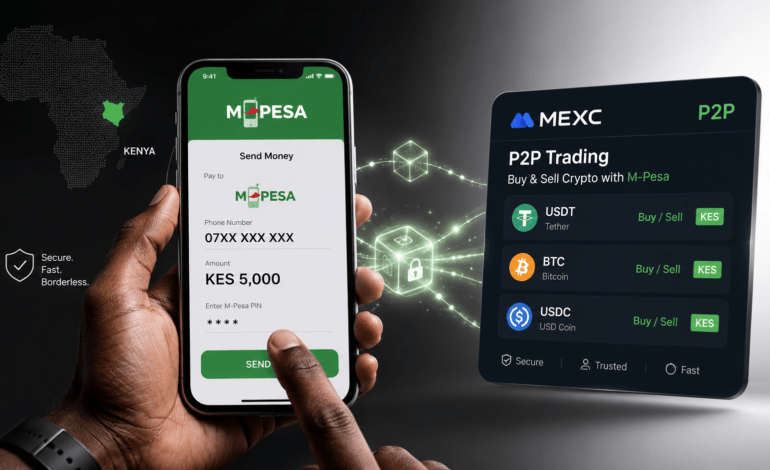
The development comes as global crypto exchanges are also increasing support for local African payment methods. MEXC announced in September 2025 that its P2P platform now supports the Kenyan shilling, allowing users to trade BTC, USDT, ETH, and USDC using KES. The exchange said the move was part of its effort to support more local fiat currencies on its peer-to-peer marketplace.
MEXC’s addition of KES and M-Pesa-related payment access gives the story a user-market angle. While the M-Pesa and ADI Foundation partnership focuses on blockchain infrastructure and possible settlement rails, MEXC’s P2P support shows how mobile money is already becoming a practical entry point for Kenyan users accessing stablecoins and other digital assets.
For Kenyan traders, M-Pesa support on P2P platforms makes crypto onboarding more familiar. Instead of relying only on bank transfers or card payments, users can interact with merchants through a payment method they already use daily. This is especially relevant for stablecoins such as USDT and USDC, which are commonly used by traders for digital dollar exposure, cross-border transfers, and crypto market access.
The two developments are not the same partnership. MEXC is not part of the ADI Foundation and M-Pesa blockchain initiative. However, both developments point to the same broader trend: mobile money is becoming an important bridge between local African payment systems and the global digital asset economy.
The M-Pesa and ADI Foundation partnership suggests blockchain may first be used as back-end infrastructure rather than as a consumer-facing crypto trading feature inside M-Pesa. This could allow M-Pesa to explore faster settlement, improved cross-border payments, and new digital financial services while maintaining a familiar mobile money experience for users.
At the same time, MEXC’s P2P support highlights how demand for local payment options is growing among African crypto users. As more platforms support payment methods such as M-Pesa, Kenyan users may find it easier to move between local currency and digital assets.
Stablecoin adoption has also been gaining attention in Kenya and other African markets as some traders, importers, and diaspora users seek faster and more affordable ways to move money across borders. Business Daily has reported rising interest in stablecoins for payments and transfers, especially where traditional channels are slow or expensive.
However, several details remain unclear. M-Pesa and ADI Foundation have not fully explained when the blockchain integration will go live, whether users will directly hold stablecoins, how regulators in each market will respond, or whether the first products will target consumers, merchants, or business settlement.
For Kenya, the development is significant because M-Pesa is already a core part of the country’s financial infrastructure. If implemented within regulatory limits, blockchain could support faster and more connected payment services while allowing users to continue interacting with M-Pesa in a familiar way.
Together, M-Pesa’s blockchain exploration and MEXC’s M-Pesa-supported P2P trading options show how Kenya’s mobile money ecosystem is increasingly connected to the global digital asset market. One side is focused on institutional infrastructure and settlement. The other is focused on consumer access to crypto and stablecoins.
The result is a growing link between mobile money, blockchain infrastructure, and stablecoin-powered payments as African fintech continues to evolve beyond traditional digital wallets into more advanced cross-border financial systems.
About M-Pesa
M-Pesa is one of Africa’s leading mobile money platforms, offering payments, money transfers, savings, credit, merchant services, and other digital financial services across multiple African markets.
About ADI Foundation
ADI Foundation is an Abu Dhabi-based blockchain organization behind ADI Chain, a blockchain network focused on institutional digital finance, stablecoins, tokenized assets, and regulated blockchain infrastructure.
About MEXC
MEXC is a global digital asset exchange that offers spot trading, futures trading, and peer-to-peer crypto trading services. Its P2P marketplace supports selected local fiat currencies, including the Kenyan shilling, allowing users to buy and sell digital assets through supported payment methods.
X: https://x.com/MEXC_AfricaBU
Telegram: https://t.me/mxcafrica
TikTok: https://www.tiktok.com/@mexcafrica