








MoneyGram Launches MGUSD Stablecoin as Remittance Giants Move Toward Digital Dollars

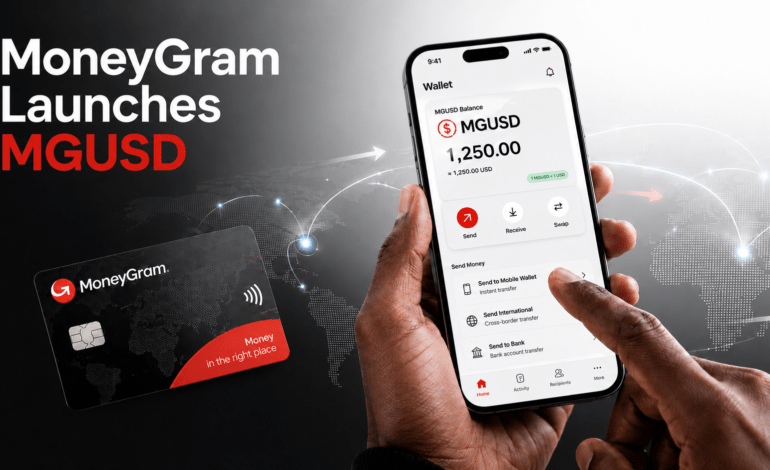
MoneyGram has officially entered the stablecoin race.
The global money transfer company has launched MGUSD, a U.S. dollar-backed stablecoin built on the Stellar blockchain. The move is important because MoneyGram is not a small crypto startup trying to test a new idea. It is one of the world’s most recognized remittance companies, with millions of customers and a large global cash-in and cash-out network.
MGUSD shows how stablecoins are moving beyond crypto exchanges. They are becoming part of real payment systems used for remittances, treasury management, settlement, and cross-border transfers.
For Africa and other emerging markets, this development matters. Many people already depend on remittances from family members abroad. Many also face currency weakness, high transfer fees, slow settlement, and limited access to dollar-based savings. MGUSD could become part of a bigger shift where stablecoins become normal tools for sending, storing, and receiving money across borders.
What Is MGUSD?
MGUSD is a U.S. dollar-denominated stablecoin launched by MoneyGram.
A stablecoin is a digital asset designed to maintain a stable value. In this case, MGUSD is meant to track the value of the U.S. dollar. The idea is simple: one MGUSD should represent one U.S. dollar in value.
MoneyGram says MGUSD will become the foundation for a wider set of financial services across its global network. At launch, the stablecoin is issued natively on Stellar, with support from Bridge, M0, and Fireblocks.
This is not just about creating another token. MoneyGram wants MGUSD to support its own payment infrastructure. The company plans to use it for treasury management, settlement, and currency-related operations before expanding its use more widely.
Why MoneyGram Chose Stellar
MoneyGram’s MGUSD stablecoin is launching on the Stellar blockchain.
This is not surprising. MoneyGram and the Stellar Development Foundation have worked together for years. In April 2026, the two organizations extended their partnership to scale real-world stablecoin utility globally. That agreement built on more than five years of work around stablecoin access, digital wallets, and cash on/off-ramp services.
Stellar has positioned itself as a blockchain for payments, stablecoins, and financial access. Through MoneyGram Ramps, users and developers can connect digital wallets to physical cash locations. Stellar says the service helps users convert physical cash into digital dollars and back again, even without a bank account.
That matters because many people in emerging markets still operate in cash-heavy economies. A stablecoin is not useful for everyday users if there is no simple way to convert it into local money. MoneyGram’s existing agent network gives the company a strong advantage in that area.
Who Is Behind MGUSD?
MGUSD brings together several major infrastructure players.
MoneyGram is the consumer-facing brand and payment network. Stellar provides the blockchain infrastructure. Bridge, which is now part of Stripe, is involved as the stablecoin issuer. M0 provides smart contract infrastructure, while Fireblocks provides wallet infrastructure.
Bridge’s involvement is especially important. Stripe completed its acquisition of Bridge in February 2025, strengthening its position in stablecoin infrastructure. Bridge describes itself as an end-to-end stablecoin platform that helps businesses receive, store, convert, issue, and spend stablecoins.
This means MGUSD is not being launched in isolation. It is part of a larger trend where payment companies, fintech firms, and blockchain infrastructure providers are joining forces to make stablecoins usable in mainstream finance.
How MoneyGram Plans to Use MGUSD
MoneyGram is expected to use MGUSD in stages.
At first, the stablecoin will be used in areas such as treasury management, settlement, and currency trading. It will be available in the United States first, with plans for broader global rollout later.
Over time, MoneyGram wants MGUSD to become a deeper part of its customer experience. Reports say the company wants its users to hold balances in MGUSD, send money across borders, and convert funds into local currency when needed.
That could make MGUSD useful for people in high-inflation countries or countries where access to dollars is limited. Instead of only sending money from one bank or agent location to another, users could eventually hold a digital dollar balance and decide when to cash out.
This is where the story becomes bigger than MoneyGram. MGUSD could help bring stablecoins closer to ordinary remittance users, not just traders and crypto investors.
Why This Matters for Remittances
Remittances are one of the clearest use cases for stablecoins.
According to the World Bank, officially recorded remittances to low and middle-income countries were expected to reach $685 billion in 2024. These flows are a financial lifeline for millions of households, especially in Africa, Asia, and Latin America.
But traditional remittances still face problems. Transfers can be expensive. Settlement can be slow. Exchange rates can be unfavorable. Some recipients must travel to collect cash. In some countries, local currencies can lose value quickly after money is received.
Stablecoins try to solve part of this problem by making money digital, fast, and dollar-denominated. A person can receive a digital dollar balance without waiting for traditional banking settlement. In theory, they can then hold it, send it, or convert it to local currency.
This is why MoneyGram’s entry matters. The company already understands remittance users. If MGUSD is integrated smoothly into its existing system, it could make stablecoins easier to use for people who do not think of themselves as crypto users.
MGUSD Comes as Stablecoins Go Mainstream
MGUSD is launching at a time when stablecoins are becoming a major part of global finance.
CoinGecko data shows the stablecoin sector has grown to roughly $315 billion in market capitalization. This market is no longer small. Stablecoins are now used in crypto trading, DeFi, cross-border payments, merchant settlement, and increasingly by fintech companies.
Recent reports also show that payment companies and financial institutions are becoming more serious about stablecoins. MoneyGram is not alone. Other companies are also exploring stablecoin payment rails, tokenized deposits, and blockchain-based settlement.
This shift is important because stablecoins are starting to compete with older payment infrastructure. They can move value quickly across borders, settle outside normal banking hours, and reduce the need for multiple intermediaries.
However, they also raise major questions about regulation, reserves, consumer protection, money laundering controls, and monetary sovereignty.
The Regulatory Question
The growth of stablecoins has attracted strong attention from regulators.
In the United States and other markets, lawmakers have been working on clearer stablecoin rules. In Europe, regulators have warned that dollar-backed stablecoins could strengthen the global role of the U.S. dollar and weaken the influence of other currencies.
This concern is especially relevant for emerging markets. If people increasingly hold and transact in dollar stablecoins, local central banks may have less control over monetary policy. This is sometimes called digital dollarization.
For users, the appeal is easy to understand. A stable digital dollar may feel safer than a fast-depreciating local currency. But for governments, large-scale stablecoin adoption can create policy challenges.
That is why MGUSD will likely be watched closely by regulators, especially if it expands into regions with high remittance flows and weak local currencies.
What Could Go Right
MGUSD could be useful if MoneyGram executes it well.
First, it could make remittances faster and more flexible. Instead of forcing recipients to cash out immediately, users could hold funds digitally and convert when needed.
Second, it could reduce settlement friction for MoneyGram itself. Stablecoins can help companies move value more efficiently between markets and partners.
Third, it could help users in high-inflation countries protect value for short periods. A dollar-denominated digital balance may be useful for people who receive money from abroad but do not want to hold everything in local currency immediately.
Fourth, it could bring crypto infrastructure to people who do not want to deal with exchanges, seed phrases, or complex blockchain tools.
What Could Go Wrong
MGUSD also comes with risks.
The first risk is trust. Users need to know whether the stablecoin is properly backed, redeemable, and regulated. If a stablecoin cannot maintain its peg or users cannot redeem it easily, confidence can disappear quickly.
The second risk is custody and wallet design. If users are expected to manage self-custodial wallets, they need simple and safe recovery options. Many ordinary remittance users are not ready for complicated crypto wallet management.
The third risk is regulation. Stablecoin rules differ across countries. A product that works in the United States may face restrictions elsewhere.
The fourth risk is liquidity. A digital dollar is only useful if users can convert it into local currency when they need to spend. MoneyGram’s cash network helps here, but execution will matter.
The fifth risk is fees. If the system still becomes expensive through spreads, withdrawal costs, or local cash-out charges, users may not feel much benefit.
FAQ
What is MGUSD?
MGUSD is a U.S. dollar-backed stablecoin launched by MoneyGram. It is designed to maintain the value of one U.S. dollar and support payments across MoneyGram’s network.
Which blockchain does MGUSD use?
MGUSD is issued natively on the Stellar blockchain.
Is MGUSD for crypto traders?
Not mainly. MoneyGram appears to be positioning MGUSD for payments, remittances, settlement, and users who need digital dollar access.
Why is MGUSD important?
It shows that stablecoins are moving into mainstream remittance infrastructure. A major money transfer company is now launching its own digital dollar.
Why does this matter for Africa?
Africa receives large remittance flows and has strong demand for faster, cheaper, and more flexible cross-border payments. A stablecoin connected to a cash-out network could become useful if implemented well.
What are the risks of MGUSD?
The main risks include regulation, stablecoin backing, redemption, wallet security, liquidity, fees, and user education.