









$TRUMP Memecoin Earned Trump-Linked Entities $636M While Buyers Lost $3.8B

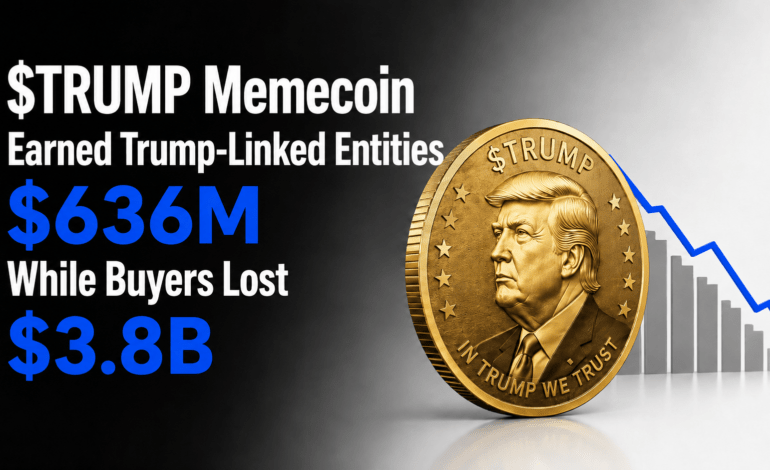
Donald Trump-linked businesses reported approximately $635 million in income from the $TRUMP memecoin in 2025, while blockchain data indicates that nearly one million wallets that bought the token were collectively down about $3.81 billion by the end of June 2026.
The contrasting figures highlight how profits from the politically branded token became heavily concentrated among its creators and early buyers, while a much larger group of later participants suffered substantial losses as its price collapsed.
Trump’s annual financial disclosure for 2025 showed that his businesses received approximately $635 million from the sale of Trump memecoins. Reuters reported that the disclosure was filed with the US Office of Government Ethics and formed part of more than $1.4 billion in income connected to Trump family crypto ventures during the year.
The investor-loss estimate comes from blockchain analytics firm Nansen. Its analysis found that 988,905 of the 1.48 million wallets that had bought $TRUMP were collectively down $3.81 billion. That means roughly two-thirds of the wallets tracked by the firm were in a losing position.
What the $636 million figure represents
The frequently cited $636 million figure should not be interpreted as an exact amount deposited directly into Donald Trump’s personal bank account.
The income was reported through Trump-linked corporate entities associated with the memecoin and included proceeds or royalties arising from the project. Reuters rounded the disclosed amount to approximately $635 million.
Trump remains the beneficiary of the trust that ultimately receives income from his business assets, although the White House says day-to-day control of the businesses has been placed in the hands of his children.
The precise amount personally retained by Trump after ownership arrangements, payments to partners, expenses and taxes is not publicly clear.
It is therefore more accurate to say that Trump-linked entities generated or reported $636 million from the memecoin venture than to say Trump personally pocketed every dollar.
How the $TRUMP project generated revenue
The entities behind $TRUMP could make money through several channels.
These included:
- selling tokens;
- receiving royalties under licensing arrangements;
- collecting transaction fees;
- providing liquidity for token trading; and
- benefiting from holdings retained by project insiders.
An earlier Reuters investigation estimated that the $TRUMP project generated approximately $1.2 billion in total revenue from token sales and related channels. Based on the estimated profit-sharing arrangement, Reuters calculated that the Trump family’s share was about $616 million at that stage.
The later financial disclosure, reporting roughly $635 million in memecoin-related income for 2025, broadly supports the scale of Reuters’ earlier blockchain-based estimate.
The project also earned substantial transaction fees almost immediately after launch. Blockchain analytics firms consulted by Reuters estimated that $TRUMP had generated between $86 million and $100 million in trading fees by January 30, 2025, less than two weeks after its debut.
CIC Digital, a Trump Organization affiliate, was among the entities entitled to receive revenue linked to trading activity.
Nearly one million wallets were underwater
Nansen’s analysis paints a sharply different picture for most buyers.
Of the 1.48 million wallets that had purchased the token since its January 2025 launch, 988,905 were collectively down approximately $3.81 billion. Only 492,285 wallets were in profit.
The profitable wallets had accumulated combined gains of approximately $4.04 billion, according to Nansen. Those gains were heavily concentrated among buyers who entered during the earliest hours of trading, when the token was available for less than $1.
Once gains and losses across all tracked wallets were combined, investors were ahead by approximately $236 million overall. That positive aggregate figure masks a highly unequal distribution: a relatively small group of early participants captured much of the upside, while a substantially larger number of later buyers lost money.
Does “buyers lost $3.8 billion” mean the money is permanently gone?
Not necessarily.
The $3.81 billion estimate combines the positions of wallets that Nansen classified as being in loss. Depending on whether individual wallets had already sold their tokens, those losses may include both:
- realized losses, where tokens were sold for less than their purchase price; and
- unrealized losses, where the tokens were still being held at a lower market value.
An unrealized loss can change if the token’s price later rises or falls. A realized loss is locked in once the holder sells.
Nansen reported that approximately 722,000 wallets were still holding the token, with their positions valued at a combined $465 million at the time of the analysis.
The $3.8 billion figure should therefore be understood as the combined shortfall recorded across losing wallets, rather than proof that every dollar had already been permanently lost through completed sales.
$TRUMP rose rapidly before collapsing
The official $TRUMP token launched on January 17, 2025, shortly before Trump returned to the White House.
It initially traded below $1 before surging to nearly $75 within two days. By July 2026, it was trading near $1.79, approximately 96% below its peak, according to CoinDesk’s report on the Nansen data.
Its market capitalization had declined from almost $15 billion at its peak to approximately $425 million. Despite the collapse, around $71 billion in cumulative value had moved through the token since launch.
The rapid rise attracted speculative traders hoping to benefit from Trump’s political popularity and the attention surrounding his return to office.
Those who bought early and sold during the initial surge could record enormous gains. Those entering closer to the peak faced far worse outcomes as demand weakened.
Early traders captured most of the gains
The uneven distribution of profits is typical of highly speculative memecoins.
Early buyers can acquire tokens before widespread attention causes prices to rise. Later retail participants often enter after social-media promotion, exchange listings and rapidly increasing prices create fear of missing out.
Nansen found that profitable $TRUMP wallets were concentrated among buyers who entered in the first hours after launch.
Reuters reached a similar conclusion in its earlier analysis. It found that a small number of large traders made substantial profits while hundreds of thousands of smaller wallets lost money.
By April 30, 2026, Reuters estimated that buyers had spent at least $1.2 billion acquiring a group of tracked tokens at prices reaching $75.35. Those holdings were then worth approximately $521 million, representing losses of more than $700 million within that particular dataset.
The later Nansen estimate captures a broader group of wallets and a later point in the token’s decline, explaining why it produced a much larger $3.81 billion loss figure.
Promotion by a sitting president raises ethical concerns
The token has attracted criticism because its value and trading activity are linked to the popularity and public actions of a sitting US president.
Trump promoted $TRUMP through his social-media accounts and later participated in events aimed at major token holders.
In 2025, the project offered top holders access to a dinner attended by Trump. A US Senate resolution noted that the announcement was followed by a sharp increase in the token’s price and trading volume.
Critics argue that the arrangement could give wealthy buyers, including foreign participants, a financial route to gaining access or signalling support while enriching entities connected to the president.
The same Senate resolution raised concerns about the project’s insider holdings, transaction-fee income and the possibility of foreign interests purchasing the token. The resolution represented the position of its sponsors and was not itself a judicial finding of wrongdoing.
The White House has rejected claims that Trump’s crypto ventures create improper conflicts of interest. A spokesperson told Reuters that Trump and his family had not engaged in conflicts of interest and said his crypto policies were intended to advance the interests of the United States.
A memecoin is not the same as a conventional investment
Memecoins generally derive their value from attention, branding, online communities and speculation rather than a claim on business earnings or productive assets.
The $TRUMP project’s own disclaimer described the token as an expression of support rather than an investment opportunity. That wording was quoted in the US Senate resolution addressing the project.
However, buyers can still purchase such tokens with the expectation that prices will rise.
This creates a market in which attention becomes the primary financial driver. When attention fades, there may be little fundamental value supporting the price.
The $TRUMP token’s decline from almost $75 to below $2 demonstrates how quickly paper wealth in memecoins can disappear.
Why the figures differ between reports
Various reports have produced different estimates of how much the Trump family earned and how much investors lost.
The differences arise from several factors:
- the calculations cover different dates;
- some count only realized income;
- others estimate token sales from blockchain transfers;
- some include fees and royalties;
- investor datasets may cover different wallets;
- and loss estimates may mix realized and unrealized positions.
Reuters estimated approximately $616 million in Trump family profit from the memecoin before the annual disclosure became available. The official disclosure later reported about $635 million in related income.
Nansen’s $3.81 billion estimate reflects losing positions across almost one million wallets as of late June 2026.
These figures are not necessarily contradictory. They measure different things using different methodologies.
Blockwisely Take
The $TRUMP story is not simply about a token falling in price.
It demonstrates how memecoin economics can produce radically different outcomes for insiders, early traders and the wider retail market.
Trump-linked entities were able to generate hundreds of millions of dollars through sales, royalties and trading-related revenue. A smaller group of early buyers also made billions in combined gains.
Most participating wallets were not as fortunate.
Nearly one million addresses ended up approximately $3.8 billion underwater after buying into a token whose value was built largely on political branding, attention and speculation.
The two headline figures should not be treated as a direct transfer from losing buyers to Trump. But together they reveal the structure of the market: revenue and gains were concentrated near the project and its earliest participants, while losses were spread across a much larger group of later buyers.
For retail investors, the lesson is familiar but important. A token can be profitable for its creators even when most people who buy it lose money.