








CBN Device Binding Rule: What One Phone, One App Means for Crypto Users

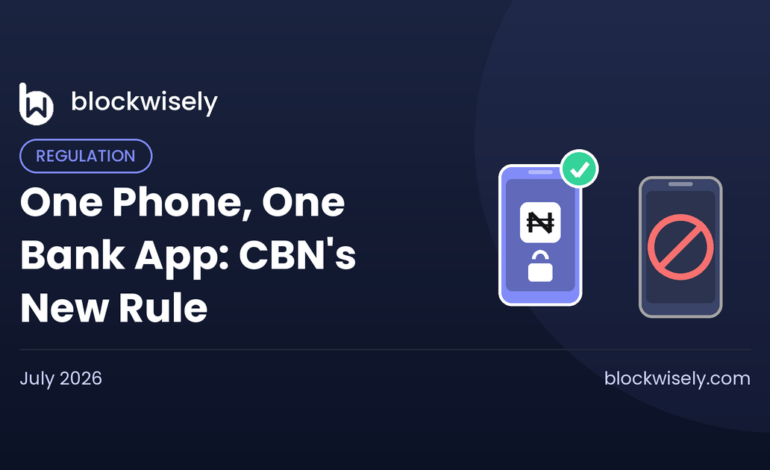
Since July 1, every banking and fintech app in Nigeria has been locked to a single phone. The CBN device binding rule, issued in a March 12 circular signed by Musa Jimoh, Director of the Payments System Policy Department, gave banks and payment providers 109 days to comply, and the deadline has now passed. One app, one device, no concurrent logins. Switch phones and the app must go through fresh activation and authentication before it works again, with a 20,000 naira transaction cap on the newly activated app for its first 24 hours.
For a market where OPay, Moniepoint, Kuda, PalmPay, and Paga alone serve an estimated 30 to 50 million people, this is one of the most consequential consumer banking changes in years. And for crypto users, whose naira on ramps and off ramps run straight through these same apps, it deserves close attention.
What the CBN device binding rule actually requires
The circular sets minimum standards for every institution offering instant payments. Mobile financial apps can be enabled on only one device at a time. Moving to a new device triggers automatic reactivation and authentication, and a newly activated app faces the 20,000 naira cap on both inflows and outflows for 24 hours. First time internet banking logins from a new device require additional multi factor authentication. Banks must run enterprise fraud monitoring that watches inflows and outflows in real time, and all online account opening or reactivation must pass a liveness check validated in real time against the BVN or NIN database.
There are user controls too. Customers can opt out of instant payments entirely for any period, subject to multi factor authentication, and can voluntarily adjust their own transaction limits within the existing ceilings of 25 million naira for individuals and 250 million naira for corporates.
The rule also does not stand alone. Since May 1, Nigerians can change the phone number linked to their BVN only once in a lifetime, BVN enrolment is now restricted to those 18 and above, and a BVN tied to a reported fraudulent transaction can be placed on a temporary 24 hour watchlist.
Why the CBN did this
The problem is real and expensive. Instant payments in Nigeria hit roughly 285 trillion naira in the first quarter of 2025 alone, and fraud grew with them. Data from the Financial Institutions Training Centre showed fraud losses jumping 603 percent year on year to 3.29 billion naira in that quarter, across more than 12,000 reported cases. SIM swap fraud and account takeovers, where a criminal hijacks your line or logs into your app from their own device, have drained billions from depositors. Device binding attacks that playbook directly: a stolen password is useless on a phone the bank does not recognise, and the 24 hour cap limits how much a fraudster can move even if they get through.
Two weeks into the rollout, there is no public evidence of the system wide disruption some feared. What has emerged instead is a slower, more deliberate experience for anyone changing phones, and a genuinely narrower path for the most common fraud methods.
The trade offs Nigerians are living with
The friction is not evenly distributed. Nigeria has over 172 million active mobile subscriptions, but phones here are lost, stolen, swapped, and replaced far more often than in wealthier markets, and many households share a single smartphone. The rule assumes stable, individual device ownership that many people simply do not have. Shared device families are being pushed toward USSD or branch visits. A trader who loses a phone on Friday, replaces it Saturday, and clears verification Sunday spends the weekend locked to a 20,000 naira ceiling while suppliers wait. And because device migration is validated against central BVN and NIN databases, any downtime there leaves banks with no separate path to approve a legitimate switch.
There is also the lifetime rule to respect: lose your SIM more than once and casually reassign your BVN number, and you can exhaust your single allowance for good.
What this means for crypto users
Here is the part that matters most for this audience. Nigerian crypto activity, especially peer to peer trading, depends on fintech and bank apps for the naira leg of almost every trade. When your OPay or Kuda app is stuck in a 24 hour, 20,000 naira window after a phone switch, your P2P settlement capacity is stuck with it. If you trade actively, a lost phone is no longer a minor inconvenience. It is a liquidity event.
Exchange apps themselves are regulated separately under the SEC crypto sandbox and VASP framework rather than this circular, but every ramp between naira and crypto passes through an institution that must now comply. Expect exchanges and P2P counterparties to feel the new rhythm of delayed settlements around device changes.
A few practical steps follow naturally. Keep the phone number on your BVN active and correct, because it is now nearly impossible to change twice. Never switch or reset your main banking device casually, and if you must, plan trades and transfers around the 24 hour cap rather than being surprised by it. Enable every authentication option your apps offer, since the rule rewards accounts that verify cleanly. And it is worth noting the deeper principle this episode teaches: in custodial systems, access is something institutions grant you, while a self custody wallet secured by a seed phrase moves with you across any device. That is not a reason to abandon banking apps, which now carry genuinely stronger fraud protection. It is a reason to understand what each kind of wallet actually promises.
Bottom line
The CBN device binding rule trades convenience for security, and two weeks in, the trade looks deliberate rather than chaotic. Fraudsters lose their easiest paths into Nigerian accounts, while honest users inherit new rituals around changing phones. For crypto users, the rule is a reminder that the fiat side of your portfolio has its own rules, its own friction, and its own single points of failure. Plan for them, and the new regime is manageable. Ignore them, and your next phone upgrade could freeze more than your group chats.
Sources