








Nigeria Crypto Regulation Enters New Phase Under CBN-Led Council


Nigeria crypto regulation is entering a more coordinated phase, with the Central Bank of Nigeria taking a central role in the country’s oversight of cryptocurrencies and other virtual assets.
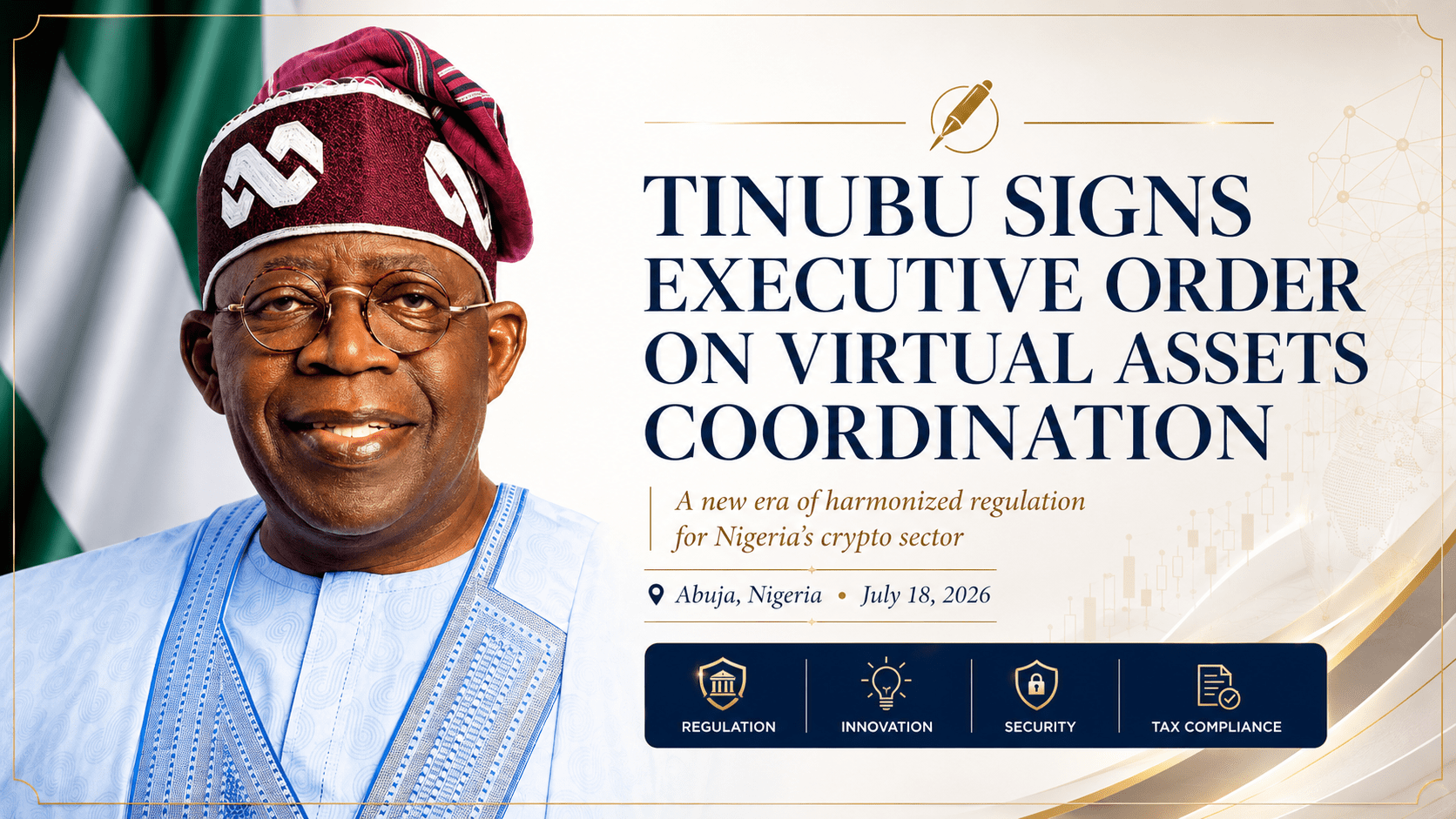
The Presidency announced on July 18, 2026, that President Bola Tinubu had signed the Presidential Executive Order on Virtual Assets Coordination, 2026. The order took immediate effect and established a framework for cooperation among Nigeria’s financial, capital-market, revenue and security agencies.
Rather than creating another regulator, the order establishes a Virtual Asset Council to coordinate the work of existing institutions. The CBN chairs the council, while the Nigeria Revenue Service and Securities and Exchange Commission serve as vice-chairs. The Nigerian Financial Intelligence Unit and Office of the National Security Adviser are also members.
CBN chairs the new Virtual Asset Council
The government introduced the council in response to regulatory gaps and overlapping responsibilities across different agencies.
Virtual assets can operate as investments, payment instruments, stores of value or tools for transferring funds. These different functions have made it difficult for a single regulator to oversee the entire sector.
According to the Presidency, the previous fragmented approach created opportunities for fraud, money laundering, terrorism financing, cybersecurity threats and revenue losses. The council will promote information sharing and develop a more consistent national policy without removing the independence of participating agencies.
A new Virtual Asset Office will handle the council’s daily operations. Its secretariat will sit within the CBN and coordinate applications, reporting and information sharing through a common supervisory technology platform.
This arrangement places the CBN at the operational centre of the framework. However, the central bank will not control every aspect of Nigeria crypto regulation.
How regulatory responsibilities will be divided
The new order follows an activity-based approach to registration.
The SEC will continue to oversee virtual assets and services that qualify as securities or capital-market products. The Investments and Securities Act 2025 expressly gives the SEC authority to regulate virtual and digital asset exchanges, Virtual Asset Service Providers and other digital asset operators.
The CBN will oversee payment, settlement, custody and related services involving virtual assets that do not fall within the securities category.
The Virtual Asset Council will help determine responsibility when an activity does not fit clearly within one regulator’s mandate. The Presidency said the framework coordinates existing powers instead of transferring them from one institution to another.
This distinction is important for exchanges, custodians, stablecoin companies, payment providers and other businesses. A company’s regulator will depend largely on the service it provides and the nature of the assets it handles.
Regulatory sandbox planned for virtual assets
The CBN is also preparing a regulatory sandbox for virtual-asset products and blockchain-based services.
The sandbox will allow eligible companies to test products under supervision before launching them across the wider market. Regulators will use the process to examine potential effects on financial stability, consumer protection, monetary sovereignty, market integrity, financial inclusion and government revenue.
The CBN has not yet published the sandbox’s full eligibility requirements or operating procedures. The Presidency said the bank would release further details separately.
Nigeria already has a similar initiative within the capital market. The SEC’s Accelerated Regulatory Incubation Programme allows selected digital-asset businesses to operate within a controlled environment while the commission evaluates their models and safeguards.
In July 2026, the SEC admitted GIGX Technologies and KuCoin Nigeria into the programme. Their approval-in-principle is conditional and does not amount to a final operating licence.
Nigeria shifts from restriction to supervised participation
Nigeria’s regulatory position has changed considerably since the CBN restricted banks from facilitating cryptocurrency transactions in 2021.
In December 2023, the CBN issued guidelines allowing regulated financial institutions to operate accounts for approved Virtual Asset Service Providers. The guidelines marked a move toward controlled access between the banking and digital-asset sectors.
The latest executive order advances that transition. It does not prohibit cryptocurrency ownership or introduce a blanket ban on trading. Instead, it creates clearer registration and supervision channels for companies operating within the sector.
However, the order does not make Bitcoin, stablecoins or other privately issued cryptoassets legal tender. The eNaira remains the CBN-issued digital form of Nigeria’s sovereign currency and has legal-tender status.
At the Nigeria Stablecoin Summit in Lagos, NRS official Oni Olushola said the framework would help regulators better understand how crypto companies operate while protecting participants and recognising the sector’s legitimate economic activity.
Why Nigeria’s crypto market matters
The government’s shift reflects the scale of cryptocurrency activity already taking place in Nigeria.
Nigeria ranked sixth in Chainalysis’ 2025 Global Crypto Adoption Index. It also ranked third globally for decentralised-finance activity under the report’s methodology.
Chainalysis estimated that Nigeria received more than $92.1 billion in on-chain value between July 2024 and June 2025. That made it Sub-Saharan Africa’s largest crypto market by a wide margin.
High adoption continued despite years of regulatory uncertainty. Stablecoins and Bitcoin have been used for investment, savings, international payments, commercial settlement and access to dollar-denominated value.
The new framework acknowledges that virtual-asset activity cannot be managed effectively through banking restrictions alone.
What the framework means for crypto businesses
The coordinated system could provide greater certainty for legitimate operators. However, it will also raise compliance expectations.
Companies serving Nigerian customers may face closer requirements concerning:
- Registration and minimum capital
- Customer identification and transaction monitoring
- Cybersecurity and asset custody
- Tax reporting and remittance
- Consumer complaints and disclosures
- Anti-money-laundering controls
- Cross-agency data sharing
The SEC has already introduced revised capital requirements for several digital-asset business categories. These include exchanges, custodians, token issuers and real-world asset tokenisation platforms. Affected operators have until June 30, 2027, to comply with the new capital rules.
The NRS is also expected to publish a dedicated virtual-asset tax policy. The Presidency said the policy would explain how existing tax laws apply to the sector and improve reporting certainty for businesses and taxpayers.
Implementation will determine the outcome
The executive order creates a clearer institutional structure, but its success will depend on implementation.
Businesses will need to know how applications move between regulators, how quickly agencies make decisions and what happens when services fall under more than one regulatory category.
Regulators must also avoid turning coordination into duplicated compliance. A company should not have to submit the same information repeatedly to several agencies simply because its services involve payments, securities and taxation.
The strongest outcome would be a system that removes uncertainty while maintaining effective safeguards against fraud and financial crime.
With the CBN chairing the Virtual Asset Council, Nigeria crypto regulation has moved toward centralised coordination. The next test is whether that structure can protect consumers, support responsible innovation and provide predictable rules for one of Africa’s most active digital-asset markets.
Sources
- Presidential Executive Order on Virtual Assets Coordination
- CBN guidelines for VASP bank accounts
- SEC Accelerated Regulatory Incubation Programme
- Chainalysis Global Crypto Adoption Index
- Chainalysis Sub-Saharan Africa report
- Blockwisely