








AI and Blockchain: How AI and Blockchain Enable Decentralized AI

The Convergence of AI and Blockchain
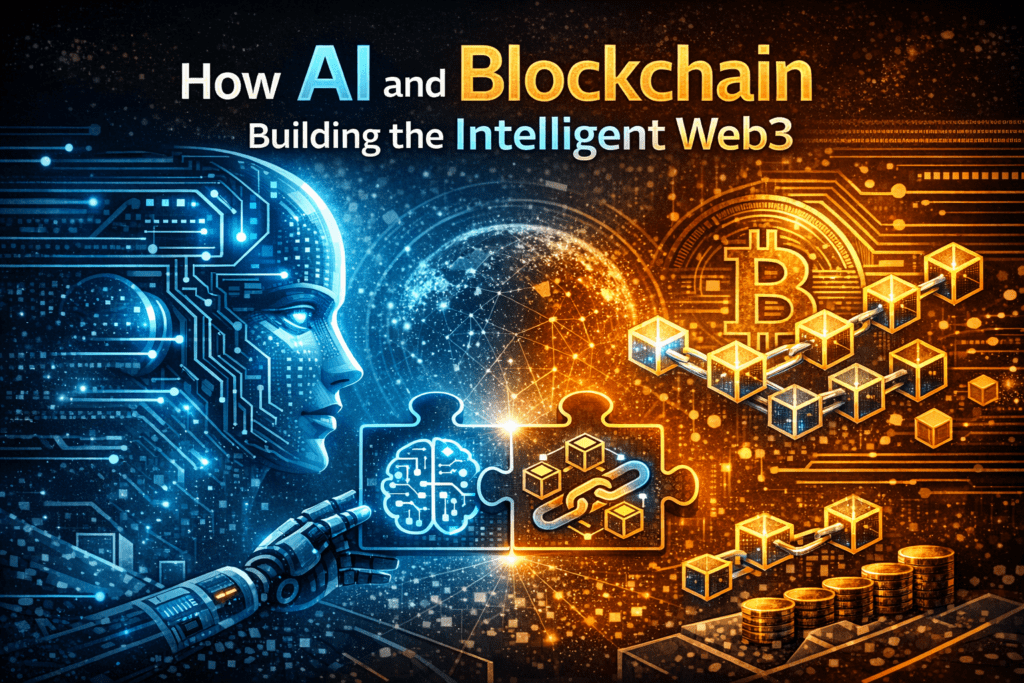
Two of the most transformative technologies of our time, Artificial Intelligence (AI) and blockchain are beginning to merge in ways that could redefine the internet.
AI is changing how machines process data, make predictions, and automate complex decisions.
Blockchain is changing how we establish trust, ownership, and transparency online.
Individually, these technologies are powerful.
But together, they unlock something much bigger: decentralized intelligence.
This convergence is already shaping the future of Web3, enabling decentralized AI marketplaces, autonomous digital agents, and entirely new economic models.
And while the idea once sounded futuristic, developers are already building it.
Why AI and Blockchain Are a Powerful Combination
Both technologies solve different problems.
AI excels at learning from data, recognizing patterns, and making predictions.
Blockchain excels at verification, transparency, and decentralized coordination.
But each also has limitations.
AI’s biggest challenges
- Centralized control by major tech companies
- Lack of transparency in decision-making
- Data ownership issues
- Privacy concerns
Blockchain’s biggest challenges
- Limited computational intelligence
- Rigid smart contracts
- Difficulty adapting to dynamic conditions
This is where the combination becomes powerful.
Blockchain can provide verifiable trust layers for AI systems, while AI can bring intelligence and automation to blockchain networks.
The result is a new category of technology: Decentralized AI.
What Is Decentralized AI?
Decentralized AI refers to artificial intelligence systems that operate on blockchain-based infrastructure instead of centralized servers.
Instead of one company controlling the models, data, and infrastructure, decentralized networks allow:
- developers to contribute AI models
- users to access AI services
- contributors to earn rewards for data or computation
This shifts AI from corporate ownership to open networks.
Several projects are already exploring this model.
Examples include:
- SingularityNET — a marketplace for AI algorithms
- Ocean Protocol — a data economy for training AI models
- Bittensor — a network where machine learning models collaborate and compete
These platforms aim to create open AI ecosystems instead of centralized AI monopolies.
Autonomous AI Agents in Web3
Another area where AI and blockchain intersect is the rise of autonomous AI agents.
These agents are AI-powered software systems that can interact with blockchain networks independently.
For example, AI agents could:
- manage crypto portfolios
- execute trades automatically
- coordinate logistics in decentralized marketplaces
- negotiate transactions with other agents
Projects like Fetch.ai are already exploring this concept.
In the future, users might have personal AI agents managing their digital identities, investments, and online services.
The Human-AI Collaboration Economy
While AI automation is expanding rapidly, one reality remains clear:
AI still needs human intelligence.
Humans provide creativity, judgment, contextual understanding, and specialized knowledge that AI systems often lack.
This is where emerging concepts like RentAHuman become interesting.
The idea behind platforms like RentAHuman is simple:
Create decentralized marketplaces where human intelligence and AI systems collaborate.
In this model:
- Humans provide expertise, creative input, or training data
- AI handles automation and scale
- Blockchain ensures trust, payments, and reputation systems
This could create an entirely new hybrid intelligence economy where humans and machines work together across decentralized networks.
Industries that could benefit include:
- AI training and data labeling
- digital consulting
- creative production
- decentralized freelancing
- AI supervision and verification
Instead of replacing human workers, these systems could augment human intelligence at scale.
AI-Powered Smart Contracts
Smart contracts are one of blockchain’s most important innovations.
However, traditional smart contracts follow fixed rules.
They cannot adapt or learn.
AI introduces the possibility of intelligent smart contracts.
Imagine contracts that can:
- analyze market conditions before executing trades
- adjust insurance premiums based on risk analysis
- optimize supply chain operations in real time
These systems could dramatically expand the real-world applications of blockchain technology.
AI in Decentralized Finance (DeFi)
AI is also beginning to influence Decentralized Finance (DeFi).
Machine learning models can analyze massive amounts of financial data and identify patterns humans might miss.
Possible applications include:
- predictive trading algorithms
- automated portfolio optimization
- fraud detection in DeFi protocols
- smarter lending risk models
Projects like Numerai already use crowdsourced machine learning models to improve financial strategies.
As DeFi evolves, AI could become a core layer of financial automation.
Infrastructure Powering Decentralized AI
Building decentralized AI requires massive computational power.
New blockchain infrastructure networks are emerging to support this demand.
Examples include:
- Render Network — distributed GPU power for AI and rendering
- Bittensor — collaborative machine learning networks
- Alethea AI — interactive AI-powered NFTs
These projects aim to decentralize the computing layer of AI itself.
Challenges of AI and Blockchain Integration
Despite the excitement, the convergence of AI and blockchain still faces significant challenges.
Scalability
AI computations require massive processing power that many blockchain networks currently struggle to support.
Energy Consumption
Both AI training and blockchain operations can be resource-intensive.
Regulation
Governments are still figuring out how to regulate both technologies separately, let alone together.
Data Quality
Blockchain can verify data authenticity, but it cannot guarantee that the data itself is accurate.
The Future of AI and Blockchain in Web3
Despite these challenges, the intersection of AI and blockchain is one of the most promising frontiers in technology.
Over the next decade, we may see:
- decentralized AI model ownership
- personal AI agents managing digital assets
- AI-powered DAO governance systems
- cross-chain AI infrastructure networks
- human-AI collaboration economies
As Web3 evolves, intelligence may become decentralized just like finance and ownership.
Final Thoughts
The convergence of AI and blockchain is more than a technological trend.
It represents a shift toward a new type of internet, one where intelligence, trust, and economic coordination operate without centralized control.
AI provides the brains.
Blockchain provides the trust layer.
Together, they form the foundation of decentralized intelligence.
And the systems being built today could become the backbone of tomorrow’s digital economy.