








Crypto Trader Loses Nearly $50 Million in Aave Swap Mishap, Protocol Offers $600K Refund

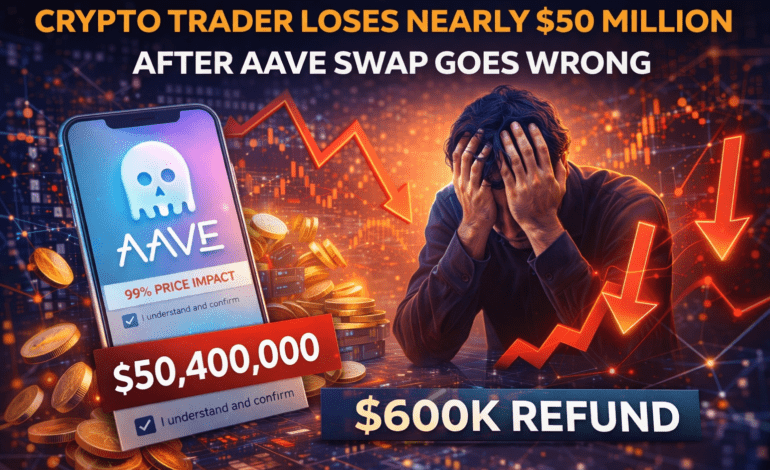
A cryptocurrency trader lost almost $50 million after executing a massive token swap on the decentralized finance platform Aave, highlighting the risks of large trades in decentralized markets.
The incident occurred on March 12, 2026, when an anonymous wallet attempted to swap tens of millions of dollars worth of stablecoins into AAVE governance tokens. Due to extreme slippage and thin liquidity pools, the trader ended up losing nearly the entire value of the trade.
In response, Aave’s team later offered a $600,000 refund in transaction fees, a rare gesture in the decentralized finance ecosystem where users typically bear full responsibility for their transactions.
The $50 Million DeFi Trade That Went Wrong
The incident began when the trader deposited $50.4 million worth of USDT, the stablecoin issued by Tether (USDT), into the Aave platform.
According to blockchain data from Etherscan, the wallet had received the funds from the cryptocurrency exchange Binance roughly 20 days before the trade.
The trader then attempted to swap the funds into AAVE tokens through Aave’s interface. The transaction was routed through CoW Swap, a decentralized exchange aggregator designed to find optimal trading routes across multiple liquidity pools.
However, the large trade size collided with limited liquidity, turning the swap into a costly mistake.
Breaking Down the Transaction
On-chain data shows the trade unfolded in three major steps across multiple decentralized exchanges.
Step 1: Converting aEthUSDT to USDT
First, the trader converted 50.43 million aEthUSDT (Aave’s interest-bearing version of USDT) back into regular USDT.
This step occurred without significant losses.
Step 2: USDT Swapped to WETH
Next, the trader swapped the USDT for 17,958 WETH (Wrapped Ether) through Uniswap V3.
This single transaction caused approximately $13.36 million in slippage losses.
Step 3: WETH Swapped to AAVE
Finally, the WETH was swapped for just 324 AAVE tokens on SushiSwap, resulting in another $37 million loss.
In total, the trader received AAVE tokens worth only about $36,100, representing a 99.9 percent loss on the original $50.4 million.
The entire transaction took only seconds, demonstrating how quickly trades execute on blockchain networks.
Aave Displayed a Slippage Warning
Before the transaction was finalized, the Aave interface displayed a warning indicating that the trade would have 99 percent price impact due to extraordinary slippage.
To continue, the trader had to manually confirm the warning by checking a confirmation box.
Reports suggest the trade may have been executed from a mobile device, possibly making it easier to overlook the warning.
Aave Responds With a Fee Refund
Following the incident, Stani Kulechov, founder of Aave, addressed the situation publicly.
Kulechov explained that the protocol functioned as intended and that the warning message had clearly indicated the risks.
However, he also expressed sympathy for the trader and announced that the platform would refund approximately $600,000 in fees collected from the transaction.
While the refund represents only a small portion of the total loss, it is unusual for DeFi platforms to return fees in such situations.
Kulechov also said the team is researching improvements to the user interface that could help prevent similar mistakes in the future.
Crypto Community Reaction
The incident quickly sparked debate across the crypto community on X (formerly Twitter).
Some users expressed sympathy for the trader, pointing out how devastating such a loss could be.
Others argued that the trader ignored clear warnings and therefore bears full responsibility for the outcome.
Some analysts also questioned whether DeFi interfaces should include additional safeguards for extremely large trades.
The debate reflects a broader question within decentralized finance: how to balance user responsibility with platform protections.
A Reminder of Liquidity Risks in DeFi
The incident highlights one of the biggest risks in decentralized finance: liquidity limitations in decentralized exchanges.
Platforms like Uniswap and SushiSwap rely on liquidity pools rather than traditional order books.
When extremely large trades are executed against shallow pools, the resulting slippage can dramatically distort prices.
Although aggregators like CoW Swap try to route trades through the best available pools, they cannot always prevent losses when liquidity is insufficient.
Lessons for Crypto Traders
For traders dealing with large positions, the incident highlights several important lessons.
- Large trades should often be split into smaller transactions.
- Over-the-counter (OTC) desks may be safer for very large swaps.
- Liquidity depth should be checked before executing major trades.
- Slippage warnings should never be ignored.
As decentralized finance continues to evolve, incidents like this may push platforms to build better safeguards without compromising decentralization.
For now, the anonymous trader’s story stands as a stark reminder that in DeFi, transactions are irreversible and mistakes can be extremely expensive.