








Is Bitcoin Doomed If Miners Struggle?


It is a scary question, especially when you see mining companies shutting down or complaining about profits.
If you have been following crypto for a while, you may have seen claims that Bitcoin is heading for failure because mining is becoming too expensive.
Some argue that mining companies are struggling. Margins are shrinking. Energy costs are rising. Transaction fees are not high enough to replace block rewards. Therefore, Bitcoin is doomed.
That sounds serious.
But is it true?
In this article, we will answer these simple questions:
- What do Bitcoin miners actually do?
- What happens if mining becomes unprofitable?
- Does Bitcoin depend on mining companies to survive?
- Can transaction fees eventually replace block rewards?
- Is Bitcoin really at risk if miners struggle?
Let’s break it down step by step.
What Do Bitcoin Miners Actually Do?
Bitcoin miners are not just people trying to earn coins. They secure the network.
Miners use powerful machines to:
- Verify transactions
- Bundle them into blocks
- Compete to add the next block to the blockchain
When a miner wins, they receive:
- A block reward, which is newly created Bitcoin
- Transaction fees from users
This system was first described in Bitcoin: A Peer-to-Peer Electronic Cash System by Satoshi Nakamoto in 2008. The whitepaper explains how miners help prevent double spending and secure the network without needing a central authority.
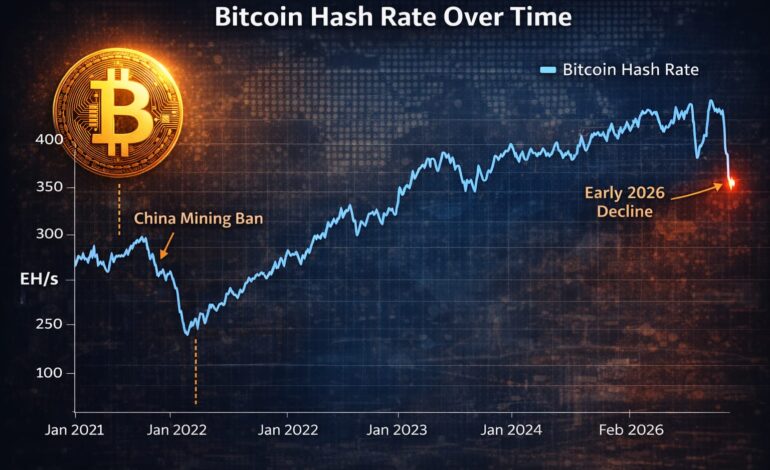
The total computing power used by miners is called hash rate. The higher the hash rate, the harder it is to attack the network.
What Happens If Mining Becomes Unprofitable?
Mining is a business.
Miners have expenses:
- Electricity
- Hardware
- Maintenance
- Staff
If the price of Bitcoin falls too low, or if competition becomes too intense, some miners may operate at a loss.
When that happens, weaker miners shut down.
But here is the important part.
Bitcoin automatically adjusts its mining difficulty about every two weeks. If many miners leave:
- Difficulty decreases
- Remaining miners earn more per machine
- Profitability improves
This mechanism is built directly into Bitcoin’s code and described in the original design.
Bitcoin does not need every miner to be profitable. It only needs enough miners to secure the network.
Do Mining Companies Equal Bitcoin?
No.
Mining companies are businesses. Bitcoin is a protocol.
A company may struggle during a bear market. That does not mean Bitcoin itself fails.
If large miners go bankrupt:
- Their machines are sold
- New miners buy them at cheaper prices
- The network continues
We saw this during the 2022 crypto downturn. Several mining firms faced financial stress, yet Bitcoin kept producing blocks every ten minutes on average.
Businesses can fail. The protocol keeps running.
What About Security?
If many miners leave at once, hash rate drops.
A lower hash rate can theoretically make the network easier to attack. But in practice, Bitcoin’s network is extremely large.
After China banned mining activities in 2021, hash rate dropped sharply. The ban was enforced by authorities including the People’s Bank of China.
However, mining activity relocated to other countries. According to research from the Cambridge Centre for Alternative Finance, Bitcoin mining redistributed globally rather than disappearing.
Today, data tracked by Coin Metrics shows that Bitcoin’s hash rate remains near historical highs.
Security did not collapse. The network adjusted.
The Real Concern: Block Rewards vs Fees
Here is the deeper issue.
Bitcoin miners are currently paid mostly through block rewards. Every four years, this reward is cut in half in an event called the halving.
Over time:
- Block rewards shrink
- Eventually, no new Bitcoin will be created
- Miners will rely mostly on transaction fees
Critics argue that transaction fees are not high enough to sustain miners in the future.
That is a fair concern.
However, several factors matter:
- Bitcoin’s price may rise over time
- Increased adoption may increase fee demand
- Bitcoin may function as a high value settlement network
- Layer 2 systems like the Lightning Network can scale payments while still relying on the base layer for final settlement
The transition from block rewards to fees is gradual. It will take decades, not years.
We are not near the end of mining incentives yet.
Has This Happened Before?
Yes.
Bitcoin mining has gone through many difficult periods:
- 2014 after the Mt. Gox collapse
- 2018 after the ICO bubble burst
- 2022 during the broader crypto crash
Each time:
- Mining became unprofitable for some
- Miners shut down
- Difficulty adjusted
- The network stabilized
On-chain data from Glassnode shows that miner capitulation events have occurred during previous bear markets, often near market bottoms.
Historically, stress in mining has not led to the end of Bitcoin.
Could Bitcoin Actually Fail?
In theory, yes.
If:
- Bitcoin’s price collapsed permanently
- Almost all miners left
- No one stepped in to mine
Then security would weaken significantly.
But as long as Bitcoin has value, someone will mine it.
Mining is competitive. If many miners leave, it becomes easier and more profitable for those who remain.
The system is designed to self-correct.
So Is Bitcoin Doomed If Miners Struggle?
Short answer: no.
Mining companies can struggle. Bitcoin can continue.
Mining profitability rises and falls with price cycles. That does not automatically mean the protocol itself is broken.
The real long-term debate is whether transaction fees will eventually provide enough incentive once block rewards shrink significantly.
That is an open economic question.
But it is a long-term question, not an immediate crisis.
For now:
- The network is secure
- Hash rate remains historically strong
- Difficulty adjustment protects stability
- Mining continues globally
Bitcoin was built to survive stress.
When you see claims that mining struggles mean Bitcoin is doomed, remember this:
Companies operate on business cycles.
Markets move in waves.
Bitcoin adjusts automatically.
The protocol keeps running.