








Bitcoin’s Open Door: Can African Miners Outrun Local Hurdles?

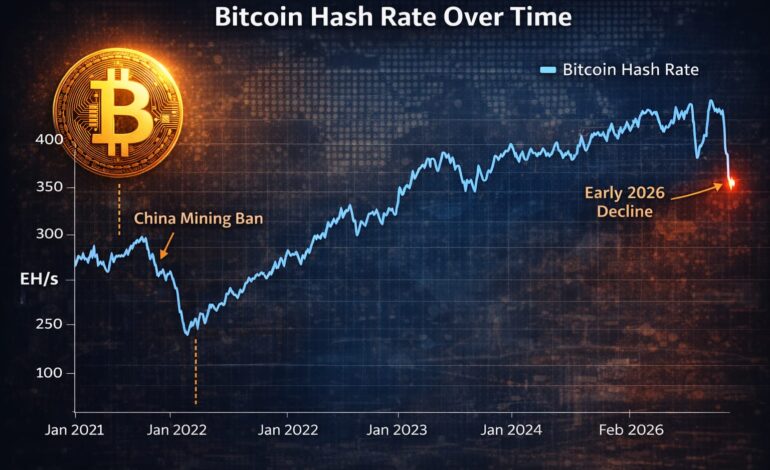
Bitcoin’s network has just undergone one of its sharpest difficulty adjustments in years. For African operators, from Gridless in Kenya to Phoenix Group in Ethiopia and Tech Hut in South Africa : the question now is: Is Bitcoin mining still profitable, and can Africa remain competitive as the global race tightens?
In late January and early February 2026, Bitcoin’s total hashrate saw a notable decline. While this is not the first time(similar volatility occurred after the 2021 China mining ban) the move reflects structural pressure in the mining industry, triggering a downward difficulty adjustment on February 7.
Bitcoin mining difficulty currently stands at 125.86 T, effective from block 935,429, according to CoinWarz. The network’s average block time is roughly 9.47 minutes, just below the 10-minute target.The next difficulty adjustment, expected on February 20, is projected to increase by approximately 5.63%, reaching 132.96 T, CoinWarz data indicates.
Why Did the Hashrate Drop?
Three main factors converged:
1. Price Compression
After trading above $120,000 in late 2025, Bitcoin retraced into the $60,000–$70,000 range in early 2026. When price falls but electricity and operational costs remain constant, high-cost operators , often called “marginal miners” are forced to shut operations.Mining is a thin-margin business. Operators paying more than $0.06–$0.08 per kWh often struggle during price drawdowns, especially after the 2024 halving reduced block rewards from 6.25 BTC to 3.125 BTC.
2. Energy Disruptions
Large mining hubs in Texas temporarily curtailed operations due to winter grid stress events. The U.S. remains one of the largest global mining centers, so regional disruptions can visibly impact network hashrate.
3. Difficulty Adjustment
Bitcoin approximately adjusts its mining difficulty every two weeks (every 2,016 blocks) to maintain an average block time of ten minutes.When hashrate drops, difficulty follows. This reduces competition among remaining miners and slightly improves profitability for efficient operators.
Africa’s Position: Still Small, But Growing
Africa is estimated to contribute 5% of global Bitcoin hashrate, still modest compared to North America and parts of Asia, but meaningfully higher than two years ago.
Ethiopia
Ethiopia has climbed to 8th globally, capturing 2.6% of the world’s Bitcoin hashrate, powered by the Grand Ethiopian Renaissance Dam (GERD). Firms like Phoenix Group and BIT Mining are scaling up,but the “cheap power” story is changing.
- End of Flat Rates: The $0.03/kWh flat rate ended in Dec 2025.
- Time-of-Use Shock: Peak-hour power now costs $0.06/kWh, nearly double previous rates.
- Regulatory Freeze: No new mining permits since mid-2025; growth comes from scaling existing facilities.
- State-Backed Mining: Ethiopia is seeking partners for nationalized mining projects, signaling a shift from selling power to owning Bitcoin.
Ethiopia is Africa’s industrial mining leader,but centralized, state-driven policies make it a high-reward, high-risk environment compared to Kenya’s decentralized model.
Kenya
In Kenya, smaller-scale mining experiments have focused on “stranded energy,” remote hydro or solar generation not fully integrated into the national grid. Companies like Gridless deploy modular units in rural areas, monetizing excess energy while supporting local infrastructure.
Marathon Digital Holdings has also entered the space, partnering with the Ministry of Energy to leverage geothermal excess for Bitcoin mining. This adds a large-scale, grid-stabilizing dimension to Kenya’s energy optimization thesis.
Kenya is not a global mining heavyweight, but it represents a different thesis: mining as energy optimization rather than industrial speculation.
South Africa
South Africa has active Bitcoin circular economy experiments such as Bitcoin Ekasi, where Bitcoin is used directly in communities. Mining itself is less dominant due to higher grid costs, but adoption at the retail layer is notable. Other markets in Africa are Nigeria,DR Congo and Malawi.
The Risks
Regulatory Uncertainty
Only a handful of African countries have clearly defined frameworks for large-scale Bitcoin mining. Sudden tax changes, power pricing revisions, or outright restrictions remain possible.
Energy Politics
In regions facing energy poverty, public perception matters. If communities believe mining diverts power from households or industry, political backlash can follow.
Hardware and E-Waste
ASIC machines have limited economic lifespans. Without local refurbishment or recycling ecosystems, Africa risks becoming a secondary market for aging hardware.Mining rewards efficiency.
Is Mining Still Profitable?
Profitability in 2026 depends almost entirely on three variables:
- Electricity cost
- Hardware efficiency (e.g., next-generation ASICs)
- Access to capital and stable regulation
For operators with electricity below $0.05 per kWh and modern equipment, the recent difficulty drop improves margins. For anyone above $0.08 per kWh using older rigs, break-even remains tight.
The Bitcoin Circular Economy: Africa’s More Durable Play?
While large-scale mining draws headlines, Africa’s more sustainable Bitcoin story may lie elsewhere.
In parts of Kenya and South Africa, Bitcoin is used in small but growing “circular economies”:
- Workers paid in sats via Lightning
- Merchants accepting Bitcoin directly
- Local value circulating without immediate fiat conversion
This model reduces remittance friction, minimizes banking fees, and offers some insulation from currency volatility, though it introduces Bitcoin’s own price risk.
The key distinction: mining extracts value from energy. Circular economies retain value within communities.
For Africa, the opportunity exists, particularly where renewable energy is abundant and underutilized. But mining alone will not transform economies.
The hard question is this:
Can Africa use Bitcoin to build resilient local economies around energy, payments, and financial sovereignty?