









Leverage 1:101: What It Is and How It Really Works

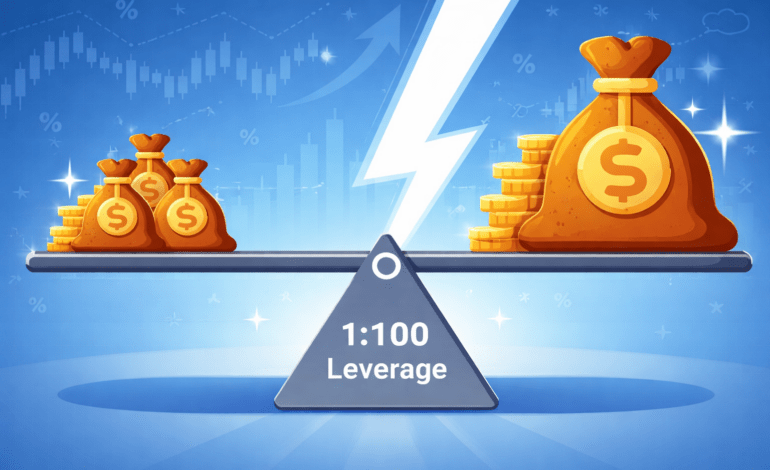
If you are learning about forex, crypto, or trading in general, one word keeps coming up: leverage.
People talk about it confidently:
- “I’m using 1:100 leverage”
- “Leverage is how you grow a small account”
- “Without leverage, profits are too small”
At the same time, you’ll also hear warnings:
- “Leverage will wipe your account”
- “That’s how beginners lose money”
So what is the truth?
In this article, we’ll answer these questions clearly and simply:
- What is leverage?
- How does it work in real trades?
- How much do you gain or lose when price moves by 5%?
- Is leverage a loan?
- Can you withdraw leveraged money?
- Can everyone get leverage?
- How does leverage affect trading fees?
- When does it make sense to use leverage?
The basic idea of leverage
Leverage means trading with more money than you actually have.
That’s it.
When you use leverage, the trading platform allows you to open a position that is bigger than your account balance. You are not being given free money. You are being allowed to control a larger trade.
Your own money acts as a security deposit, often called margin.
A simple starting example (no leverage)
Let’s start without leverage so things are clear.
Imagine you have KSh 10,000.
You open a trade worth KSh 10,000.
Now imagine the price of what you are trading moves by 5%.
If price goes UP by 5%
- 5% of KSh 10,000 = KSh 500
- You gain KSh 500
If price goes DOWN by 5%
- You lose KSh 500
Simple. Clean. Easy to understand.
Now let’s introduce leverage
Now imagine you still have KSh 10,000, but you use 1:10 leverage.
This means:
- Your KSh 10,000 allows you to open a trade worth KSh 100,000
You are still only risking your KSh 10,000 but the trade size is much larger.
Example 1: A 5% win using leverage
You open a trade worth KSh 100,000
The price goes UP by 5%
- 5% of KSh 100,000 = KSh 5,000
Result:
- You started with KSh 10,000
- You gain KSh 5,000
- That is a 50% gain on your account
This is why leverage feels attractive.
Small price moves suddenly produce big results.
Example 2: A 5% loss using leverage
Same trade:
- Trade size: KSh 100,000
- Your money: KSh 10,000
- Price goes DOWN by 5%
- 5% of KSh 100,000 = KSh 5,000
Result:
- You lose KSh 5,000
- Half your account is gone
If the price drops 10%, your entire KSh 10,000 is wiped out.
This is how accounts disappear quickly not because the market moved a lot, but because the trade size was large.
Why leverage feels confusing to beginners
Beginners often think:
“I only deposited a small amount, so my risk is small.”
But the market doesn’t care how much you deposited.
It reacts to the size of the trade.
Leverage changes the size of the trade — not the risk of the market.
Is leverage a loan?
Not in the normal sense.
You are not receiving money into your wallet that you can spend or withdraw. The platform is simply allowing you to open a larger position.
Think of it like this:
- You are allowed to drive a bigger vehicle
- But you don’t own the extra engine
Your money is locked as long as the trade is open.
Can you withdraw leveraged money?
No.
You can only withdraw:
- your own funds
- plus any profits (after the trade is closed)
The leveraged portion:
- cannot be withdrawn
- cannot be transferred
- disappears the moment the trade is closed
It exists only inside the trade.
Can everyone get leverage?
Usually, yes but the amount depends on:
- the platform
- the market (forex, crypto, stocks)
- regulations in different regions
Forex platforms often offer high leverage by default.
Crypto platforms usually make leverage optional.
Just because leverage is available does not mean it must be used.
How does leverage affect trading fees?
This part is often overlooked.
Trading fees are calculated on the total trade size, not on your deposit.
So:
- bigger trade = higher fees
- higher leverage = bigger trade
Even if the price doesn’t move much, fees can slowly eat into your account if you trade large positions often.
Leverage magnifies fees just like it magnifies profits and losses.
When is it better to use leverage?
Leverage is better used when:
- you already understand risk management
- you use stop losses properly
- you are trading with a clear plan
- you accept small, controlled losses
Leverage is dangerous when:
- you are chasing fast profits
- you are emotional
- you are trying to recover losses
- you don’t fully understand position size
For beginners, lower leverage is almost always better.
A better way to think about leverage
Instead of asking:
“How much leverage can I use?”
Ask:
“How much am I willing to lose if this goes wrong?”
Professional traders think in risk percentages, not leverage numbers.
Leverage is a tool to express risk, not a shortcut to skill.