




What Is a Blockchain Oracle? How It Works, Types, and Real-World Examples

Imagine placing a bet on a football match using a blockchain application. You predict that Arsenal will beat Chelsea, and your friend predicts the opposite. Both of you deposit money into a smart contract, which promises to automatically pay the winner when the match ends.
But there is a problem.
The smart contract cannot watch the football match. It cannot open a sports website to check the final score. It cannot even tell whether the match has ended.
So, how does it know who won and who should receive the money?
This is where a blockchain oracle comes in.
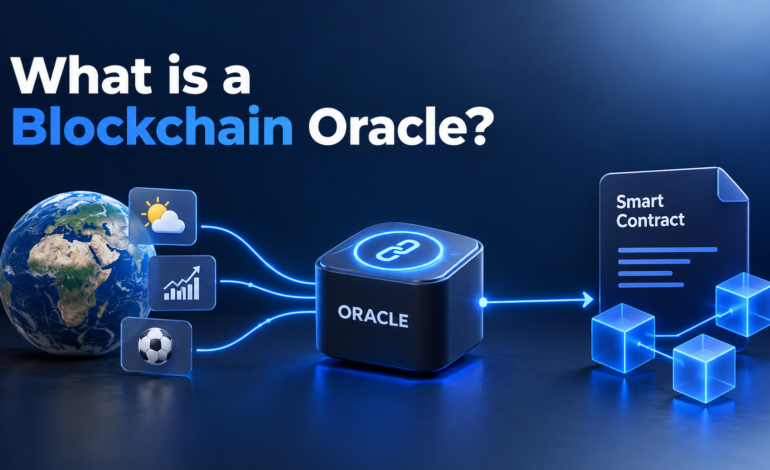
A blockchain oracle connects blockchains to information from the outside world. It helps smart contracts access information such as cryptocurrency prices, football scores, weather conditions, bank payment confirmations, and much more.
Without oracles, many of the blockchain applications we use today would be far less useful.
In this guide, we will explain what blockchain oracles are, how they work, why they are important, their different types, and the risks you should understand.
What Is a Blockchain Oracle?
A blockchain oracle is a technology that connects a blockchain to information, services, and systems outside the blockchain.
Think of it as a messenger between a blockchain and the real world.
For example, a blockchain oracle can provide information about:
- The current price of Bitcoin or Ethereum.
- The result of a football match.
- Whether a flight has been delayed.
- The amount of rainfall in a particular area.
- Whether a shipment has reached its destination.
- Whether a payment has been completed through a traditional banking system.
A blockchain oracle can collect this information, check or process it, and make it available to a smart contract.
Some oracles also work in the opposite direction. They can take instructions from a blockchain and send them to external systems.
In simple terms, a blockchain oracle allows smart contracts to interact with information and systems beyond their own blockchain.
However, an oracle does not automatically guarantee that the information it provides is correct. Its reliability depends on where the information comes from and how the oracle is designed.
Why Do Blockchains Need Oracles?
To understand why oracles are important, we first need to understand a limitation of blockchain technology.
Blockchains cannot directly access information outside their networks
Imagine having a calculator that can perform calculations perfectly but cannot connect to the internet.
You can enter numbers, and the calculator will give you accurate answers. However, if you ask it for the current price of Bitcoin, it will not know.
You must first provide that information.
Blockchains work somewhat similarly.
A blockchain stores information and allows computers across its network to agree on transactions and results.
For example, a blockchain can verify that:
- A wallet has enough cryptocurrency to complete a transaction.
- A transaction has been signed correctly.
- A user has transferred tokens to another wallet.
- A smart contract’s conditions have been satisfied using information already available on the blockchain.
However, blockchain smart contracts cannot normally go online and retrieve information from external websites or databases by themselves.
This limitation is intentional.
If every computer validating a blockchain transaction independently requested live information from the internet, they might receive different answers.
For example, imagine several computers checking the price of Bitcoin at slightly different times.
One computer might find a price of $70,000, another $70,010, and another $69,990.
Which price should the blockchain accept?
Without a reliable way to agree on external information, different computers could reach different conclusions about the same smart contract.
This would create serious problems for a system that depends on consistent results.
Oracles provide a way for external information to be delivered to smart contracts in a form they can use.
What Is a Smart Contract?
Before explaining how oracles work, it helps to understand smart contracts.
A smart contract is a computer program stored on a blockchain that automatically performs actions when certain conditions are met.
Consider a simple agreement between two people.
Alice agrees to pay Bob $100 if it rains in Nairobi tomorrow.
Instead of relying on Alice to manually send the money, they create a smart contract.
The contract contains two instructions:
- If it rains in Nairobi tomorrow, send $100 to Bob.
- If it does not rain, return the money to Alice.
The smart contract can automatically handle the payment.
But there is one problem.
How will the smart contract know whether it rained in Nairobi?
It cannot independently check the weather.
An oracle can obtain rainfall data from a weather service or measuring station and provide that information to the contract.
The smart contract then uses the information to determine what happens to the money.
This illustrates the relationship between smart contracts and oracles.
The smart contract contains the rules, while the oracle supplies the external information needed to apply those rules.
How Does a Blockchain Oracle Work?
A blockchain oracle generally works by collecting information from outside a blockchain and making it available to a smart contract.
The exact process depends on the oracle system, but the basic steps are similar.
Step 1: A smart contract needs external information
Imagine a decentralized lending platform that allows users to borrow money using Ethereum as collateral.
Collateral is something valuable that a borrower deposits to secure a loan.
To determine how much a user can borrow, the platform needs to know the current price of Ethereum.
The smart contract cannot independently check cryptocurrency exchanges, so it needs external price data.
Step 2: The oracle obtains the information
The oracle gets the required information from one or more external sources.
For cryptocurrency prices, these sources might include exchanges, professional market data providers, or other financial data services.
The information is generally retrieved using an Application Programming Interface, commonly called an API.
An API is a tool that allows different software systems to communicate and exchange information.
Step 3: The oracle processes or checks the data
Depending on its design, the oracle may compare information from multiple sources.
For example, imagine three independent market data sources report the following Ethereum prices:
| Source | ETH price |
|---|---|
| Source A | $3,000 |
| Source B | $3,005 |
| Source C | $2,995 |
These figures are hypothetical.
An oracle network could calculate the median price, which is $3,000.
The median is the middle value after arranging numbers from lowest to highest.
Using multiple sources can help reduce dependence on one inaccurate or manipulated source.
However, not all oracles use multiple sources, and different networks use different methods to combine and validate information.
Step 4: The information reaches the blockchain
Once the oracle has prepared the information, it can publish the result to the blockchain.
The smart contract can then read the data.
In some systems, oracle information is published regularly, even without a new request from a smart contract.
In others, a user or application brings previously prepared oracle data onto the blockchain when it is needed.
Step 5: The smart contract takes action
The lending platform receives the Ethereum price and uses it to calculate the value of the borrower’s collateral.
Depending on the contract’s rules, it might approve a loan, require additional collateral, or liquidate a risky position.
Liquidation means selling or taking control of collateral when the conditions of a loan are no longer satisfied.
The smart contract follows its programmed rules using the information supplied by the oracle.
A simple summary
The process looks like this:
Real-world data → Oracle → Blockchain → Smart contract → Action
The important thing to understand is that the oracle provides the information, while the smart contract decides what to do with it.
What Is the Blockchain Oracle Problem?
The oracle problem is one of the biggest challenges associated with connecting blockchains to external information.
It raises an important question:
How can a blockchain use information from the outside world without introducing an unreliable or easily manipulated source of information?
Blockchains are designed to reduce the need for trusting a single person or organization.
For example, on a decentralized blockchain, many independent computers participate in validating transactions.
However, imagine a smart contract that depends entirely on information supplied by one company.
Even if the blockchain itself is secure, that company could provide inaccurate information, suffer an outage, or become compromised.
The smart contract could then make the wrong decision.
Example: A manipulated cryptocurrency price
Imagine a lending platform that uses Bitcoin as collateral.
A borrower has deposited Bitcoin worth $10,000.
The platform uses an oracle to monitor Bitcoin’s price.
Now suppose an attacker manages to make the oracle report that the Bitcoin is worth only $5,000, even though its actual market value has not fallen that much.
The smart contract might conclude that the borrower no longer has enough collateral.
It could automatically liquidate the borrower’s position.
The blockchain may execute the smart contract exactly as programmed, but the result is still harmful because the information was wrong.
This teaches us an important lesson:
A secure blockchain cannot automatically make inaccurate external information trustworthy.
The Ethereum documentation on oracles explains why smart contracts need external data and the security challenges this introduces.
Similarly, Chainlink’s explanation of the oracle problem describes how unreliable external information can undermine otherwise secure blockchain applications.
What Are the Different Types of Blockchain Oracles?
Not every blockchain oracle works in the same way.
Oracles can be grouped according to the information they collect, the direction in which they move data, and how they are managed.
Here are the main types.
1. Software Oracles
Software oracles collect information from digital sources.
These sources can include websites, databases, APIs, and online financial services.
For example, a software oracle might obtain:
- Cryptocurrency prices from market data providers.
- Football results from sports databases.
- Flight information from airline systems.
- Exchange rates from financial data services.
- Weather forecasts from meteorological services.
Software oracles are widely used because much of the world’s information is already available digitally.
Example: A decentralized lending application uses a software oracle to obtain the market price of Ethereum.
2. Hardware Oracles
Hardware oracles collect information from physical devices in the real world.
These devices can include sensors, scanners, GPS equipment, and other connected machines.
For example, a hardware oracle might obtain information from:
- A temperature sensor inside a warehouse.
- A rainfall measuring station on a farm.
- A GPS tracker attached to a delivery vehicle.
- A sensor monitoring electricity production.
- A scanner confirming that a package has arrived.
Example: A farmer has insurance that pays compensation if rainfall falls below a certain level.
A rainfall monitoring device records the weather conditions.
An oracle system provides the relevant measurements to a smart contract, which determines whether the farmer qualifies for compensation.
One important limitation is that a blockchain cannot automatically know whether a physical sensor is functioning correctly or has been tampered with.
Reliable hardware and trustworthy measurements remain essential.
3. Inbound Oracles
Inbound oracles bring information from outside the blockchain into it.
This is one of the most common ways oracles are used.
For example, an inbound oracle might provide the current exchange rate between the US dollar and the Kenyan shilling.
A smart contract could use that rate to calculate the value of a payment.
Example: A decentralized application needs to know the USD/KES exchange rate before processing a currency conversion.
The oracle provides that information.
4. Outbound Oracles
Outbound oracles work in the opposite direction.
They communicate information or instructions from a blockchain to systems outside it.
Imagine a smart lock connected to an external security system.
A user pays for access using cryptocurrency.
Once the blockchain confirms the payment, an outbound oracle or related integration can send an instruction to the security system to unlock the door.
Other possible applications include sending payment instructions, updating traditional business databases, and triggering notifications.
In practice, an external system must also be configured to receive and act on these instructions.
5. Centralized Oracles
A centralized oracle is managed by one organization or operator.
It might collect information from a single source and provide it to a blockchain application.
Centralized oracles can be simpler to build and manage.
However, they create a major security concern.
If the operator provides incorrect information, goes offline, or is compromised, the applications that depend on it may be affected.
Imagine a football prediction platform that relies on only one sports information provider.
If that provider incorrectly reports the winning team, the platform might distribute payments to the wrong users.
This is known as a single point of failure.
A single point of failure is one component whose failure could disrupt the entire system.
6. Decentralized Oracles
Decentralized oracles use multiple independent participants to collect, process, or deliver information.
Rather than relying entirely on one organization, a decentralized oracle network can gather reports from multiple sources and operators.
For example, several oracle nodes might obtain cryptocurrency prices independently.
The network combines their reports to produce a value that the smart contract can use.
This can make the system more resistant to errors, manipulation, and outages.
However, decentralization does not guarantee accuracy.
If several participants rely on the same faulty data source, the network could still produce an incorrect result.
A well-designed decentralized oracle must consider both the independence of its operators and the quality of its information sources.
7. Cross-Chain Oracles
Different blockchains often operate as separate networks.
For example, information available on Ethereum is not automatically available to a smart contract running on another blockchain.
Cross-chain oracle systems can help blockchain networks exchange information and coordinate actions.
They can support applications such as moving messages between networks and verifying events that happened on another blockchain.
However, cross-chain communication requires additional security measures because an error or attack could affect more than one network.
8. Computation Oracles
Some oracle systems do more than collect and deliver information.
They can also perform calculations or other tasks outside the blockchain.
This is useful because complex calculations can be expensive or impractical to perform directly on certain blockchains.
For example, a computation oracle might:
- Combine information from several data sources.
- Generate verifiable random numbers.
- Perform calculations for a financial application.
- Process information while protecting sensitive details.
- Help automate certain smart contract operations.
The results can then be delivered to the blockchain for use by smart contracts.
Centralized vs. Decentralized Oracles: What Is the Difference?
The main difference is how much an application depends on a single operator.
| Feature | Centralized oracle | Decentralized oracle |
|---|---|---|
| Management | One operator | Multiple operators |
| Data sources | One or more | Often multiple |
| Failure risk | Greater dependence on one operator | Can distribute failure risk |
| Complexity | Often simpler | Usually more complex |
| Manipulation resistance | Depends heavily on the operator | Can be stronger if properly designed |
| Cost | May be cheaper | May cost more to operate |
Decentralized oracles are generally attractive for applications where large amounts of money depend on accurate information.
However, what matters most is the security of the entire system, not simply how many nodes it has.
Real-World Uses of Blockchain Oracles
Blockchain oracles are useful across many industries.
Let’s look at some practical applications.
1. Decentralized Finance (DeFi)
DeFi stands for Decentralized Finance.
It describes financial applications that use blockchain technology to offer services such as lending, borrowing, trading, and earning yield.
Many DeFi applications need external prices.
For example, a lending protocol needs to know the current value of the assets users deposit as collateral.
Oracles supply the price information used to assess collateral values and manage loans.
Without reliable price information, lending platforms could struggle to determine whether loans are adequately secured.
2. Prediction Markets
Prediction markets allow users to trade or take positions based on the outcome of future events.
These events might include:
- Which candidate wins an election.
- Whether Bitcoin reaches a particular price.
- Whether a football team wins a match.
- Whether an economic indicator exceeds a certain level.
Imagine a prediction market asking:
Will Bitcoin trade above $100,000 on December 31?
When the specified date and time arrive, the platform needs reliable price information to resolve the market.
An oracle can provide that information.
Some prediction markets use more complicated resolution systems involving designated sources, dispute periods, voting, or economic incentives.
Therefore, not every prediction market relies on a conventional price-feed oracle.
3. Agricultural Insurance
Agricultural insurance is another potential application.
Imagine a farmer in Nakuru who purchases rainfall insurance through a blockchain application.
The insurance agreement states that compensation will be paid if measured rainfall falls below a particular threshold during the farming season.
An oracle system can provide rainfall measurements from approved weather stations or other data sources.
If the information satisfies the contract’s conditions, the smart contract can automatically trigger a payment.
This model is often called parametric insurance.
Unlike traditional insurance, which may require an assessment of actual losses, parametric insurance uses predefined measurements to determine whether a payout is due.
However, reliable weather data, suitable contract terms, and appropriate insurance regulation are essential.
4. Supply Chain Management
A supply chain describes the steps involved in producing, transporting, and delivering products.
Imagine a company shipping fresh flowers from Kenya to Europe.
The flowers must remain within a certain temperature range during transportation.
Sensors inside the shipment can record temperature readings.
An oracle system could provide these readings to a blockchain application.
A smart contract might then release payment once delivery is confirmed and the agreed transport conditions have been satisfied.
This is an example of how blockchain technology could help automate certain business processes.
However, such systems still depend on accurate sensor readings and reliable confirmation of real-world events.
5. Gaming and Digital Collectibles
Blockchain games sometimes require random numbers.
For example, a game might randomly select the winner of a prize.
Generating trustworthy randomness entirely within a blockchain application can be difficult.
Poorly designed systems may allow participants to predict or influence the outcome.
Some oracle services provide verifiable randomness, allowing applications to obtain random results with cryptographic evidence that they were generated according to the specified process.
This can help developers build fairer blockchain games and prize-selection systems.
6. Real-World Asset Tokenization
Tokenization involves representing rights or interests in an asset using digital tokens on a blockchain.
Such assets might include property, bonds, commodities, or investment funds.
A tokenized asset platform may need reliable information about the asset’s value, ownership records, interest rates, or other financial details.
Oracles can help deliver this information to blockchain applications.
For example, a tokenized investment fund might use an oracle to receive updated information about the fund’s net asset value.
Net asset value is a measure of the value of a fund’s assets after accounting for its liabilities.
7. Stablecoins
Stablecoins are cryptocurrencies designed to maintain a relatively stable value, often against a currency such as the US dollar.
Some stablecoin systems use oracles to monitor market prices, collateral values, or reserve information.
For example, a crypto-collateralized stablecoin protocol may need an oracle to determine whether enough collateral supports the stablecoins issued.
It is important to understand that not all stablecoins rely on oracles in the same way.
A stablecoin’s design determines what external information it needs and how that information is used.
Examples of Blockchain Oracle Projects
Several projects provide oracle technology for blockchain applications.
Chainlink (LINK)
Chainlink is a blockchain oracle platform that connects smart contracts with external information and systems.
Its services include cryptocurrency price feeds, verifiable randomness, automation, and cross-chain communication.
Chainlink uses decentralized oracle networks for many of its services.
LINK is the native token used within the Chainlink ecosystem for functions such as paying for certain services and supporting its economic security mechanisms.
However, using Chainlink does not necessarily mean that an application or its users must personally buy LINK tokens.
Pyth Network (PYTH)
Pyth Network focuses heavily on providing financial market information to blockchain applications.
Its price feeds cover different assets and are designed to help applications access market data.
Pyth uses a model in which price information can be updated outside the blockchain and submitted to applications when needed.
This approach is particularly useful for applications that require frequent financial price updates.
RedStone
RedStone is another oracle infrastructure provider that focuses on delivering data to blockchain applications.
It provides financial information that can be used by decentralized finance platforms, including lending and trading applications.
Its architecture includes models where price data is supplied when transactions need it.
API3
API3 focuses on connecting smart contracts to external data through APIs.
Its approach includes first-party oracles, where data providers can participate directly in delivering information to blockchain applications.
The idea is to reduce some of the intermediaries involved in transferring external data.
Band Protocol
Band Protocol provides oracle infrastructure that allows blockchain applications to access information from external sources.
It is designed to support the delivery and verification of data used by smart contracts.
These projects use different approaches, and their suitability depends on the needs and security requirements of each application.
What Is the Difference Between an Oracle and a Blockchain?
Although they work together, a blockchain and an oracle perform different functions.
A blockchain maintains a shared record of transactions and supports applications that follow its rules.
An oracle connects those applications to external information or services.
Think of a blockchain as an office where important decisions are recorded.
The oracle is like a messenger who brings information from outside the office.
The office can process and record the information, but it must consider whether the messenger and the source are trustworthy.
The blockchain does not automatically verify that every real-world claim delivered by an oracle is true.
What Is the Difference Between an Oracle and an API?
Beginners often confuse oracles with APIs because both can help software access information.
However, they are not the same.
An API is a method that allows software applications to communicate.
For example, a cryptocurrency exchange might provide an API that lets developers retrieve Bitcoin prices.
An oracle is the system that makes external information usable by a blockchain application.
An oracle might use an API to collect the Bitcoin price, process it, and publish it to a smart contract.
In other words:
API: Helps software systems exchange information.
Oracle: Connects external information or systems to blockchain applications.
An oracle may use one or several APIs, but an API by itself is not necessarily a blockchain oracle.
What Are Push and Pull Oracles?
You may encounter the terms push oracle and pull oracle when learning about blockchain data feeds.
These terms describe how information is made available to blockchain applications.
Push Oracles
A push oracle publishes data to the blockchain based on predefined conditions.
For example, it might update a cryptocurrency price when the price changes significantly or when a certain amount of time has passed.
The smart contract can then read the most recently published value.
One limitation is that the value available on the blockchain may not always reflect the latest market movement.
Pull Oracles
A pull oracle allows data to be prepared outside the blockchain and supplied when an application needs it.
For example, a user might submit a transaction that includes a recent, verifiable cryptocurrency price report.
The contract checks that the report meets its requirements before using the information.
Pull-based systems can reduce some costs associated with continuously publishing information on-chain, although they have their own requirements for verification and data freshness.
The choice between push and pull depends on the application’s design.
What Are the Advantages of Blockchain Oracles?
Blockchain oracles provide several important benefits.
They make smart contracts more useful
Without oracles, smart contracts would mostly be limited to information already available on their blockchain.
Oracles allow them to respond to external events.
They support financial applications
Many DeFi services depend on information such as asset prices, exchange rates, and financial reference data.
Oracles help make this information available.
They enable automation
Smart contracts can use oracle information to trigger payments, settle agreements, or perform other programmed actions.
This can reduce the need for certain manual processes.
They connect blockchains with traditional systems
Oracles can help connect blockchain applications to existing banking services, business databases, and other systems.
They expand possible blockchain applications
Insurance, gaming, agriculture, logistics, financial markets, and other sectors can use oracles to develop applications that depend on external information.
What Are the Risks and Limitations of Blockchain Oracles?
Blockchain oracles are important, but they also introduce risks.
1. Incorrect information
An oracle might receive incorrect information from its sources.
If a smart contract relies on that information, it could execute the wrong action.
2. Data manipulation
Attackers may attempt to manipulate the information an oracle uses.
For example, an attacker could artificially influence prices on a low-liquidity trading market.
Liquidity describes how easily an asset can be bought or sold without causing a significant price change.
If an oracle uses manipulated market prices, a DeFi application may calculate incorrect collateral values or execute unfair trades.
3. Centralization
An application that depends on one oracle operator may become vulnerable if that operator fails or behaves dishonestly.
4. Delayed information
An oracle may provide information that is outdated.
This is especially dangerous in financial applications where prices can change quickly.
5. Technical failures
Oracle software, networks, APIs, and other supporting systems may experience outages or technical problems.
A smart contract that depends on an unavailable oracle may be unable to operate normally.
6. Costs
Reliable oracle services require infrastructure.
Operating independent nodes, collecting data, performing calculations, and publishing information to blockchains can create costs.
These costs may eventually affect application developers or users.
7. Trust in real-world information
Some information is difficult to verify objectively.
For example, whether an event was successful or whether a company fulfilled a complicated business obligation may involve human judgment.
An oracle cannot necessarily eliminate disputes about such matters.
How Do Decentralized Oracles Improve Security?
Decentralized oracle systems aim to reduce dependence on one operator or source of information.
They may use several techniques.
Multiple independent data sources: Information can be collected from several providers instead of one.
Independent node operators: Different participants can collect, process, and report information.
Data aggregation: Information from multiple reports can be combined using predefined rules, such as calculating a median.
Cryptographic signatures: Reports can be digitally signed so systems can verify which authorized participant submitted them and whether the signed data was changed.
Economic incentives: Some systems reward reliable participants or penalize certain forms of misconduct.
Monitoring: Developers can track oracle performance, identify stale data, and introduce safeguards for unusual market conditions.
These mechanisms help improve reliability, but they do not completely eliminate risk.
A decentralized oracle network is only as strong as its overall design, sources, operations, and security controls.
Can a Blockchain Work Without an Oracle?
Yes.
A blockchain does not need an external oracle to perform every function.
For example, sending cryptocurrency from one wallet to another can be verified using information available on the blockchain.
A smart contract that only transfers tokens according to its internal rules may also operate without external data.
However, an oracle becomes useful when the application needs information or actions involving systems outside its own blockchain.
For example, a blockchain can record that someone transferred 1 ETH.
But if an application needs to know how much that ETH is worth in Kenyan shillings, it needs an exchange rate.
That information must be supplied through an external mechanism, such as an oracle.
Can Blockchain Oracles Be Hacked?
Yes.
Oracle systems can be attacked, just like other software and financial infrastructure.
An attacker might attempt to compromise an oracle operator, exploit a software vulnerability, manipulate a data source, or interfere with how information is collected.
Sometimes, a legitimate oracle can also report an incorrect value because of problems with the underlying market data.
For example, if a price source is based on a market with very little liquidity, an attacker might manipulate transactions in that market to influence the reported price.
This is why secure applications need more than simply choosing a well-known oracle provider.
They may also need appropriate data freshness checks, price deviation limits, independent sources, monitoring, and emergency safeguards.
How Can Beginners Evaluate a Blockchain Oracle?
If you are considering using a DeFi application, understanding its oracle setup can help you assess its risks.
Here are some useful questions:
- Where does the data come from? Is it provided by reputable and sufficiently independent sources?
- Who operates the oracle? Does the system rely on one organization or multiple independent operators?
- How frequently is the information updated? Could the smart contract use outdated information?
- What happens if the oracle fails? Does the application pause, continue using old data, or switch to a fallback system?
- Can the data be manipulated? Are safeguards in place against unusual prices or malicious reports?
- Has the system been reviewed? Are there security audits, monitoring systems, and clear documentation?
You do not need to become a blockchain developer to understand why these questions matter.
When real money depends on external information, the reliability of that information is extremely important.
The Future of Blockchain Oracles
As blockchain applications become more connected to traditional financial systems and real-world businesses, oracle infrastructure is likely to remain important.
There are several areas where oracles could play a growing role.
Connecting traditional finance and blockchain
Banks, investment platforms, and financial institutions may need secure ways to connect existing systems with blockchain applications.
Oracles can help transfer information, verify conditions, and coordinate activities between these environments.
Supporting more tokenized assets
As tokenized financial products develop, applications may need information about asset valuations, interest rates, and ownership records.
Oracle systems can help deliver that information.
Connecting artificial intelligence with blockchains
Blockchain applications may also need to interact with AI systems.
For example, an application could request an AI-generated result and use an oracle or related verification system to deliver that result to a smart contract.
However, an AI-generated answer is not necessarily accurate simply because an oracle delivers it.
Developers still need ways to manage the reliability, verification, and security of AI outputs.
Expanding real-world automation
Oracles may support applications involving logistics, agriculture, insurance, digital identity, and connected devices.
For example, a smart contract could respond to verified shipment data, an approved external payment confirmation, or information from an industrial sensor.
How quickly these applications develop will depend on their practical value, data quality, security, and regulatory requirements.
Frequently Asked Questions About Blockchain Oracles
1. What is a blockchain oracle in simple words?
A blockchain oracle is a system that connects a blockchain to information or services outside it. It allows smart contracts to use information such as cryptocurrency prices, weather conditions, and sports results.
2. Why are blockchain oracles needed?
Blockchain smart contracts cannot normally access external information directly. Oracles provide a way for them to receive information from outside their networks and act on it.
3. Is Chainlink a blockchain oracle?
Yes. Chainlink is an oracle platform that provides services connecting smart contracts to external information, systems, and computational resources.
4. What is the oracle problem in blockchain?
The oracle problem is the challenge of introducing external information into blockchain applications without exposing them to unreliable, manipulated, or unavailable data.
5. What is the difference between a centralized and a decentralized oracle?
A centralized oracle depends on one operator, while a decentralized oracle network distributes responsibilities among multiple participants. A properly designed decentralized system can reduce dependence on a single operator.
6. Can smart contracts access the internet?
Smart contracts generally cannot directly browse the internet or call ordinary web APIs while executing on a blockchain. They need external systems, such as oracles, to make that information available.
7. Do all cryptocurrencies use oracles?
No. Basic cryptocurrency transfers do not necessarily require oracles. Oracles are mainly needed when applications depend on external information or systems.
8. Are blockchain oracles secure?
Their security depends on their design, sources, operators, and safeguards. Some oracle networks use multiple independent participants and data sources to reduce risks, but no system is completely risk-free.
9. Are blockchain oracles free?
Not always. Many oracle services involve costs for data provision, network operation, or blockchain transactions. The cost depends on the provider, service, and application.
10. What is a price oracle?
A price oracle provides financial price information to blockchain applications. For example, it may supply the market price of Bitcoin or Ethereum to a decentralized lending platform.
11. What is a decentralized oracle network?
A decentralized oracle network is a group of participants that collectively provide information or computation services to blockchain applications. Its goal is to reduce reliance on one operator and improve reliability.
12. Can an oracle change a smart contract?
An oracle does not normally rewrite a smart contract’s code. Instead, it provides information or results that the contract uses when executing its existing rules. Any administrative control over a contract is a separate matter.
13. What happens if an oracle provides the wrong information?
A smart contract may execute an incorrect action, such as making the wrong payment or liquidating a position unnecessarily. The outcome depends on the contract’s rules and the safeguards implemented.
14. What is the difference between an API and a blockchain oracle?
An API allows software systems to communicate. A blockchain oracle is infrastructure that makes external information or services available to smart contracts. An oracle may use APIs to collect its information.
15. Can blockchain oracles work with artificial intelligence?
Yes. Oracle systems can help blockchain applications receive information or results from external AI systems. However, additional verification may be necessary because AI outputs are not automatically correct.
Key Takeaways
- A blockchain oracle connects smart contracts to information and systems outside their blockchain.
- Oracles can provide cryptocurrency prices, weather information, sports results, and many other types of data.
- Smart contracts need oracles because they cannot normally retrieve external information by themselves.
- The oracle problem concerns the reliability and security of external information.
- Oracles can be centralized or decentralized, and their designs have different benefits and risks.
- Decentralized oracle networks can reduce reliance on a single operator, but they do not guarantee that all information is accurate.
- Oracles are important in DeFi, prediction markets, insurance, gaming, logistics, and tokenized assets.
- A smart contract is only as reliable as the information and rules on which its decisions depend.
Conclusion
Blockchain oracles are one of the technologies that make smart contracts useful beyond the blockchain itself.
Without them, many decentralized applications would struggle to access the prices, events, records, and external services required for their operations.
Oracles bridge that gap.
They help smart contracts respond to real-world information and support applications ranging from cryptocurrency lending to agricultural insurance.
However, they also remind us that blockchain technology does not automatically remove every form of trust.
Even when a smart contract is secure, the information it receives must still be reliable.
The simplest way to remember it is this: A smart contract follows the rules, while a blockchain oracle provides information from the outside world that helps the contract apply those rules.