








CZ Tells 1Password Users to Change Every Password After Security Breach

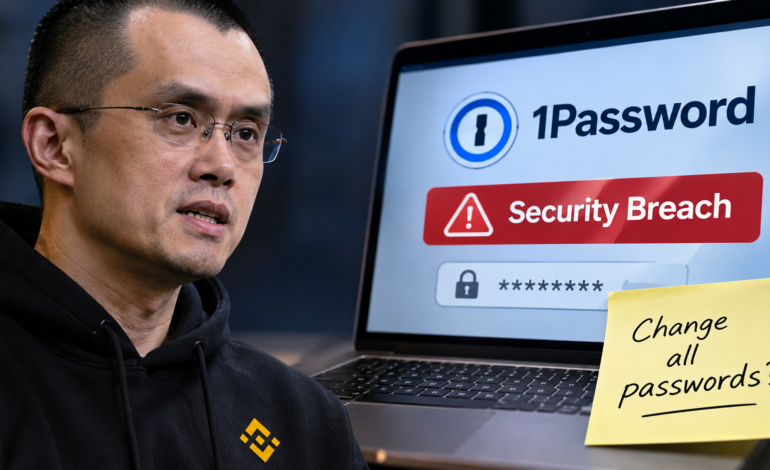
Binance founder Changpeng Zhao, popularly known as CZ, has urged users of password manager 1Password to change every password they have stored after the company confirmed that hackers accessed its internal systems and stole customer information. However, 1Password has responded directly to CZ, saying its customers’ passwords remain safe and there is no need for a mass password reset.
The disagreement follows a security incident disclosed by 1Password on November 25, 2026.
According to the company’s official security announcement, an attacker gained access to an employee’s corporate GitHub account and used it to compromise parts of the company’s backend infrastructure.
The attacker copied source code and obtained account information belonging to an undisclosed number of customers.
However, the company insists that encrypted password vaults, stored credentials and the encryption keys protecting them were not accessed.
On November 26, CZ took a more cautious position.
In a post on X, he urged users to change every password stored in the service.
1Password subsequently replied that the incident did not expose customer passwords and that changing them was unnecessary based on the company’s findings.
The exchange raises an important question for millions of people who rely on password managers.
If hackers compromise a password management company’s internal systems, how can users know whether their saved passwords are still safe?
What Did CZ Say About the 1Password Breach?
CZ issued his warning on November 26 after reports emerged that hackers had accessed 1Password’s backend systems.
His advice was straightforward.
He recommended that people using the password manager replace all the passwords they had stored in it.
CZ acknowledged that changing every password would be inconvenient but described the precaution as necessary.
His comments attracted attention because 1Password is designed to help users create, store and manage sensitive credentials.
A person may store dozens or hundreds of passwords in one vault.
These could include email accounts, banking portals, cryptocurrency exchanges, business systems and social media platforms.
For someone relying heavily on a password manager, changing every stored password can be a major undertaking.
However, CZ’s recommendation was precautionary.
He did not provide evidence that attackers had accessed the actual passwords stored in customer vaults.
That distinction matters because the publicly disclosed breach involved customer account information rather than confirmed exposure of stored passwords.
How Did Hackers Breach 1Password?
According to 1Password, the incident began with unauthorized access to an employee’s corporate GitHub account.
GitHub is a platform developers use to store, manage and collaborate on software code.
For technology companies, employee GitHub accounts can have access to important internal projects and software development systems.
On November 19, 2026, 1Password began investigating indications that an attacker had gained access to one of these accounts.
The attacker used the compromised account to access private source code repositories.
The company says malicious code was then pushed to its backend services.
That code was used to download administrative customer information.
The attacker also accessed parts of 1Password’s continuous integration and deployment infrastructure, commonly called CI/CD systems.
These systems help developers build, test and release software.
Because such infrastructure can contain credentials used to operate services, unauthorized access is a serious security concern.
However, access to software development systems does not automatically mean access to encrypted customer password vaults.
1Password says those vaults remained protected.
What Information Was Stolen?
The company has confirmed that customer account records were copied from its backend systems.
The affected information included several categories of data.
| Information | What 1Password disclosed |
|---|---|
| Customer names | Accessed |
| Email addresses | Accessed |
| Account and user identifiers | Accessed |
| Account creation dates | Accessed |
| Last sign-in timestamps | Accessed |
| Certain public cryptographic keys | Accessed |
| Authentication protocol parameters | Accessed |
| Some invitation and recovery-related tokens | Accessed |
| Stored passwords | Not accessed, according to 1Password |
| Encrypted vault contents | Not accessed, according to 1Password |
| Vault encryption keys | Not accessed, according to 1Password |
The company has not publicly disclosed the total number of affected customers.
It has also not established that every 1Password user had information stolen.
The compromised data came from a subset of customer accounts.
Why are email addresses important?
An email address may seem less sensitive than a password.
However, it can still help criminals identify potential targets.
For example, if an attacker knows that someone uses 1Password, they may send a convincing email pretending to come from the company’s security department.
The message might claim the person’s account needs urgent verification.
It could direct the recipient to a fake login page designed to steal their account password or Secret Key.
This is called phishing.
The stolen customer information could make such messages more believable because the attacker may already know the victim’s name or registered email address.
That is why 1Password is warning customers about unexpected security messages, invitations and account recovery requests.
Did Hackers Steal the Passwords Stored in 1Password?
According to 1Password, no.
The company says attackers did not obtain customer vault contents, saved passwords, protected items or the encryption keys required to decrypt them.
This is the most important distinction in the entire incident.
1Password stores sensitive information using an encryption system designed to prevent the company itself from reading customers’ saved passwords.
A password manager’s servers may store encrypted information, but reading that information requires the appropriate cryptographic keys.
In 1Password’s system, a user’s account password and Secret Key help protect access to their encrypted vault.
The company says it does not store those secrets in a form that would allow it to read customer vaults.
It also says the attacker never had access to the contents of customer vaults during this incident.
These findings are based on 1Password’s own investigation and disclosures.
They do not mean that all password managers are immune to attacks or that future incidents are impossible.
But they do mean there is currently no verified evidence that this breach exposed the passwords saved by 1Password customers.
What Is a 1Password Secret Key?
A Secret Key is an additional security credential used by 1Password to help protect a user’s account.
It works alongside the account password.
The idea is to make it harder for someone to access a vault even if they obtain certain other information.
For example, knowing someone’s email address does not provide everything needed to decrypt their 1Password vault.
The attacker would still face additional authentication and encryption protections.
1Password says neither account passwords nor Secret Keys were obtained during the November incident.
The company also warns that users should never provide these credentials in response to unexpected emails, calls or messages.
A legitimate security notification should not require customers to send their Secret Keys to a stranger.
1Password Responds to CZ: No Password Reset Is Necessary
Following CZ’s warning, 1Password publicly responded through its official X account.
The company explained that users do not need to change their 1Password account passwords or the credentials saved in their vaults because of the disclosed incident.
It emphasized that the attacker did not obtain customer passwords.
The company also reiterated that it does not store customers’ account passwords or Secret Keys in a way that gives it access to encrypted vault contents.
Instead of asking everyone to reset their passwords, 1Password recommended being alert to phishing attempts.
This creates two different approaches to the same security incident.
CZ favors changing all passwords as an additional precaution.
1Password says its investigation does not justify that step.
Neither position should be misrepresented.
CZ’s recommendation is not proof that passwords were stolen.
Similarly, 1Password’s reassurance is a statement based on its current findings, rather than a guarantee that no security incident could ever affect its users.
What About the Exposed Account Recovery Tokens?
One of the more technical concerns involves tokens associated with certain account invitations and recovery procedures.
These tokens can appear in emails sent when someone is invited to join an organization or begins an account recovery process.
According to 1Password, some tokens were present in the information the attacker obtained.
However, the company says possession of such a token is not enough to take over an account.
The attacker would also need additional authentication, such as single sign-on access or a verification code sent to the registered email address.
1Password says a small number of users had relevant pending invitation or recovery processes during the incident.
Those users were specifically notified.
As an extra precaution, the company increased the length and complexity of verification codes used for these processes.
The previous six-digit numerical codes were replaced with ten-character alphanumeric codes.
1Password also says it found no internal evidence of account takeovers involving the exposed provisioning tokens.
That does not eliminate the importance of monitoring suspicious account recovery requests.
What Has 1Password Done Since Discovering the Breach?
The company says it has taken several actions to contain the incident and strengthen security.
First, it disabled the compromised GitHub account and revoked the stolen access token.
Second, it removed access established by the attacker.
Third, it restored clean versions of affected backend services.
Fourth, it rotated or revoked internal credentials that may have been exposed.
The company also introduced tighter controls across its development and deployment infrastructure.
It says additional monitoring has been implemented to help detect similar attacks.
Independent cybersecurity specialists have been engaged to assess the response and containment measures.
1Password says its applications, browser extensions and normal services continue operating.
However, independent assessment and further investigation may still produce additional information.
The company has said it will update its public disclosure if its findings change.
Should You Change All Your Passwords?
Based on the evidence disclosed so far, changing every password stored in 1Password is not necessary solely because of this incident.
The company reports that its encrypted vault contents were not accessed.
That means users should not assume every exchange, email or banking password stored in the service has been exposed.
However, there are circumstances where changing passwords is appropriate.
For example, someone should change a password if they entered it into a suspected phishing website.
A password should also be changed if it has been reused across multiple services and one of those services experiences a separate credential breach.
If an account shows unauthorized sign-ins, suspicious changes or other signs of compromise, the affected credentials should be reset promptly.
For people managing large numbers of accounts, password changes should be performed carefully.
Users should visit the genuine service, create a new unique password, and update the corresponding entry in their password manager.
Unexpected links claiming to offer an emergency password reset should be avoided.
Why Does This Matter for Cryptocurrency Users?
The consequences of losing account credentials can be particularly serious in cryptocurrency.
Many crypto users store passwords for exchanges, email accounts and other financial services in password managers.
Some also store information associated with wallets.
If someone gains access to a cryptocurrency exchange account, they may attempt unauthorized transactions or withdrawals.
If they gain access to an email account, they may attempt password resets on other services.
And if a cryptocurrency wallet’s recovery phrase or private key is exposed, the consequences can be much more severe.
Unlike a conventional account password, a cryptocurrency recovery phrase cannot simply be changed while continuing to use the same wallet keys.
If the phrase is compromised, the safer response is generally to establish a new wallet with a new recovery phrase and transfer remaining assets, provided the user can still access them safely.
That is why cryptocurrency users should distinguish between ordinary website passwords and wallet recovery secrets.
They require different recovery procedures.
Should you store wallet recovery phrases in 1Password?
There are different approaches to securing wallet recovery phrases.
Some users rely on encrypted digital storage.
Others prefer offline backups that are kept separate from internet-connected devices.
The appropriate approach depends on the value being protected and the person’s ability to manage backups safely.
For substantial self-custodied cryptocurrency holdings, keeping a securely protected offline backup can reduce dependence on a single online service or device.
However, offline storage also creates risks involving loss, damage and unauthorized physical access.
The main objective is to prevent unauthorized disclosure while preserving a reliable way to recover access.
The November 1Password incident does not establish that wallet recovery phrases stored in customer vaults were stolen.
Could Scammers Use This Breach to Target Crypto Holders?
Yes, phishing is a realistic concern.
Imagine a criminal obtains the name and email address of someone who uses 1Password.
They might send an email with a subject such as:
“Urgent Security Alert: Your 1Password Vault Must Be Reverified.”
The message could include a link to a website resembling the legitimate password manager.
The victim might be asked to enter their account password, Secret Key or recovery information.
If the victim complies, the attacker could gain access to information that was not exposed in the original breach.
This is why phishing can be dangerous even when encrypted vault contents remain protected.
The criminal does not necessarily need to break encryption.
Instead, they try to persuade the user to reveal their credentials.
1Password has specifically warned customers about unexpected invitations and account recovery messages following the incident.
Is This Similar to the LastPass Security Breach?
Password manager breaches have happened before, but their technical impact can differ significantly.
In 2022, LastPass disclosed that attackers had obtained backups containing customer vault data.
Some of that information was encrypted.
However, the theft of encrypted vault backups created long-term concerns because attackers could potentially attempt to decrypt them.
The November 2026 1Password incident is different based on the information currently available.
1Password says the attacker did not access customer vaults or obtain encrypted vault contents.
Instead, the disclosed theft concerned account information and source code.
This distinction matters.
A breach involving customer names and email addresses can increase phishing risks.
A breach involving copies of encrypted vault data can introduce additional risks, particularly if weak passwords or other security problems make decryption easier.
It would therefore be inaccurate to describe the two incidents as technically identical.
Does This Mean Password Managers Are Unsafe?
Not necessarily.
Password managers can help people use long, unique passwords instead of reusing the same password across multiple accounts.
They also reduce the need to remember dozens of different credentials.
However, they remain security-sensitive services.
Their operators must protect internal systems, software development infrastructure and customer account information.
Users must also protect their own devices, account passwords and recovery credentials.
The 1Password breach shows that even a company specializing in security can experience an intrusion.
It does not establish that storing passwords in a reputable encrypted password manager is inherently less safe than reusing weak passwords or storing them in unprotected files.
The most useful lesson is that security depends on several layers of protection.
Frequently Asked Questions
Did CZ tell 1Password users to change all their passwords?
Yes. Changpeng Zhao posted the recommendation on X on November 26, 2026.
Was 1Password hacked?
Yes. The company confirmed unauthorized access to parts of its backend systems.
When did the incident happen?
1Password began investigating suspicious access on November 19, 2026, and disclosed the breach on November 25.
What information was stolen?
The company says the attacker copied customer names, email addresses, account identifiers, timestamps and certain other account metadata.
Were stored passwords stolen?
1Password says no customer vault contents or stored passwords were accessed.
Were Secret Keys compromised?
According to 1Password, account passwords and Secret Keys were not obtained.
Should I change every password stored in 1Password?
The company’s current findings do not indicate that a mass password reset is necessary. Change credentials if there is separate evidence they were exposed or misused.
Can hackers use the stolen email addresses?
Yes. They may attempt phishing or impersonation using information that identifies someone as a 1Password customer.
Were customer account recovery tokens exposed?
Some relevant tokens were included in the copied account data, but 1Password says they cannot provide account access on their own.
How many customers were affected?
The company has not disclosed a verified total.
Is it safe to continue using 1Password?
The company says its apps and services remain operational and that customer vaults were unaffected. Users should continue following secure sign-in practices and monitor official security updates.
What should cryptocurrency users do?
Protect exchange accounts, email accounts and wallet recovery information. Be cautious of phishing, use additional authentication and avoid sharing wallet recovery phrases or Secret Keys.
Key Takeaways
- CZ advised 1Password users to change every stored password on November 26, 2026.
- 1Password disclosed a security breach on November 25.
- The attacker gained access through an employee’s corporate GitHub account.
- Malicious code was used to obtain customer account information.
- Customer names, emails and certain metadata were exposed.
- 1Password says stored passwords, vault contents and encryption keys were not compromised.
- The company publicly responded that mass password resets are unnecessary.
- Some account invitation and recovery-related tokens were included in the exposed data.
- 1Password says it found no internal evidence of account takeovers using those tokens.
- Phishing is a significant concern following the breach.
- Users should base password changes on verified exposure and suspicious account activity rather than assuming every stored credential was stolen.
Editor’s note: CZ’s warning is confirmed by his public November 26 X post. Details of the breach and statements about vault security come from 1Password’s official November 25 disclosure and subsequent public response. The absence of confirmed vault exposure reflects the company’s investigation as reported at publication time, not an independent forensic guarantee.