








Tether Can Freeze Stolen USDT in Minutes. Why Are Some Victims Being Asked to Pay 20% to Get It Back?

Tether can freeze billions of dollars in stolen USDT within minutes, preventing hackers from moving the funds. But a new investigation has revealed a troubling problem. Some victims who successfully had their stolen stablecoins frozen were reportedly asked to pay a 20% fee to recover them, while others have waited years without receiving their money.
The findings come from a Bloomberg investigation published on November 25, 2026, which examined how major stablecoin issuers handle stolen cryptocurrency.
Bloomberg reviewed emails and spoke to people involved in disputes over frozen USDT.
One case involved a Singapore-based cryptocurrency exchange called Bittok, which lost approximately $50 million in a 2020 cyberattack.
Tether froze some of the stolen assets.
However, more than five years later, the affected USDT had reportedly still not been returned.
According to Bloomberg, a lawyer representing Tether told the company that acquired Bittok that a 20% fee would apply to any funds eventually returned.
Tether says recovery procedures involve substantial legal risks and costs, particularly when multiple parties claim ownership of the same assets.
The revelations raise an important question for cryptocurrency users.
If a stablecoin company can stop hackers from moving stolen funds almost immediately, why can returning those funds take years and cost victims a significant percentage of their money?
How Can Tether Freeze Stolen USDT?
USDT is a stablecoin issued by Tether.
It is designed to maintain a value of approximately one US dollar and is used for cryptocurrency trading, payments, transfers and savings.
Unlike Bitcoin, USDT is issued and managed by a centralized company.
On supported blockchain networks, Tether has administrative controls that allow it to block transactions involving particular addresses.
This process is commonly called freezing or blacklisting.
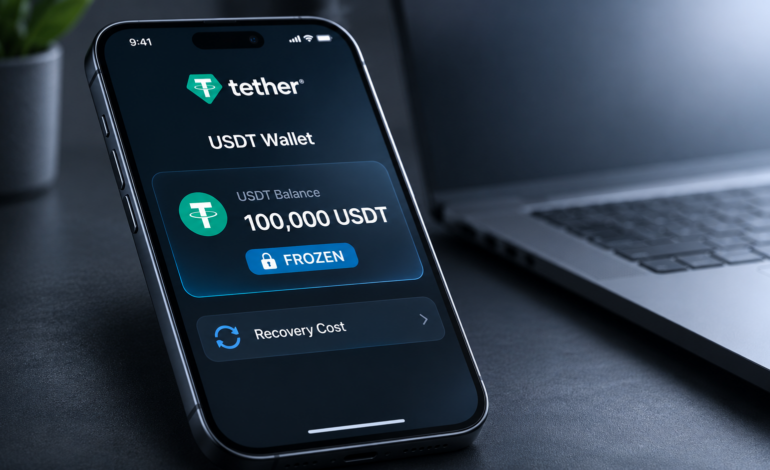
For example, imagine a hacker steals 100,000 USDT from a cryptocurrency wallet.
If investigators identify the address holding the stolen tokens, Tether may be able to prevent the tokens from moving.
The company does not necessarily need the hacker’s private key to apply that restriction.
The tokens can remain visible on the blockchain, but the address is prevented from transferring them through the affected token contract.
Tether can also support processes that cancel frozen tokens and issue replacement tokens, depending on the circumstances and applicable technical and legal arrangements.
However, these actions are discretionary or subject to applicable legal requirements.
They are not an automatic recovery service available to every USDT holder.
Tether Froze $1.5 Billion During the Binance Hack
The company’s freezing capabilities became particularly visible during the major Binance security breach on October 29, 2026.
Hackers stole approximately $6.3 billion in cryptocurrency from the exchange, according to reporting on the incident.
During the attack, Tether acted quickly to prevent part of the stolen cryptocurrency from being transferred.
In its official November 2 announcement, Tether said it froze more than $1.5 billion in USDT within 30 minutes.
Circle, the issuer of USDC, also froze approximately $1.1 billion, according to Bloomberg’s reporting.
The rapid response helped prevent attackers from moving a substantial portion of the stolen stablecoins.
US authorities and blockchain investigators have attributed the Binance attack to North Korean cyber actors.
However, this attribution is based on their investigations. It should not be confused with a completed criminal trial establishing the identity of every person involved.
The Binance response demonstrated how centralized stablecoins can be stopped during an emergency.
But smaller victims have not always received the same speed or outcome.
The Bittok Case: $50 Million Stolen and More Than Five Years Waiting
One of the most striking examples examined by Bloomberg involves Bittok Technology Pte. Ltd., a Singapore-based cryptocurrency exchange.
In June 2020, hackers stole approximately $50 million from Bittok.
Tether subsequently froze some of the stolen USDT.
That should have prevented the attackers from transferring those particular tokens.
However, freezing them did not result in an immediate refund.
According to Bloomberg, the case became complicated by legal discussions and disputes over returning the assets.
The investigation reviewed emails showing that a lawyer representing Tether informed the entity that acquired Bittok about a 20% reissuance fee on whatever funds were eventually returned.
More than five years after the original attack, Bittok’s frozen USDT reportedly remained unrecovered.
The report does not establish that Bittok actually paid the proposed 20% charge or received a completed recovery.
That distinction matters.
The documented issue is that the fee was reportedly requested as part of the recovery arrangements.
Bloomberg also reported similar situations involving other victims who received their frozen funds in stages, with comparable fees.
Those accounts came from people involved in private negotiations.
The full terms of every agreement have not been made public.
What Would a 20% Recovery Fee Mean?
A 20% charge can substantially reduce the amount a victim eventually receives.
Consider someone who loses 100,000 USDT in a hack.
Imagine that Tether successfully freezes the entire amount.
If a 20% reissuance fee were applied to a completed recovery, the result would look like this:
| Description | Amount |
|---|---|
| Stolen USDT successfully frozen | 100,000 |
| Hypothetical 20% recovery fee | 20,000 |
| Amount returned to victim | 80,000 |
The victim would recover only 80% of the frozen amount before considering any other legal or administrative expenses.
For someone who has already suffered a major financial loss, that would be a significant additional cost.
However, this is an illustration.
It does not mean Tether charges every victim 20%.
The Bloomberg investigation concerns specific reported recovery arrangements, not a publicly announced universal fee.
But Tether’s Official Recovery Policy Says 10%
This is where the story becomes more complicated.
Tether’s official token recovery policy describes a fee of up to 10% of the amount recovered or $1,000, whichever is greater.
At first glance, this appears to contradict reports of 20% charges.
However, the two arrangements concern different types of cases.
Tether’s published token recovery procedure mainly addresses cryptocurrency sent by mistake to unsupported addresses or incompatible smart contracts.
For example, someone might accidentally send USDT to a contract that does not support normal withdrawals.
In certain circumstances, Tether may attempt to recover those tokens.
The company states that requests generally must exceed $1,000, and recovery is not guaranteed.
It also says that the process is discretionary and may take several months.
Crucially, the policy directs theft, hacking, scams and law enforcement matters to a separate information requests team.
It does not publish a universal fee schedule for recovering stolen cryptocurrency.
Therefore, the publicly stated fee for mistaken transfers should not automatically be treated as a 10% limit on every hacking-related recovery.
That distinction helps explain how the reported 20% arrangements could exist alongside Tether’s published policy.
However, it also raises questions about the transparency of recovery fees for theft victims.
Why Does Tether Say Recovery Is So Complicated?
Tether argues that returning frozen cryptocurrency can involve legal and operational risks.
One important problem is identifying the rightful owner.
Imagine a stolen cryptocurrency balance that has passed through multiple wallets, exchanges and intermediaries.
Several parties may claim ownership of the same funds.
A company returning those funds to the wrong party could face further legal disputes.
There may also be court orders, investigations and competing claims from different countries.
In the Bloomberg investigation, Tether CEO Paolo Ardoino explained that funds involved in civil disputes may be reissued gradually because of these risks.
Tether says the fees charged in recovery cases help cover legal expenses and the work involved in reissuing tokens.
A company spokesperson told Bloomberg that Tether had reissued approximately $1.2 billion in USDT to date.
This is a company-reported figure.
It does not establish how much of the total was returned to individual hack victims, how long each recovery took or what fees were charged in every case.
The difference between protecting funds and returning them remains important.
Freezing Crypto and Recovering Crypto Are Not the Same Thing
To understand the controversy, it helps to separate three different actions.
1. Freezing
A freeze prevents specified tokens from being transferred.
The stolen assets may still exist at the affected blockchain address, but they cannot move normally.
This can stop a hacker from laundering or spending those particular tokens.
2. Reissuing
Where technically supported and legally appropriate, an issuer may invalidate or burn frozen tokens and create replacement tokens.
Those replacements can then be sent to a designated address.
This is an important mechanism because the issuer does not need to obtain the attacker’s private key to perform certain contract-level actions.
3. Returning the funds
The final stage involves determining who is legally entitled to receive the replacement tokens.
That may require identity checks, evidence of the theft, legal documentation and decisions about competing claims.
This is the stage where victims can face long delays and significant expenses.
A successful freeze does not guarantee that the issuer will approve a reissuance or that a claimant will ultimately receive the assets.
Is Tether Required to Return Frozen USDT?
The answer depends on the legal circumstances.
Tether’s public recovery policy gives it considerable discretion over certain recovery requests.
In January 2026, the Office of the New York Attorney General raised concerns about stablecoin recovery practices in a letter to US lawmakers.
The letter argued that Tether had cooperated with law enforcement to freeze and reissue stolen assets in some cases, but that its assistance was often voluntary and handled individually.
The office also raised concerns about the difficulty faced by state authorities seeking help with cryptocurrency fraud investigations.
These were the attorney general’s policy and legal criticisms, not a court ruling resolving every question about Tether’s duties.
The important point is that a victim cannot assume Tether is automatically obligated to provide reimbursement whenever stolen USDT is identified.
A person’s legal rights may depend on the relevant jurisdiction, court orders, ownership evidence and other circumstances.
What About Victims Whose USDT Was Never Frozen?
Not every victim succeeds in getting a freeze.
Bloomberg also reported the experience of Berlin-based Valentyn Golyshenko.
According to his public account, he lost approximately $75,000 in a cryptocurrency scam and repeatedly requested assistance.
He said his attempts to obtain a freeze were unsuccessful.
The funds were eventually moved out of the wallet holding the stolen cryptocurrency.
This is an account of his reported experience, not an independently established finding that Tether unlawfully rejected a valid request.
It illustrates how timing can determine whether recovery remains possible.
If stolen USDT is exchanged for another cryptocurrency or moved through systems beyond the issuer’s control, freezing the original tokens may no longer prevent further movement of the value.
For victims, delays during the first hours after a theft can be especially damaging.
What About Circle and USDC?
Tether is not the only stablecoin issuer able to restrict certain token transfers.
Circle, the company behind USDC, also has controls that allow it to freeze supported tokens.
However, Bloomberg found differences in how the two companies have historically responded to hacking incidents and legal requests.
Circle has generally emphasized legal authorization before freezing assets.
The company has also faced criticism from victims who believe it should act more quickly when funds are being stolen.
During the Binance hack, both companies responded unusually quickly.
But the investigation found that the speed of their response has not always been consistent across other incidents.
This creates a difficult policy question.
Acting too slowly can allow criminals to move stolen money.
Acting without sufficient evidence may freeze assets belonging to innocent users.
Stablecoin issuers must balance these competing risks.
Does This Mean USDT Is Not Decentralized?
USDT can operate on decentralized blockchain networks, but the token itself is centrally issued.
That distinction is important.
The blockchain may allow transactions to be recorded and validated without relying on one conventional bank.
However, Tether retains specific administrative powers over its token contracts on supported networks.
These can include freezing addresses and supporting token reissuance.
Bitcoin operates differently.
No central Bitcoin issuer has equivalent authority to freeze arbitrary Bitcoin balances simply by blacklisting an address.
That does not mean Bitcoin cannot be seized through other means.
For example, authorities may obtain private keys or require a custodial exchange to restrict an account.
But the technical arrangements are different.
For USDT users, the issuer’s control is both a potential protection and a source of risk.
It can help prevent criminals from moving stolen funds.
It can also leave legitimate owners dependent on the company’s procedures when a balance is frozen.
What Should You Do if Your USDT Is Stolen?
There is no guaranteed way to recover stolen cryptocurrency.
However, acting quickly and preserving evidence may improve the chances of investigators tracing the funds.
Users should immediately secure any remaining assets and compromised accounts.
They should preserve the relevant transaction hashes, wallet addresses, timestamps and other evidence.
If the funds moved through a centralized exchange, its security team should be notified promptly.
Victims should also report the incident to the appropriate law enforcement authority.
For cases involving theft, Tether’s official policy directs users toward its information requests procedures rather than the ordinary mistaken-transfer recovery process.
Users should avoid sending more cryptocurrency to anyone promising guaranteed recovery.
Fraudsters frequently exploit victims by offering fake tracing, unlocking or recovery services.
Even when stolen USDT is frozen, actual restitution may still require legal and ownership verification.
Frequently Asked Questions
Can Tether freeze stolen USDT?
Yes. Tether can restrict transfers from specified addresses on supported networks using administrative controls built into its token contracts.
Can Tether freeze USDT without the wallet owner’s private key?
Yes. The token contract can support restrictions without Tether obtaining the private key for the affected address.
Does Tether charge victims 20% to recover stolen funds?
Bloomberg reported that Tether sought 20% reissuance fees in some cases. This has not been established as a universal rate for all victims.
What is Tether’s official recovery fee?
Its published policy for certain mistaken transfers lists a fee of up to 10% of the recovered amount or $1,000, whichever is greater. Theft and hacking cases are handled separately.
What happened to Bittok?
Bittok reportedly lost around $50 million in a 2020 hack. Some assets were frozen, but Bloomberg reported that its frozen USDT remained unrecovered more than five years later.
How quickly did Tether freeze funds during the Binance hack?
Tether says it froze more than $1.5 billion in USDT within 30 minutes of the October 29, 2026 attack.
Has Tether returned stolen cryptocurrency to victims before?
Yes. Tether says it has reissued approximately $1.2 billion in USDT, although this company-reported total does not describe every individual recovery outcome.
Is frozen USDT automatically returned?
No. Freezing, reissuing and returning cryptocurrency are separate processes.
Can Bitcoin be frozen in the same way?
Bitcoin does not have a central issuer with equivalent token-level freezing controls. Custodial services and legal seizure procedures are separate matters.
What should I do if someone steals my USDT?
Secure your remaining assets, preserve transaction evidence, notify relevant platforms, report the theft to authorities and use verified official reporting channels. Recovery is not guaranteed.
Key Takeaways
- Bloomberg reported that Tether sought 20% reissuance fees from some USDT theft victims.
- The Bittok case involves a reported $50 million hack in June 2020.
- Some of Bittok’s stolen USDT was frozen but had reportedly not been returned more than five years later.
- Tether says it froze over $1.5 billion in USDT during the Binance hack within 30 minutes.
- Tether’s published mistaken-transfer recovery policy has a different fee structure from the reported theft-related arrangements.
- The company says fees help cover legal and operational expenses.
- A freeze prevents token movement but does not automatically establish ownership or guarantee reimbursement.
- Stablecoin users should understand the differences between centralized token controls and decentralized blockchain settlement.
- Greater transparency around fees, claims and recovery procedures could improve consumer protection.
Editor’s note: The 20% fee is attributed to Bloomberg’s November 25 investigation, including correspondence the journalists reviewed. Tether’s freezing capabilities and published mistaken-transfer recovery policy are independently supported by the company’s official documentation. The article does not suggest that every victim is charged 20% or that a proposed fee was necessarily paid.