








Bank of Ghana Says More Than 3 Million Ghanaians Use Virtual Assets

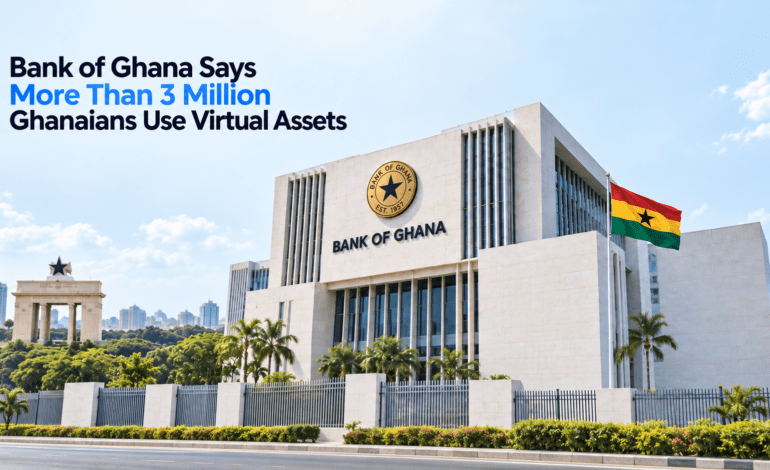
More than three million people in Ghana now use or participate in virtual assets, according to the Bank of Ghana, as the country moves deeper into regulating an industry that has largely developed outside the traditional financial system.
The figure appears in the Bank of Ghana’s latest policy position on virtual assets, which says Ghana’s virtual-asset ecosystem has expanded to encompass more than three million users.
Days later, Philip Kwaw Sebuabe, Head of the Bank of Ghana’s Virtual Assets Department, repeated the figure at the Digital Assets Summit Africa in Accra.
According to the Ghana News Agency’s report from the summit, Sebuabe said more than three million people in Ghana were already participating in activities including trading, saving and transferring value using virtual assets.
That is a sizeable number.
But there is an important detail before anyone starts imagining the Bank of Ghana personally counting three million crypto wallets.
It did not.
The Three Million Figure Is an Estimate
The Bank of Ghana’s figure should be understood as an estimate of participation, rather than a register of three million individually verified cryptocurrency holders.
The Bank’s Financial Stability Review 2025 explains where the number comes from.
It says estimates from TripleA and other cryptocurrency platforms and market-intelligence providers suggest that more than three million Ghanaians currently hold or use cryptocurrencies.
The number tells us that virtual assets have reached significant scale in Ghana, but it should not be interpreted as an exact census.
Some people may use multiple exchanges. Some may own several wallets. Some may use stablecoins primarily for payments rather than investment. Others may interact with virtual assets only occasionally.
Virtual Assets Mean More Than Bitcoin
The Bank of Ghana uses a broad definition of virtual assets.
Its official virtual-assets information portal describes them as digital representations of value that can be stored and transferred electronically, usually using blockchain or distributed-ledger technology.
That category includes cryptocurrencies, tokens, stablecoins and other blockchain-based instruments.
So the three-million estimate should not be read as:
“Three million Ghanaians own Bitcoin.”
It covers a much wider market.
A Ghanaian using USDT to receive a payment, someone trading cryptocurrencies on an exchange and another person holding a blockchain-based token can all fall somewhere within the virtual-asset ecosystem.
This also helps explain why Ghanaian regulators are treating the market as more than a speculative investment niche. It has become large enough to matter to payments, foreign exchange, consumer protection and financial stability.
The Bank of Ghana Is Paying Much More Attention
The tone from Ghana’s regulators has changed considerably. The Bank of Ghana’s September policy statement, issued together with the Securities and Exchange Commission and Financial Intelligence Centre, says virtual assets can no longer remain outside the country’s financial regulatory system. That is quite a shift from the days when central-bank guidance around cryptocurrency mostly consisted of some version of: “Please be careful with that.”
Ghana now has a dedicated legal framework for virtual-asset service providers, and regulators are working on the detailed rules that will determine how exchanges, brokers, custodians and other businesses operate.
At the Digital Assets Summit Africa, Bank of Ghana officials said regulators were developing coordinated requirements covering areas such as cybersecurity, anti-money-laundering controls, governance and protection of customer assets.
The discussion is also expanding beyond cryptocurrency trading.
Bank of Ghana Director of Financial Technology and Innovation Owurieku Asare said attention is increasingly moving toward stablecoins, tokenisation, digital securities and digital-asset custody.
Ghana Already Has a Virtual Asset Law
The Virtual Asset Service Providers Act, 2025, Act 1154 provides the legal foundation for regulating the sector. According to the Ghana News Agency, the law establishes the basis for the registration, licensing and supervision of virtual-asset service providers and provides for coordination between the country’s regulators.
The Securities and Exchange Commission has already begun putting parts of that framework into practice. In March 2026, the SEC launched a regulatory sandbox that allows selected virtual-asset companies to test products under supervision before moving toward full activity-based licensing.
The SEC says the sandbox runs for 12 months, although companies with market-ready products that meet regulatory requirements may potentially transition toward licensing after the first six months. This is not merely a sandbox full of cryptocurrency exchanges. It is testing several different uses of blockchain.
Ghana Is Testing Gold, Bonds and T-Bills On-Chain
The SEC’s full list of sandbox participants shows just how broad Ghana’s digital-asset ambitions have become.
Africoin Ghana is testing gold tokenisation.
Vaultra Digital Assets is testing the tokenisation of securities.
GFX Brokers is working with tokenised Treasury bills.
One Africa Securities is testing bond tokenisation.
Wewire Ghana is testing tokenised trade finance.
The Ghana Gold Board has been admitted as a real-world asset (RWA) custodian for gold, while the Ghana Commodity Exchange is participating under a virtual-asset exchange category for commodities.
Several cryptocurrency exchanges and trading platforms are also participating.
In other words, Ghana is not only attempting to regulate what already exists. It is also experimenting with what could come next.
Why Regulators Care About Three Million Users
A market with a few thousand experimental users can sometimes sit at the edge of the financial system. A market involving more than three million people is harder to ignore.
The Bank of Ghana’s Financial Stability Review says the rapid growth of virtual assets could create benefits through new products, services and alternative payment mechanisms. But it also highlights several risks. These include consumer protection, cybersecurity, fraud, money laundering, cross-border capital movement and potential pressure on the Ghanaian cedi.
Stablecoins receive particular attention. Many major stablecoins track the US dollar. If people increasingly choose to hold value in dollar-linked digital assets instead of local currency, the Bank says that could reduce demand for the cedi and potentially affect foreign-exchange conditions. That does not mean stablecoins are being banned. It means the central bank now has a reason to pay considerably more attention to them.
Three million reasons, depending on how you count.
Crypto Is Meeting Ghana’s Mobile Money Economy
There is another reason Ghana is interesting. The country already has an enormous digital-payments culture.
At the September summit, Bank of Ghana official Owurieku Asare said Ghana recorded around 10 billion mobile-money transactions worth approximately GH¢4.5 trillion in 2025, compared with about three billion transactions worth GH¢560 billion in 2020.
That matters because virtual assets are entering a market where digital money is already normal.
More Than 100 Providers Had Already Registered
Ghanaian regulators have also been trying to understand how many businesses are actually serving this market.
The Bank of Ghana’s policy work records that a mandatory registration exercise for virtual-asset service providers produced more than 100 registrations covering activities such as payments, exchanges, wallets, brokerage and investment services.
Being recorded by the regulator does not automatically mean a business has received final authorisation to offer every service.
But the exercise gave regulators a clearer picture of an industry that had largely developed outside formal supervision.
The next stage is turning that information into a functioning licensing regime.