


I Deposited KES 150,000 Into Kenya’s Jua Exchange. Twenty Days Later, I Still Cannot Withdraw My Money


What began as an attempt to support a Kenyan-built prediction market has turned into a dispute involving a missing deposit, changing account balances, disabled withdrawals, conflicting explanations, and an unresolved prediction.
Editorial disclosure: The author is a co-founder of Blockwisely and is personally involved in this dispute.
Sometimes, you meet people building impressive products locally and wonder why we continue using foreign platforms when Kenyans are capable of creating similar solutions.
I have always believed that African technology companies deserve an opportunity to compete with international businesses.
But I recently learned that supporting local innovation should never mean compromising on accountability.
On October 20, 2026, I deposited KES 150,000 into Jua Exchange, a Kenyan prediction market platform.
The money left my M-Pesa account, but the deposit did not reflect in my Jua trading account as expected.
Fourteen days later, I still cannot withdraw my money.
Over those twenty days, I have contacted Jua’s founder, reached out to the payment processor, attempted to organize meetings between the parties, and tried alternative recovery arrangements.
My account initially showed the deposit as pending. It later showed the transaction as failed.
Then something even stranger happened.
On November 1, an unexplained balance of KES 300,690 appeared in my account.
By November 2, the balance had changed again, this time to KES 449,930.
Despite the platform showing this amount as available and withdrawable, I still cannot withdraw anything.
The withdrawal button is greyed out.
Interestingly, the deposit functionality remains active.
Meanwhile, Jua’s founder has accused me of attempting to hack the platform after I repeatedly requested an explanation.
I also have a separate KES 10,000 prediction involving Anthropic’s IPO that has not been settled, even though its October 31 deadline has passed.
I am sharing this experience becauseI do not want another person to find themselves in the same situation.
How I Met Jua’s Founder
I met Muchiri Elkanah, the founder and CEO of Jua, through a mutual friend.
Elkanah is associated with Jua Markets, a Kenyan company developing a prediction market platform.
During our interaction, he learned about my background in software testing, technology consultancy, and cryptocurrency trading.
I have worked in technology consultancy for approximately a decade and have been involved in cryptocurrency trading since 2019.
Given that experience, he encouraged me to explore the Jua platform and provide feedback.
I was happy to do so.
Prediction markets have become increasingly popular through platforms such as Polymarket and Kalshi.
They allow people to trade positions based on whether future events will happen.
For example, traders can predict whether Bitcoin will reach a certain price, whether a company will go public, or whether a particular political or economic event will occur.
I was excited to see a Kenyan company building something similar.
I signed up and started exploring the platform.
I Started With Small Deposits
Like I normally do when using an unfamiliar financial platform, I started by testing it with relatively small amounts.
My first deposit was KES 150.
I then deposited KES 10,000.
The deposits worked, and I was able to explore the prediction market interface.
I also tested certain platform features, including withdrawals, order placement, account balances, and trading functionality.
During this process, I shared product feedback with Elkanah.
Some of the questions I asked concerned transaction fees, market liquidity, order execution, and how the platform handled different types of transactions.
These were ordinary questions from someone evaluating a product before committing significant funds.
I was increasingly convinced that Jua was worth trying.
In fact, I placed a KES 10,000 prediction on Anthropic’s IPO, which I will explain later.
Then, on October 20, I decided to deposit a larger amount.
I sent KES 150,000.
That is where my problems began.
October 20: My KES 150,000 Deposit Does Not Reflect
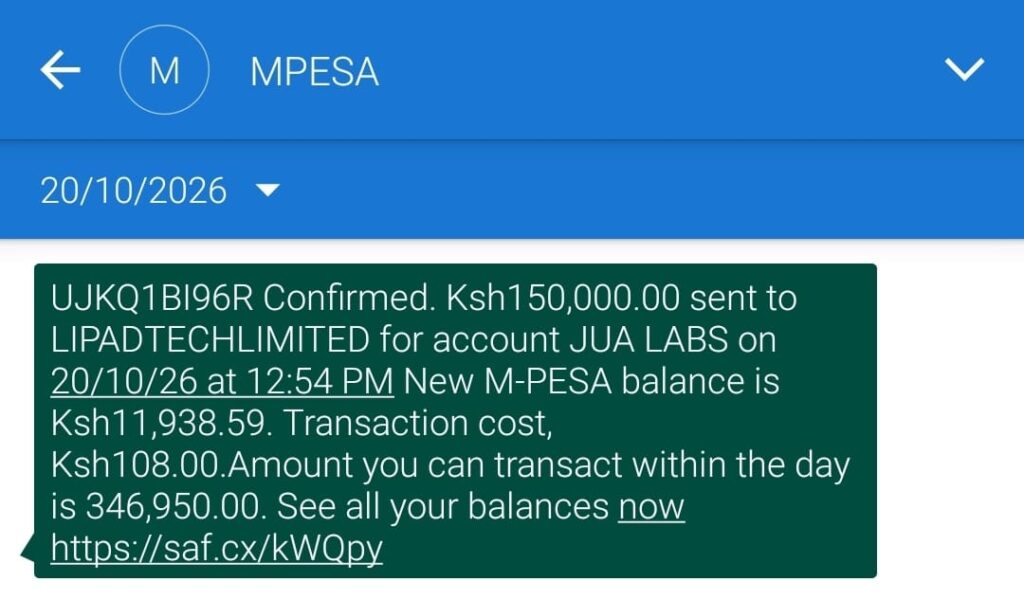
On October 20, 2026, at 12:54 PM, I made an M-Pesa payment of KES 150,000.
The payment confirmation showed that the funds were sent to LIPADTECHLIMITED for account JUA LABS.
M-Pesa confirmed the transaction.
However, the deposit did not reflect in my Jua account.
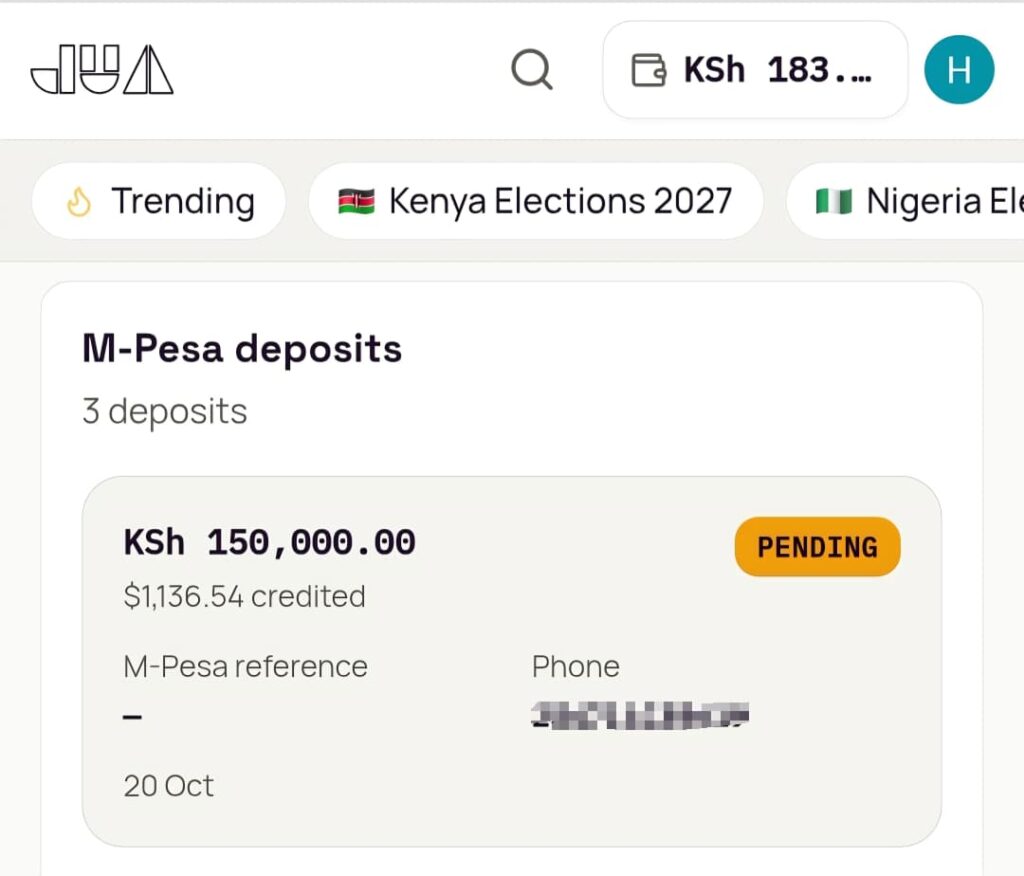
After waiting for approximately 22 minutes, I contacted Elkanah.
He checked the system and informed me that he could see a pending transaction.
He asked for the amount involved and later requested my M-Pesa confirmation, which I provided.
Initially, I assumed it was a temporary technical problem.
Payment integrations sometimes fail.
A payment can succeed on M-Pesa while the receiving application fails to update its database.
But I expected the parties responsible to identify the problem and correct it within a reasonable period.
That did not happen.
Jua and Lipad Give Conflicting Explanations
Jua uses a payment provider called Lipad for certain payment services.
During the deposit process, I could identify the payment processor, which allowed me to contact Lipad directly.
I reached out on October 20 and provided the M-Pesa transaction details.
Initially, a Lipad representative said the transaction was pending at the mobile network operator.
Later, at 9:16 PM, the representative wrote:
This was successful on our end they should credit you
Meanwhile, Jua was still investigating the deposit.
On October 21, Elkanah informed me that his team believed the account had already been credited.
But when I checked, the transaction was still pending.
I shared a screenshot showing the status.
On October 24, after several days without a resolution, I contacted Lipad again and requested a reversal.
The representative told me that the transaction had been confirmed with Jua.
He later wrote:
They confirmed value is given
This left me confused.
Lipad was saying the transaction had succeeded and that Jua had confirmed value was provided.
Jua had previously indicated that the issue was on the payment provider’s side.
Yet I still could not access my KES 150,000.
I Tried Bringing Both Companies Into a Meeting
After days of back-and-forth communication, I decided to arrange a meeting involving both Jua and Lipad.
My thinking was simple.
If both companies were blaming different parts of the payment process, bringing their representatives into the same meeting might help establish exactly where the transaction had failed.
I created meeting invitations.
For the first scheduled meeting, the Lipad representative attended, but Elkanah did not join.
I subsequently arranged another meeting, which also failed to bring the relevant people together.
I continued asking for updates.
I had paid KES 150,000, but I was spending my own time trying to coordinate the investigation between the platform and its payment provider.
Even Jua’s Advertised Support Email Did Not Work for Me
On October 26, I attempted to make a formal complaint.
I wanted the dispute documented through an official company support channel rather than continuing to rely on informal WhatsApp conversations.
I sent an email to support@jua.app, the address advertised on Jua’s website.
The email appeared to bounce back as undeliverable.
On October 27, I informed Elkanah that the email did not appear to exist.
Interestingly, Jua’s website advertises support@jua.app, while its Privacy Policy and Terms of Use list support@jua.co.ke.
Jua Proposes a Cryptocurrency Workaround
As the dispute continued, Elkanah proposed an alternative solution.
He suggested creating another Jua account using a cryptocurrency wallet.
According to his explanation, he could then arrange to credit the funds through a crypto deposit.
I attempted to follow his instructions.
I experienced problems connecting MetaMask to the Jua account but was later able to. But then, nothing happened. The account was not funded as promised.
Even after following the instructions and creating another account, the proposed solution did not successfully return my money.
The problem remained unresolved.
October 31: My Deposit Is Marked as Failed
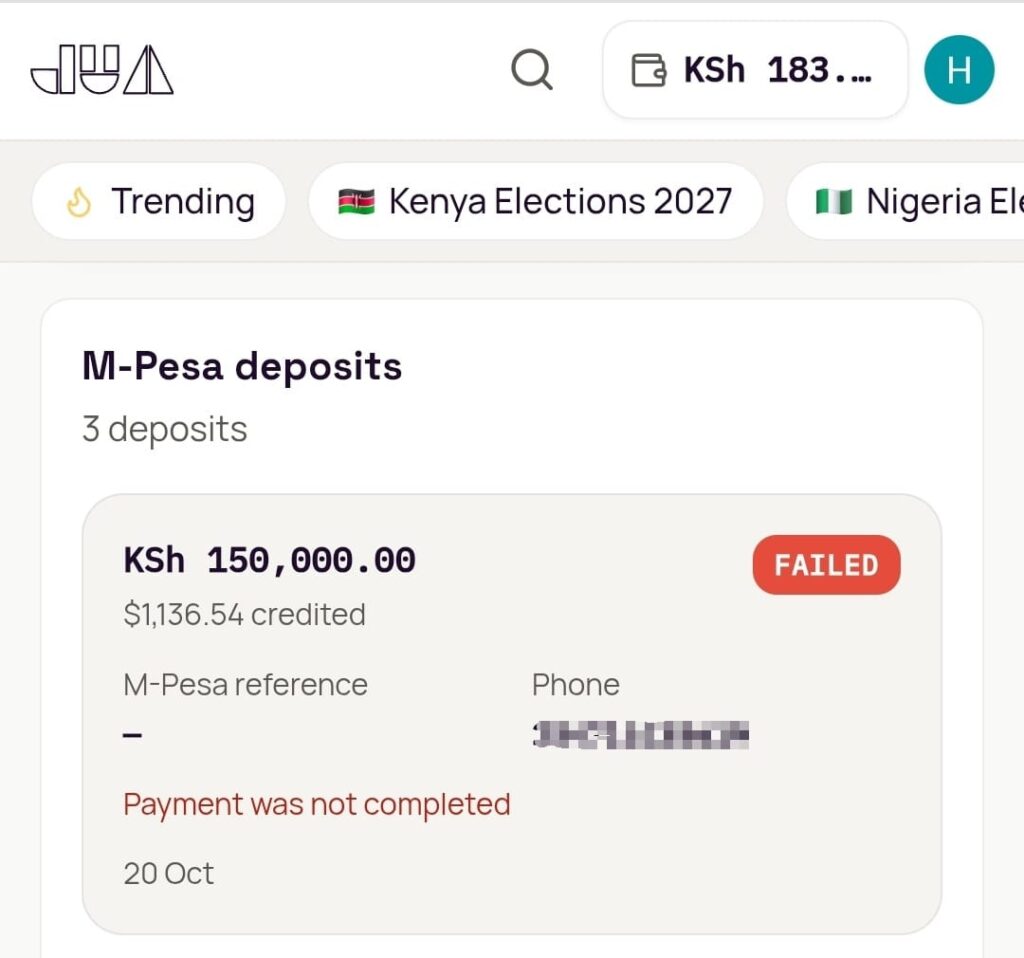
On October 31, 11 days after the transaction, the original KES 150,000 deposit was showing as FAILED on Jua.
This was particularly concerning because Lipad had previously reported successful processing.
I shared the updated deposit status with both companies.
By that point, I had repeatedly requested a reversal or some other verifiable way of recovering the amount.
I told Elkanah that I was considering making my experience public if the issue was not resolved.
His response was troubling.
In a WhatsApp message, he challenged my decision to go public, ending his message with:
we will see who will be destroyed
I found the response inappropriate in the context of an unresolved customer payment dispute.
I was not asking for special treatment.
I wanted access to the money I had deposited.
November 1: An Unexplained KES 300,690 Balance Appears
On November 1, something unusual happened.
When I accessed my Jua account, the balance displayed KES 300,690.
That was significantly more than the amount I expected.
I had no explanation for where the additional balance came from.
I immediately informed Elkanah.
I wrote:
Crazy balances just appeared in my wallet without traces.
I explained that the amount exceeded the deposits and expected prediction proceeds I could account for.
I asked him to investigate.
I did not consider the unexpected balance to be money I had earned.
I did not ask for the entire amount to be paid to me.
I reported the discrepancy and requested that the platform reconcile my account.
Despite the balance displayed in the application, I still could not withdraw my money.
November 2: My Balance Changes Again to KES 449,930
Just when I thought the account figures could not become more confusing, they changed again.
By November 2, 2026, my account was displaying a total balance of KES 449,930, equivalent to 3,461 USDC according to the platform.
The balance breakdown was particularly interesting.
| Account field | Amount displayed |
|---|---|
| Total balance | KES 449,930 |
| Available | KES 449,930 |
| Locked in orders | KES 0 |
| Promo credit | KES 0 |
| Withdrawable | KES 449,930 |
| Unrealized P&L | -$74.06 |
| Realized P&L | $0 |
According to the interface, the entire KES 449,930 was both available and withdrawable.
There were no amounts locked in orders.
There was no promotional credit included in the balance.
Yet I could not withdraw even a small portion of it.
The withdrawal button was greyed out.
At the same time, the deposit functionality remained available.
From a customer’s perspective, the platform was still allowing deposits, while my account displayed a large withdrawable balance that I could not actually withdraw.
I cannot determine from the interface alone whether this resulted from an account restriction, a payment-processing issue, a wallet connection problem, an internal ledger discrepancy, or another technical cause.
But the contradiction between the displayed balance and the withdrawal functionality needs an explanation.
November 2: Jua’s Founder Accuses Me of Hacking
As I continued asking questions, Elkanah’s response changed.
He questioned why I had asked technical questions about the platform before depositing money.
He also questioned my decision to make smaller test deposits before the larger payment.
At one point, he wrote:
You are tech guy, most prolly trying to hack our system
He went further, alleging that Jua had identified attempts to exploit weaknesses in its payment systems.
I strongly disputed those allegations.
I tested the platform because I was considering using it with real money.
I asked technical questions because of my professional background.
I contacted Lipad because my KES 150,000 deposit had not reached my trading balance.
And when the account displayed unexplained funds, I reported them.
Elkanah also alleged that I had violated the platform’s terms and conditions.
I asked him to identify the specific provision. He did not provide a specific clause or technical evidence demonstrating that I attempted to hack the system.
Jua is entitled to investigate suspicious activity and protect its platform.
But accusations of wrongdoing should be supported by evidence.
A customer asking for a transaction to be reconciled should also receive a clear explanation of any restrictions placed on their account.
Another Concern: My KES 10,000 Anthropic Prediction
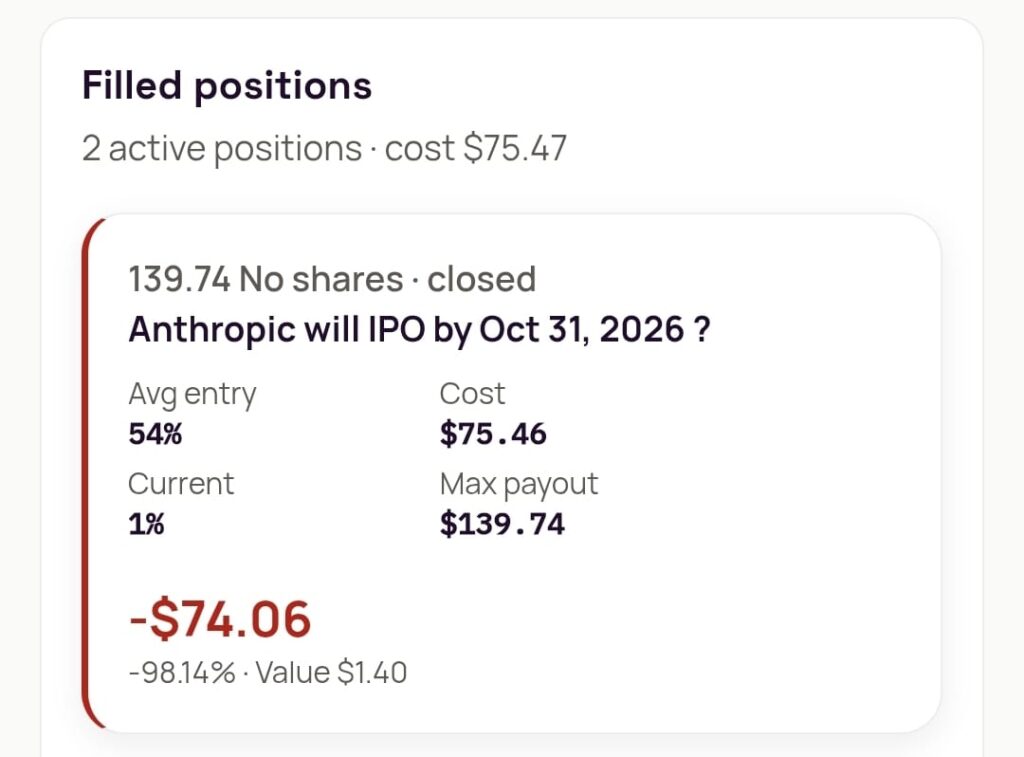
My concerns are not limited to the KES 150,000 deposit.
Before the large deposit problem, I had placed a prediction worth KES 10,000 on Jua.
The market asked whether Anthropic, the company behind Claude AI, would go public by October 31, 2026.
I predicted NO.
In other words, I believed Anthropic would not complete its IPO before that deadline.
The position shown in my Jua account was:
| Position details | Value |
|---|---|
| Original investment | KES 10,000 |
| Position cost displayed by Jua | $75.46 |
| Shares purchased | 139.74 NO shares |
| Maximum payout | $139.74 |
| Potential gross profit | $64.28 |
| Displayed current value | $1.40 |
| Displayed unrealized loss | $74.06 |
Jua had publicly promoted the Anthropic IPO markets on its LinkedIn page, including deadlines of October 31, November 30, December 15, and December 31.
The October 31 deadline has now passed.
Yet my position continues to appear under active positions, marked as closed, without a clearly displayed final settlement.
I also raised the matter publicly in the comments on Jua’s LinkedIn post.
Did Anthropic Go Public Before October 31?
According to official documents, Anthropic had not completed its IPO by October 31, 2026.
On October 26, the company announced that it had filed an S-1 registration statement with the US Securities and Exchange Commission.
An S-1 registration is part of preparing for a public offering.
It does not mean that the IPO has been completed.
Anthropic’s announcement specifically described the offering as proposed and stated that the registration statement had not yet become effective.
On November 2, Anthropic filed an amended registration statement with the SEC.
The amended filing still described the offering as preliminary.
Under the ordinary meaning of going public, these documents support the conclusion that Anthropic had not completed an IPO by October 31.
That would appear to favour my NO position.
However, the actual market settlement must follow Jua’s original published resolution criteria.
I would like the company to publish those criteria, identify the official resolution source, and explain why the position has not been clearly settled.
The displayed $74.06 loss is an unrealized valuation, not proof that the position has been finally settled as a losing prediction.
What Jua’s Own Website Promises
Jua’s About page makes several claims about how the platform operates.
It describes USDC balances held in on-chain escrow contracts, with user funds separated from the company’s operating capital.
It also says that balances can be withdrawn, subject to the relevant transaction process.
For prediction markets, it says winning shares pay $1 each once an outcome is resolved and that market results are determined using publicly verifiable information.
These claims are important because they describe the protections customers should expect from the product.
My experience raises questions about whether those processes are functioning as described for my account.
I am not in a position to determine whether the problem affects other users.
That would require additional evidence.
But the company should be able to explain why its published descriptions of withdrawals and settlement do not match what I have experienced.
Is Jua Exchange a Scam?
After everything that has happened, I understand why someone might ask whether Jua Exchange is legitimate.
I have asked myself that question too.
A confirmed payment has led to an unresolved dispute, contradictory account information, unsuccessful recovery attempts, and accusations against the customer.
As of November 3, I cannot withdraw my original funds.
I will let you be the judge.
Frequently Asked Questions
What happened to the KES 150,000 deposited into Jua Exchange?
The author deposited KES 150,000 through M-Pesa on October 20, 2026. The transaction was confirmed, but the funds did not become reliably accessible through the Jua account.
Why does the account show KES 449,930?
The cause has not been established. The balance was first observed at KES 300,690 on November 1 and had increased to KES 449,930 by November 2. The author reported the unexplained discrepancy.
Can the customer withdraw the KES 449,930?
According to the author, no. Although the interface labels the full amount withdrawable, the withdrawal button is disabled. The displayed amount has not been independently verified as settled funds.
Is Jua still accepting deposits?
The author reports that the deposit functionality remains operational on his account even though withdrawals are unavailable. This does not establish whether other users are experiencing the same issue.
How much was invested in the Anthropic prediction?
The author placed a prediction using KES 10,000. Jua displays the position cost as $75.46 for 139.74 NO shares.
Did Anthropic complete its IPO by October 31, 2026?
Available official SEC filings indicate that it had not. Anthropic filed preliminary registration documents before and after October 31, but those filings do not establish a completed IPO.
Has Jua Exchange been proven to have committed fraud?
No. The available records document a serious unresolved dispute, but further evidence would be needed to establish deliberate fraud or another legal violation.