









Kenya’s New Rules Allow Court-Ordered Seizure of Crypto Wallets Linked to Financial Crime

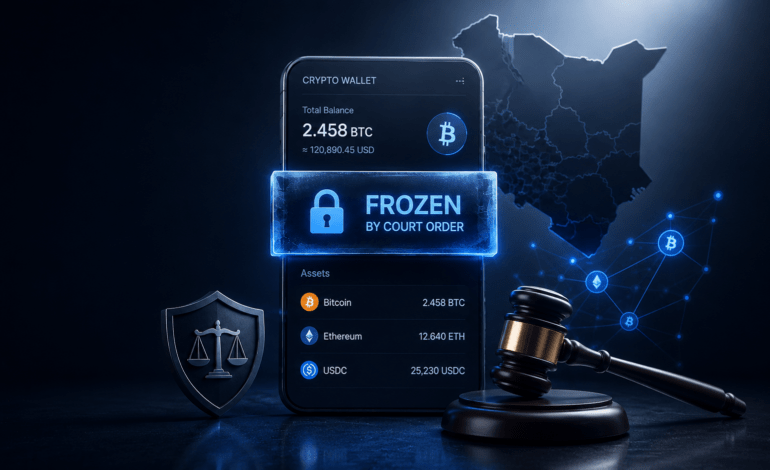
Imagine receiving cryptocurrency into an exchange account, transferring part of it to a personal wallet and later discovering that the assets have been frozen. The exchange informs you that it received a lawful order connected to a money-laundering or corruption investigation.
Under Kenya’s new cryptocurrency regulations, this is now a clearly defined legal process.
The Virtual Asset Service Providers Regulations, 2026, gazetted as Legal Notice No. 134 of 2026 on 22 July 2026, set out how Kenyan authorities can freeze, seize, store and, in some cases, convert virtual assets suspected of being connected to financial crime. (Kenya Law)
The regulations do not allow police officers or investigators to take cryptocurrency simply because they consider a transaction suspicious. A freezing or seizure order must follow the procedures and evidence requirements established under Kenya’s existing asset-recovery laws.
Kenya now has a specific process for seizing cryptocurrency
Kenya already had laws allowing authorities to identify, trace, freeze and confiscate property believed to be proceeds of crime. The Proceeds of Crime and Anti-Money Laundering Act, commonly known as POCAMLA, was created partly to provide for the freezing, seizure and confiscation of criminal proceeds. The Anti-Corruption and Economic Crimes Act also allows the High Court to issue orders preserving property suspected of being connected to corruption or unexplained wealth. (Kenya Law)
The challenge was that these laws were largely written before cryptocurrency became widely used.
The new VASP regulations address that operational gap by explaining how existing investigation and asset-recovery powers should apply to crypto exchanges, wallet providers, brokers, custodians and other regulated virtual asset businesses.
Part XIV of the regulations is specifically dedicated to freezing and seizure orders. It states that the investigation, preservation, production of records, seizure and forfeiture powers available under POCAMLA, the Anti-Corruption and Economic Crimes Act and other relevant laws apply to virtual assets with the necessary adjustments.
This means cryptocurrency is no longer treated as an unclear or unusual type of property when investigators seek to preserve suspected criminal proceeds.
Freezing is different from seizure
Although the terms may sound similar, freezing and seizure are not the same.
A freezing order prevents specified cryptocurrency from being withdrawn, transferred, converted or otherwise disposed of. The assets may remain in the account or wallet, but the owner cannot move them while the order is active.
A seizure order goes further. It allows the relevant authority to take possession or control of the specified crypto for preservation or possible forfeiture.
Neither action automatically proves that the owner committed a crime. Freezing and seizure are measures used to stop assets from being hidden, transferred abroad, converted into other tokens or moved to wallets that investigators cannot easily access.
Forfeiture is a separate legal step through which a court may ultimately order property to be transferred to the government after considering the applicable evidence and claims.
What licensed crypto platforms must do
A licensed virtual asset service provider served with a lawful freezing order must immediately block access to the specified assets.
The provider must prevent withdrawals, transfers and conversions while preserving information connected to the account. This may include:
- Customer identification records
- Wallet addresses
- Transaction histories
- Account logs and metadata
- Beneficial ownership information
- Wallet identifiers and associated credentials
- Relevant technical records
The regulations also require providers to ensure that custodians, exchange partners and other infrastructure providers under their control comply with the order where they hold or control the affected assets.
Licensed businesses must respond to lawful requests for documents and information connected to investigations. They must also maintain systems that allow them to execute court orders, warrants, directives and other lawful instruments without unnecessary delay.
For exchanges and custodial wallet providers, this means freezing and seizure capabilities will need to become part of their compliance and security infrastructure rather than something handled informally when an investigation arises.
Authorities can take control of the cryptocurrency
When a licensed provider receives a seizure order, the regulations require it to surrender control of the specified virtual assets to the competent authority.
The provider may also be required to:
- Give authorities access to relevant wallets, addresses or accounts
- Supply transaction histories and technical information
- Transfer the assets to a designated government-controlled wallet
- Preserve records needed to demonstrate how the assets were handled
- Assist authorised officers in executing the order
The final gazetted regulations specifically state that a licensee may be required to surrender control and provide full access to the affected wallets or accounts.
Seized virtual assets must then be transferred to a secure wallet controlled by the relevant government agency. Authorities are required to maintain a chain-of-custody record that includes transaction hashes and every transfer made under the seizure order.
This record is important because blockchain transfers are irreversible. A clear chain of custody can help demonstrate that the assets were transferred under lawful authority, stored securely and not improperly moved or mixed with unrelated funds.
Hardware wallets and seed phrase backups can also be seized
The regulations are not limited to cryptocurrency held on centralised exchanges.
An authorised officer may, where permitted under the seizure order, access premises where virtual asset devices are suspected to be located. The officer may seize and detain physical devices, hardware wallets, seed phrase backups or electronic systems needed to access the specified crypto.
This provision is particularly significant for people who hold crypto in self-custody.
Keeping Bitcoin, stablecoins or other assets outside an exchange does not automatically place them beyond the reach of a lawful investigation. Where authorities identify and lawfully obtain the device, recovery phrase or signing credentials controlling a wallet, they may be able to move the assets to a government-controlled address.
However, a court order does not magically provide access to every self-custody wallet. As a practical matter, investigators may still need to find the relevant device, recovery phrase, private key or other signing method. That is an operational limitation rather than a legal exemption.
Volatile cryptocurrency may be converted into fiat
Crypto prices can change significantly while an investigation or forfeiture case is ongoing.
To manage that risk, the regulations require authorised officers to take reasonable measures to preserve the value and integrity of seized assets. With the approval of a competent court, volatile cryptocurrency may be converted into fiat currency where necessary to preserve its value.
For example, an authority holding a highly volatile token could seek permission to sell it rather than risk a substantial fall in value before the case is concluded.
This power requires careful oversight. Converting an asset too early could cause losses if its value later rises, while holding it for too long could expose the government and affected parties to a market collapse. The requirement for court approval provides an important safeguard, but authorities will still need clear custody, valuation and disposal policies.
Failure to comply can lead to severe penalties
A licensed VASP that refuses or fails to comply with a lawful freezing or seizure order commits an offence.
A person convicted of the offence may face a fine of up to KSh10 million, imprisonment for up to five years, or both.
This places significant responsibility on crypto platforms. A provider cannot simply ignore an order because its headquarters, technology providers or custody partners are located outside Kenya.
Businesses serving Kenyan users will need procedures for verifying orders, identifying affected assets, blocking transactions, preserving records and transferring assets securely where required.
Investigators still need a lawful basis
The new rules do not give every police officer unlimited authority to search wallets or seize cryptocurrency.
Regulation 135 states that freezing and seizure orders must be obtained according to the procedures and evidentiary requirements contained in POCAMLA, the Anti-Corruption and Economic Crimes Act or another law dealing with the tracing, seizure or forfeiture of criminal proceeds.
The regulations define an authorised officer to include a police officer, an officer of an investigating authority or another properly appointed representative of a competent authority. This does not remove the requirement for the officer to act under a valid order or other lawful authority.
The headline phrase “court-ordered seizure” captures the main protection, although the regulations also recognise orders issued by another lawful authority where the underlying law permits it.
The rules should therefore not be interpreted as allowing cryptocurrency to be confiscated because someone made an unusually large transfer, used a self-custody wallet or interacted with a decentralised platform.
Suspicious activity may trigger an investigation, but freezing, seizure and final forfeiture remain distinct legal processes.
What this means for ordinary crypto users
For most lawful users, the regulations do not prohibit owning, sending or investing in cryptocurrency.
They do, however, make it increasingly important to keep records showing where funds came from and why transactions were made. A person questioned about a large deposit may find it helpful to have:
- Exchange statements
- P2P transaction records
- Bank or mobile-money payment confirmations
- Invoices and business contracts
- Wallet transaction hashes
- Records showing the source of investment capital
- Evidence of transfers between personal wallets
Blockchain transactions may be visible publicly, but a blockchain address does not by itself explain who owns the funds, why they moved or whether the transaction represented a purchase, investment, business payment or internal wallet transfer.
Good records can help legitimate users distinguish their transactions from criminal proceeds or unexplained assets.