


Kenya Orders Crypto Businesses to Apply for Licences as CBK and CMA Confirm New Rules

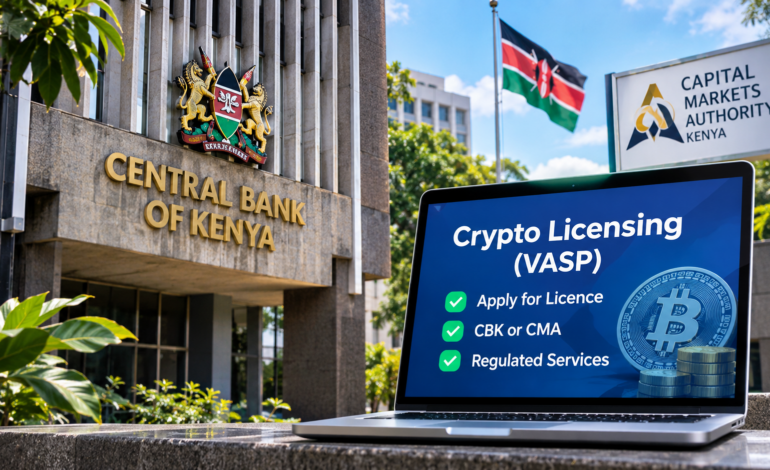
Kenya’s cryptocurrency industry has entered a new regulatory phase after the Central Bank of Kenya (CBK) and Capital Markets Authority (CMA) formally instructed businesses offering virtual asset services to apply for licences. The announcement brings greater clarity to a sector that has operated for years without a dedicated licensing framework.
In a joint public notice dated November 13, 2026, the two regulators confirmed that the Virtual Asset Service Providers Regulations, 2026, had been gazetted and that businesses offering covered cryptocurrency services must apply for authorization.
According to the official CBK and CMA announcement, the regulations were gazetted on July 22, 2026, under Legal Notice No. 134.
The announcement is important because Kenya’s Virtual Asset Service Providers Act, 2025, established the legal framework for regulating cryptocurrency businesses, but additional regulations were required to implement licensing.
The regulators have now confirmed that the regulatory framework is operational.
However, applying for a licence does not mean a company has automatically been approved.
The November 13 notice does not identify any specific licensed cryptocurrency businesses.
What Have the Central Bank of Kenya and CMA Announced?
The CBK and CMA have confirmed that people and businesses providing, or intending to provide, covered virtual asset services must apply for licences.
The notice states that applications must be made to the regulator responsible for the particular service.
The two authorities will publish lists of licensed virtual asset service providers.
This means companies seeking to operate regulated cryptocurrency businesses in Kenya now have a formal route for applying for authorization.
Previously, the regulators had indicated that licensing would begin after implementing regulations were issued.
That condition has now been addressed.
Important dates
| Date | Development |
|---|---|
| October 15, 2025 | VASP Act received presidential assent |
| October 21, 2025 | Act gazetted |
| November 4, 2025 | Act commenced |
| July 22, 2026 | VASP Regulations gazetted |
| November 4, 2026 | First anniversary of commencement and important transition milestone |
| November 13, 2026 | CBK and CMA publicly confirm operational licensing requirements |
The distinction between these dates matters.
Kenya did not first pass its cryptocurrency law in November 2026.
The Act took effect in November 2025.
The November 13, 2026 notice confirms the operational position following the issuance of implementing regulations.
What Is a Virtual Asset Service Provider?
A Virtual Asset Service Provider, commonly called a VASP, is a person or business that provides specified services involving virtual assets.
Virtual assets generally include digital representations of value that can be transferred or traded electronically.
Cryptocurrencies such as Bitcoin and Ethereum are familiar examples.
Stablecoins such as USDT and USDC may also fall within the relevant definitions and regulatory arrangements.
The VASP framework is mainly concerned with businesses providing regulated services, rather than simply individuals who own cryptocurrency for personal use.
For example, someone holding Bitcoin in a personal wallet is different from a business offering custody services to thousands of customers.
A person exchanging cryptocurrency occasionally for personal investment purposes is also not necessarily carrying on the same regulated activity as an exchange operator.
The actual classification depends on the law and what the person or company does.
Which Crypto Businesses Need Licences?
The Virtual Asset Service Providers Act, 2025 identifies different categories of virtual asset businesses.
These include custodial wallet providers, cryptocurrency exchanges, payment processors, brokers, investment advisers, asset managers, and certain virtual asset issuers.
Not every activity is regulated by the same authority.
What does CBK regulate?
Under the Act’s First Schedule, CBK is responsible for categories including:
- Virtual asset wallet providers offering custodial services.
- Virtual asset payment processors.
- Virtual asset offering providers involved in stablecoin issuance.
A custodial wallet provider holds or manages cryptocurrency private keys for customers.
A payment processor helps facilitate transactions involving virtual assets and conventional currencies, or transfers between virtual assets.
Stablecoin issuers create digital tokens intended to maintain a specified reference value.
What does CMA regulate?
The CMA is responsible for categories including:
- Virtual asset exchanges.
- Virtual asset brokers.
- Virtual asset investment advisers.
- Virtual asset managers.
- Certain token issuers and tokenization platforms.
For example, a platform allowing users to exchange Bitcoin for USDT could fall within the exchange category.
A business managing cryptocurrency investments on behalf of customers may fall within another regulated category.
Some business models may involve more than one activity and require additional regulatory analysis.
What Does This Mean for Binance and Other Exchanges?
The notice has significant implications for exchanges offering services in Kenya.
Businesses that fall within the Act’s regulated categories must comply with the applicable licensing requirements.
That includes assessing which Kenyan regulatory authority supervises their activities.
However, the November 13 announcement does not identify Binance, OKX, Bybit, MEXC, or any other specific exchange as licensed or unlicensed.
It also does not establish that a particular foreign platform has been ordered to stop serving customers.
Those are separate factual and legal questions.
A company may need to consider whether it is providing regulated services in or from Kenya, how the law applies to cross-border services, and whether it has the required authorization.
Until official licensing information is available, readers should avoid assuming that a platform is approved merely because its website or application is accessible in Kenya.
What About P2P Cryptocurrency Merchants?
Peer-to-peer cryptocurrency trading is particularly relevant in Kenya because many traders use mobile money and bank transfers to buy and sell digital assets.
P2P arrangements can take different forms.
Someone occasionally selling personal cryptocurrency is not necessarily operating the same kind of business as a commercial exchange or brokerage service.
A person running a structured business that regularly facilitates virtual asset transactions for customers may face different obligations.
The legal classification depends on the actual service provided.
The November 13 notice does not specifically state that every individual P2P trader must obtain a licence.
It would therefore be misleading to make that claim.
People operating commercial cryptocurrency services should review the Act and regulations and seek appropriate guidance on whether their activities require authorization.
How Can Crypto Companies Apply for Licences?
The CBK and CMA say detailed licensing checklists are available through their respective websites.
Applicants should first identify their business category and the relevant regulator.
The authorities can then provide guidance on applicable documentation and licensing procedures.
The November 13 notice supplies the following contacts.
Central Bank of Kenya
Email: vaspapplications@centralbank.go.ke
Website: https://www.centralbank.go.ke
Capital Markets Authority
Email: virtualassets@cma.or.ke
Website: https://www.cma.or.ke
Businesses should rely on official requirements rather than unofficial agents promising guaranteed licences.
The notice does not specify a universal application fee or one capital threshold applying to every virtual asset business.
Different categories have different requirements.
Have Any Cryptocurrency Businesses Already Been Licensed?
The November 13 announcement says lists of licensed providers will be published by the respective regulators.
It does not itself publish those lists.
In November 2025, CBK and CMA explicitly stated that they had not yet licensed any VASPs under the newly enacted Act because implementing regulations were still being developed.
That earlier statement should no longer be presented as the current position without further verification.
The regulations have since been gazetted, and the regulators have confirmed that businesses must apply for licences.
However, the November 13 announcement alone does not establish how many licences have been issued.
A company should only be described as licensed where an authoritative regulatory record or other reliable confirmation supports that claim.
Is Cryptocurrency Now Legal in Kenya?
Kenya has established a statutory framework for covered cryptocurrency-related services.
That is different from saying every cryptocurrency product or business model is automatically authorized.
Regulated businesses must meet applicable requirements.
Users should also understand that cryptocurrency ownership, trading, custody, issuance, and investment management may involve different legal considerations.
The new framework does not turn Bitcoin or USDT into legal tender.
The Kenyan shilling remains Kenya’s official currency.
Nor does the existence of regulations mean every cryptocurrency investment is safe.
Prices can change rapidly, platforms may experience operational problems, and fraudulent schemes can still exist.
Frequently Asked Questions
Has Kenya started licensing cryptocurrency businesses?
CBK and CMA confirmed on November 13, 2026, that covered virtual asset service providers must apply for licences under the operational regulatory framework.
Which authority licenses cryptocurrency exchanges?
The Capital Markets Authority is responsible for virtual asset exchanges under the Act’s First Schedule.
Who licenses crypto wallet providers?
The Central Bank of Kenya supervises covered custodial virtual asset wallet providers.
Does every P2P trader need a licence?
The notice does not state that every individual P2P trader requires licensing. The position depends on the activity and applicable legal definitions.
Is Binance licensed in Kenya?
The November 13 notice does not confirm Binance’s licensing status. That must be checked against authoritative regulatory records.
Are USDT and Bitcoin legal tender?
No. Kenya’s cryptocurrency regulatory framework does not make Bitcoin or USDT legal tender.
How do companies apply?
Applicants should consult the relevant CBK or CMA licensing checklist and contact the regulator responsible for their business category.
Have the 2026 regulations been gazetted?
Yes. CBK and CMA confirm that they were gazetted on July 22, 2026, under Legal Notice No. 134.
Key Takeaways
- Kenya’s CBK and CMA issued a joint notice on November 13, 2026.
- The VASP Regulations were gazetted on July 22, 2026.
- Covered virtual asset businesses must apply for licences.
- CBK and CMA supervise different categories of virtual asset services.
- The regulators will publish lists of licensed providers.
- The notice does not identify particular approved or prohibited exchanges.
- Individual P2P activity must be assessed according to the applicable legal definitions.
- Licensing introduces regulatory oversight but does not eliminate cryptocurrency risks.