


Kenya Wants Rules for Abandoned Bitcoin and Stablecoins. Could Your Crypto Go to the State?

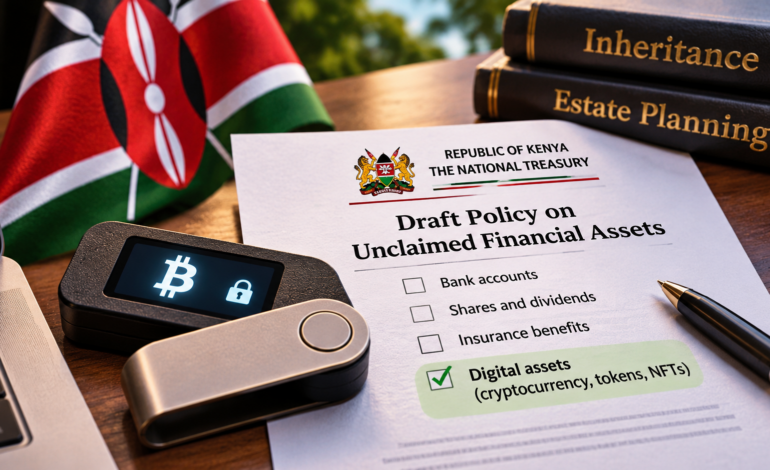
Kenya’s National Treasury is proposing changes to how unclaimed financial assets are identified, protected, and returned to their owners. The proposed framework includes digital assets such as cryptocurrencies, raising an important question for Bitcoin and stablecoin holders: what happens when someone dies or abandons a cryptocurrency account?
The proposal is contained in the Draft National Policy on Unclaimed Financial Assets, 2026, published for public participation in November.
According to the official Treasury draft, existing laws do not adequately address emerging assets such as cryptocurrencies, digital tokens, and non-fungible tokens.
The Treasury wants clearer rules for identifying these assets, safeguarding them, and ensuring they can eventually be returned to their rightful owners or beneficiaries.
Some reports have described the proposal as a plan for the government to seize abandoned cryptocurrency.
However, the draft is not an enacted cryptocurrency seizure law.
It is a proposed policy intended to guide future legal and regulatory changes.
The Treasury and Unclaimed Financial Assets Authority (UFAA) have invited comments from members of the public until December 4, 2026.
What Exactly Is Kenya Proposing?
Kenya already has an established system for handling unclaimed financial assets.
These include money held in dormant bank accounts, unpaid dividends, insurance benefits, and certain other assets that remain unclaimed.
The Unclaimed Financial Assets Authority is responsible for receiving, protecting, and reuniting qualifying assets with their rightful owners.
However, the existing framework was developed before cryptocurrencies became widely used.
This creates practical questions about digital assets.
For example, how should an exchange handle cryptocurrency belonging to a customer who has died?
What should happen when a cryptocurrency account remains inactive for many years?
And how should the value of cryptocurrency be recorded when its market price changes every day?
The Treasury’s proposed policy seeks to address these issues.
In Section 3.1.1, the draft calls for reviewing the law to provide clearer coverage of different financial asset classes.
Section 3.1.4 specifically proposes developing frameworks for receiving, safeguarding, and managing emerging digital financial assets.
These proposals would require further implementation before they become a complete operational regime for cryptocurrency.
What Is an Unclaimed Financial Asset?
An unclaimed financial asset is money or another qualifying financial asset that remains with a holding institution after the owner has failed to claim it under the conditions set by law.
For example, someone might open a bank account and later move to another country.
If the person forgets about the account and it remains inactive for the applicable period, the money could eventually become reportable as an unclaimed asset.
Another person might own company shares but never collect dividends.
When someone dies, their beneficiaries may not know the deceased had accounts, investments, or other assets.
These situations can leave considerable wealth inaccessible.
Kenya’s current system provides procedures for holding institutions to report qualifying unclaimed assets and for owners or beneficiaries to claim them.
The UFAA’s official explanation emphasizes that surrendering an unclaimed asset does not mean the rightful owner permanently loses their entitlement.
The authority’s role is to safeguard qualifying assets and facilitate their return.
How Could Cryptocurrency Become Unclaimed?
Cryptocurrency can be held in different ways.
Two common arrangements are custodial wallets and self-custody wallets.
Cryptocurrency held on an exchange
When someone keeps Bitcoin or USDT on a centralized exchange, the exchange generally controls the infrastructure used to hold the cryptocurrency.
The customer has an account and a claim governed by the platform’s terms and applicable law.
For example, a Kenyan investor might buy 0.2 BTC and leave it on an exchange.
If the investor dies, their family may not know the account exists.
The balance could remain untouched for years.
Depending on future regulations, qualifying dormant cryptocurrency balances held by custodial businesses could potentially become subject to unclaimed asset reporting or surrender obligations.
However, the new Treasury draft does not establish a universal cryptocurrency dormancy period or a complete transfer procedure.
Cryptocurrency held in a self-custody wallet
Self-custody works differently.
The user controls the private keys needed to authorize transactions.
For example, someone may store Bitcoin in a hardware wallet or use a software wallet with a recovery phrase.
If that person dies without sharing a lawful means of accessing the wallet, the cryptocurrency may remain inaccessible.
There is usually no central company that can simply reset the password or transfer the coins to the government.
The Treasury’s draft does not explain a technical mechanism for gaining access to cryptocurrency held in inaccessible private wallets.
This is an essential distinction.
A proposed unclaimed-assets policy does not automatically give authorities the ability to move Bitcoin from a wallet whose private key they do not possess.
Can the Kenyan Government Take Your Bitcoin?
The proposal does not establish a general power to confiscate cryptocurrency simply because someone owns it.
It concerns assets that qualify as unclaimed under applicable legal arrangements.
Even under Kenya’s existing unclaimed financial assets system, UFAA’s purpose is to hold assets for their rightful owners and beneficiaries, rather than treat every surrendered asset as permanently forfeited property.
The new policy seeks to expand and modernize the framework.
However, major details remain unresolved for cryptocurrencies.
These include:
- Which cryptocurrency accounts would qualify as abandoned.
- How dormancy would be determined.
- Whether digital assets would be transferred in their original form.
- How asset ownership would be verified.
- Which institutions would provide cryptocurrency custody.
- How beneficiaries could claim inherited cryptocurrency.
The answers would depend on future legislative and regulatory decisions.
It is therefore premature to claim that Kenya has already empowered UFAA to seize all inactive Bitcoin wallets.
Could Unclaimed Cryptocurrency Be Converted Into Kenyan Shillings?
The draft proposes clearer arrangements for assets denominated in foreign currencies.
Section 3.1.4 states that holders should report and surrender foreign-currency-denominated financial assets in Kenyan shillings using prevailing Central Bank of Kenya exchange rates.
This could be relevant to financial products denominated in US dollars and other foreign currencies.
However, the provision does not explicitly establish how a dollar-backed stablecoin such as USDT would be treated.
A stablecoin is a digital token intended to track a reference asset. It is not necessarily the same legal instrument as a conventional foreign-currency bank deposit.
The draft separately calls for new frameworks covering emerging digital financial assets.
It would therefore be premature to claim that all unclaimed USDT must automatically be sold and converted into shillings.
A final framework would need to clarify the treatment of cryptocurrencies, stablecoins, tokenized assets, and other digital financial instruments.
Why Does Cryptocurrency Make Inheritance Difficult?
Cryptocurrency inheritance can be complicated because access depends on custody arrangements.
Consider someone who owns Bitcoin worth KSh5 million.
If the Bitcoin is held on an exchange, their family may be able to pursue a claim through the exchange’s lawful estate procedures.
The process may require a death certificate, proof of legal authority, and other documents.
However, if the Bitcoin is held in a self-custody wallet and nobody knows the private key or recovery phrase, the family may be unable to access it.
A court order or succession document does not itself recreate a lost private key.
This can create a situation where someone legally inherits an asset but cannot technically transfer it.
The problem becomes even more complicated when heirs do not know the cryptocurrency exists.
Kenya’s draft policy identifies succession procedures as one of the barriers preventing families from recovering unclaimed financial assets generally.
It proposes improving the claims process and reducing unnecessary administrative obstacles.
How Much Unclaimed Wealth Exists in Kenya?
The Treasury’s draft cites a 2025 national survey estimating approximately KSh394 billion in unclaimed financial assets.
That compares with approximately KSh241 billion in a 2018 baseline estimate.
However, the KSh394 billion is an estimate of unclaimed financial assets across multiple categories.
It is not the amount of abandoned cryptocurrency held in Kenya.
The draft also discusses difficulties returning assets to owners and beneficiaries, including outdated contact details, incomplete records, and complicated inheritance procedures.
Separately, UFAA’s official trust fund information reports substantial remittances of unclaimed money and records of other asset categories.
These figures measure different things.
An estimate of potentially unclaimed wealth should not be confused with the amount already transferred to UFAA or the value of claims paid.
No verified national total for abandoned cryptocurrency is supplied in the draft policy.
What Should Kenyan Crypto Holders Do?
The debate highlights a practical issue that cryptocurrency owners should consider before an emergency occurs.
People holding digital assets should have an appropriate estate plan.
This does not mean sharing private keys publicly or sending recovery phrases through ordinary messages.
Instead, owners can document which platforms and wallets they use, establish lawful instructions for beneficiaries, and arrange secure access through trusted legal or custody processes.
Someone using an exchange should understand its inheritance procedures.
Someone using self-custody should consider how their beneficiaries would lawfully access the wallet without unnecessarily exposing the private keys while the owner is alive.
A well-designed estate plan may reduce the chance that digital assets remain inaccessible after death.
How Can Kenyans Give Feedback on the Proposal?
The National Treasury and UFAA have invited members of the public to submit written comments on the draft policy.
According to the official public participation notice, submissions must be received by Friday, December 4, 2026.
Comments can be emailed to:
The authorities have also scheduled public participation meetings in different counties between November 23 and December 4.
These include meetings in Mombasa, Kisii, Garissa, Kisumu, Kitui, Kitale, Meru, Eldoret, Nyeri, Nakuru, and Nairobi.
The Nairobi meeting is scheduled for December 4 at the Kenya School of Government.
This provides an opportunity for cryptocurrency users, exchanges, lawyers, fintech companies, and other stakeholders to raise concerns.
Questions worth addressing include how digital assets would be safeguarded, how rightful owners would be identified, and how self-custody arrangements would be treated.
Blockwisely Take: Crypto Inheritance Is a Problem Kenya Cannot Ignore
Cryptocurrency gives people a new way to own and transfer financial value.
But it also creates a problem that traditional financial systems were not originally designed to handle.
What happens when the owner disappears or dies?
A bank can often identify a deceased customer’s account through its records.
An exchange may also maintain customer information and account balances.
But cryptocurrency held in self-custody can be much harder to recover.
A family might know that someone owned Bitcoin and still have no way to access it.
Kenya is right to examine how digital assets fit into its unclaimed-assets system.
However, the solution must respect property rights, financial privacy, and the technical differences between custodial accounts and decentralized wallets.
It must also avoid treating cryptocurrency as though it is simply another bank balance.
The goal should be protecting owners and helping lawful beneficiaries recover assets, not creating uncertainty about whether the government can confiscate digital wealth.
For individuals, the most immediate lesson is simple.
Owning cryptocurrency is one responsibility.
Making sure your loved ones can recover it when necessary is another.
Frequently Asked Questions
Is Kenya planning to take abandoned cryptocurrency?
The Treasury has proposed expanding and modernizing the unclaimed financial assets framework to cover emerging digital assets. The proposal is not yet a cryptocurrency confiscation law.
Can UFAA access my private Bitcoin wallet?
The draft does not establish a technical mechanism allowing UFAA to move Bitcoin without the necessary private keys or other valid authorization.
What happens to crypto on an exchange if the owner dies?
The outcome depends on the exchange, the account terms, applicable law, and the estate’s legal authority. Future regulations may clarify how abandoned custodial balances are handled.
Will unclaimed USDT be converted into Kenyan shillings?
The draft includes a proposal involving foreign-currency assets, but it does not clearly establish how all stablecoins would be treated.
Has the new policy become law?
No. It is a draft policy published for public participation.
When is the deadline for comments?
The Treasury has set December 4, 2026, as the deadline for public submissions.
How much cryptocurrency is abandoned in Kenya?
The draft does not publish a verified nationwide estimate of abandoned cryptocurrency.
Can family members inherit Bitcoin?
Yes, cryptocurrency can form part of an estate, but legal entitlement and technical access are separate issues.
Should I give someone my wallet recovery phrase?
Recovery phrases should not be shared casually. Any inheritance arrangement should use secure procedures that minimize the risk of theft or unauthorized access.
Key Takeaways
- Kenya’s Treasury has published a draft policy on unclaimed financial assets.
- The document specifically identifies cryptocurrencies, tokens, and NFTs as emerging asset classes.
- The policy seeks clearer rules for custody, safeguarding, and returning abandoned assets.
- It does not establish a blanket power to confiscate cryptocurrency.
- Self-custody wallets present different challenges from exchange accounts.
- The draft does not specify a universal dormancy period for crypto or a complete digital asset transfer mechanism.
- Public comments are invited until December 4, 2026.
- Cryptocurrency owners should consider appropriate inheritance and recovery arrangements