




Nasdaq-100 Goes Onchain as Janus Henderson and Centrifuge Launch Tokenized Fund

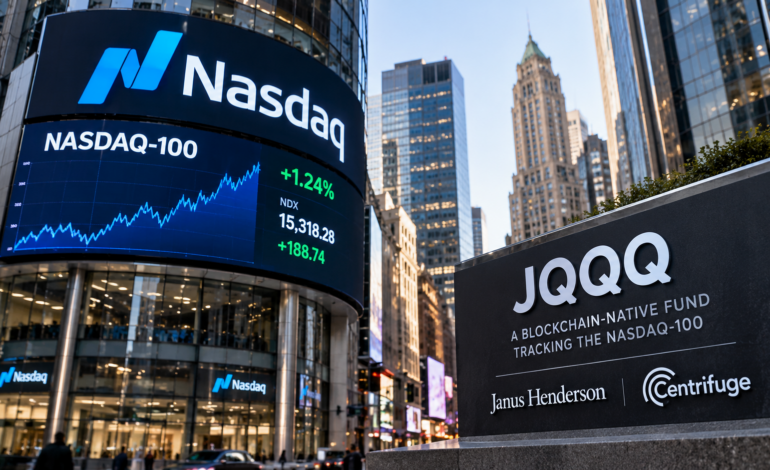
Global asset manager Janus Henderson and blockchain infrastructure company Centrifuge have launched JQQQ, a blockchain-native investment fund designed to provide exposure to the Nasdaq-100 Index.
The fund, announced on October 27, 2026, operates using the Stellar blockchain and is intended for eligible investors outside the United States.
It represents another important step in the growing effort to bring traditional financial products onto blockchain networks.
However, JQQQ is not a cryptocurrency version of every company in the Nasdaq-100, and owning it does not mean directly owning shares in those companies.
So, what exactly has been launched, and why does it matter?
What Is the JQQQ Fund?
JQQQ is an investment fund designed to provide exposure to the performance of the Nasdaq-100 Index through a blockchain-based structure.
According to an official announcement from Janus Henderson, the product combines traditional investment management with infrastructure developed by Centrifuge.
The fund seeks to track the Nasdaq-100 under a licensing arrangement with Nasdaq.
The Nasdaq-100 is an index that follows 100 of the largest non-financial companies listed on the Nasdaq Stock Market.
These include major businesses in technology and other sectors.
When people refer to the Nasdaq-100, they are talking about an index that measures the performance of a group of stocks, not a single company’s shares.
JQQQ is intended to provide investment exposure linked to that benchmark.
Importantly, investors in JQQQ do not receive direct ownership of the underlying Nasdaq-listed companies merely by holding the fund.
What Does It Mean to Put an Investment Fund on a Blockchain?
To understand the announcement, it helps to understand the difference between traditional investing and tokenization.
In a traditional investment fund, investor ownership is usually recorded and administered through financial institutions, fund administrators, custodians, and other regulated intermediaries.
Records are stored in financial databases, and transfers follow established market processes.
Blockchain technology offers another way to represent and manage financial interests.
What is tokenization?
Tokenization means creating a digital representation of an asset or a legal or economic interest in an asset on a blockchain.
For example, imagine an investment fund worth $10 million.
Instead of relying only on conventional fund administration systems, the fund could issue digital tokens representing investors’ interests.
If the structure allows it, an investor’s entitlement could be represented by a corresponding number of blockchain tokens.
The tokens would not automatically give holders additional rights beyond those established by the fund’s legal documents.
The important distinction is that the blockchain helps record or manage the investment interest.
The legal rights and underlying assets still depend on the fund structure.
What makes JQQQ different?
JQQQ has been designed for blockchain-based issuance and operation rather than simply adding a token representation to an existing retail fund.
Its infrastructure is provided by Centrifuge.
According to the Centrifuge announcement, the system is intended to support new ways of issuing, holding, and integrating institutional investment products with blockchain applications.
That could eventually include connections to other financial services, subject to eligibility, legal restrictions, and the capabilities of participating platforms.
Why Did Janus Henderson Choose the Stellar Blockchain?
The fund is launching on the Stellar network.
Stellar is a public blockchain designed to support digital asset transfers and financial applications.
It has previously been used for payment services and tokenized financial instruments.
For JQQQ, Stellar provides the blockchain infrastructure on which the fund’s digital interests can be issued and managed.
The official announcement says Stellar’s tokenized real-world asset ecosystem surpassed $4 billion in 2026.
That figure was reported by the launch partners and should not be confused with the amount invested in JQQQ itself.
The companies did not say that the new JQQQ fund had raised $4 billion.
How Is JQQQ Different From Buying a Nasdaq-100 ETF?
A traditional exchange-traded fund (ETF) that tracks the Nasdaq-100 can generally be bought and sold through a stockbroker on a supported exchange.
An ETF such as the well-known Invesco QQQ Trust provides investors with exposure to the Nasdaq-100 through a conventional securities-market structure.
JQQQ offers exposure through a different legal and technological arrangement.
| Feature | Traditional Nasdaq-100 ETF | JQQQ blockchain-native fund |
|---|---|---|
| Access | Through supported brokers and exchanges | Through eligible fund distribution arrangements |
| Recordkeeping | Conventional securities infrastructure | Blockchain-based fund infrastructure |
| Availability | Depends on the ETF and jurisdiction | Restricted to eligible investors and jurisdictions |
| Exposure | Nasdaq-100-related investment performance | Indirect Nasdaq-100-related economic exposure |
| Risk | Market, fund, and operational risks | Market, fund, blockchain, wallet, and smart contract risks |
JQQQ should not be treated as an ordinary retail ETF or a direct replacement for QQQ.
Its structure, liquidity, access requirements, and investor protections differ.
Who Can Invest in JQQQ?
The fund is not available to everyone.
Janus Henderson says the product is available only to eligible investors in jurisdictions where it can legally be offered.
It is not available to US persons.
This means someone in Kenya, Nigeria, or another African country cannot automatically invest simply because the fund operates on a public blockchain.
The investor would still need to satisfy the product’s eligibility requirements, applicable local laws, and any onboarding procedures.
The October 27 announcement did not establish that JQQQ was being offered to ordinary retail investors in African countries.
This distinction matters because blockchain accessibility and legal investment eligibility are two different things.
A token may exist on a public network without being legally available for purchase by everyone.
Could Tokenized Funds Be Used in DeFi?
One of the more interesting possibilities is the connection between traditional investments and decentralized finance, commonly called DeFi.
DeFi refers to financial applications built on blockchains, often using smart contracts to automate transactions.
A smart contract is software that executes defined actions when specified conditions are met.
In theory, tokenized investment funds could eventually be integrated into services such as:
- Collateralized lending: Using eligible fund interests as security for a loan.
- Portfolio management: Holding different financial assets within blockchain-connected investment systems.
- Automated financial products: Creating investment arrangements that follow predefined rules.
- Digital asset settlement: Coordinating the transfer of fund interests with other supported financial transactions.
These possibilities are part of the broader appeal of tokenization.
However, Janus Henderson specifically cautions that any third-party lending, collateral, or DeFi features are separate from the fund manager’s services.
Their availability is not guaranteed.
Investors should not assume JQQQ can already be used for borrowing, staking, or other DeFi activities.
What Are Real-World Assets in Crypto?
The JQQQ launch is part of a larger trend called real-world asset tokenization, often shortened to RWA tokenization.
A real-world asset is something with economic value outside the cryptocurrency market.
Examples include:
- Government bonds
- Corporate debt
- Real estate
- Investment fund shares
- Commodities
- Equity-related investment products
Tokenizing these assets means creating blockchain-based representations of the relevant ownership or economic rights.
For example, a fund holding government bonds could use blockchain tokens to represent investor interests in that fund.
The bonds would still exist within the financial and legal arrangements supporting the investment.
The blockchain would provide another method of recording or transferring the related interests.
This is different from launching a cryptocurrency with no claim on an underlying financial asset.
What Are the Risks of Investing in Tokenized Funds?
Blockchain technology introduces new possibilities, but it does not eliminate traditional investment risks.
Market risk
If the assets or investment strategy underlying a fund lose value, investors can lose money.
A blockchain record does not protect an investment from market declines.
Smart contract risk
Software vulnerabilities or failures could affect transfers, withdrawals, or other fund operations.
Liquidity risk
Investors may not always find a buyer or be able to redeem their interests immediately.
Legal risk
The rights associated with tokenized investments can depend on jurisdiction and the fund’s legal structure.
Custody and wallet risk
Access to blockchain-based assets may involve digital wallets and custody arrangements that create additional operational risks.
Janus Henderson warns that tokenized fund interests may face delays, operational failures, and potential losses arising from blockchain-related infrastructure.
What Could This Mean for African Investors?
For African investors, the development shows how global financial institutions are experimenting with new methods of providing access to investment products.
Over time, tokenization could create opportunities for financial service providers to connect eligible investors with international investment products through digital infrastructure.
It could also help African asset managers explore more efficient fund administration and settlement systems.
However, lower technical barriers do not automatically remove regulatory requirements, minimum investment amounts, foreign exchange restrictions, or investor eligibility rules.
The immediate significance of JQQQ is its demonstration of institutional interest in blockchain-based investment infrastructure.
It is not evidence that Nasdaq-100 investing has become universally accessible across Africa.
Blockwisely Take: Tokenization Is Becoming More Than a Crypto Experiment
For years, much of the conversation around blockchain focused on cryptocurrencies, trading, and speculation.
The launch of JQQQ shows a different direction.
Established investment managers are increasingly examining whether blockchain infrastructure can improve how familiar financial products are created, administered, and distributed.
That is important because the financial product itself does not have to be new.
What changes is the technology used to manage it.
A Nasdaq-100-related fund can remain an investment product with ordinary market risks while using blockchain-based infrastructure for parts of its operation.
For African markets, the most interesting long-term opportunity may be applying similar technology to local financial products such as government securities, investment funds, and other regulated assets.
But tokenization alone cannot solve financial inclusion.
A tokenized product that remains expensive, inaccessible, or difficult to redeem may offer little benefit to ordinary investors.
The real test will be whether blockchain-based funds provide better access, lower operational costs, and stronger financial services without sacrificing investor protection.
Frequently Asked Questions
What is JQQQ?
JQQQ is a blockchain-native investment fund launched by Janus Henderson and Centrifuge to provide indirect economic exposure to the Nasdaq-100 Index.
Is JQQQ a cryptocurrency?
It is a tokenized investment fund, not a conventional cryptocurrency such as Bitcoin. Its economic exposure comes from an investment structure linked to the Nasdaq-100.
Which blockchain does JQQQ use?
The fund launched on Stellar.
Can anyone buy JQQQ?
No. It is restricted to eligible investors in jurisdictions where the product can legally be offered. It is not available to US persons.
Is JQQQ the same as QQQ?
No. They are different investment products with different legal structures, distribution arrangements, and risks.
Does owning JQQQ mean owning shares in Apple or Nvidia?
No. Holding JQQQ provides economic exposure through the fund’s investment structure, not direct shareholder rights in individual Nasdaq-listed companies.
Is tokenization safer than traditional investing?
Not necessarily. Tokenization introduces additional technology and operational risks, even while potentially improving certain financial processes.
Key Takeaways
- Janus Henderson and Centrifuge announced JQQQ on October 27, 2026.
- The fund seeks to provide indirect exposure to the Nasdaq-100.
- JQQQ uses the Stellar blockchain.
- It is intended for eligible investors, not unrestricted retail trading.
- Tokenization may create new opportunities, but it does not eliminate market, legal, or technology risks.