





Circle Ventures Invests in CrissCross to Expand Stablecoin Payments Across Africa

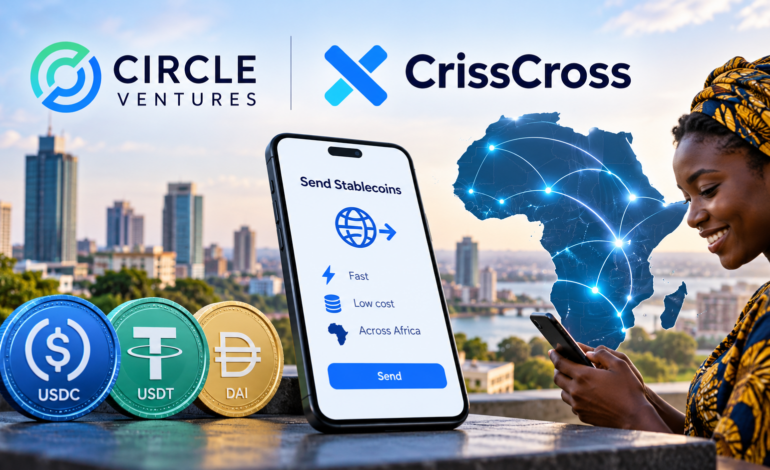
Circle Ventures has invested in African payments infrastructure company CrissCross through its parent company, Stitch Group, in a move aimed at expanding stablecoin-powered cross-border payments across more than 30 African markets.
The investment, announced on October 26, 2026, highlights growing interest from global cryptocurrency companies in solving one of Africa’s biggest financial challenges: moving money between countries quickly and affordably.
CrissCross says its infrastructure already supports more than 20 currencies and connects blockchain-based settlement systems with traditional payment methods, including bank accounts and mobile money wallets.
The amount invested was not disclosed.
What Happened Between Circle Ventures and CrissCross?
According to an official announcement by CrissCross, Circle Ventures, the investment arm of Circle Internet Group, made an investment through Stitch Group, which owns CrissCross.
Circle is best known as the issuer of USD Coin (USDC), one of the world’s largest US dollar-backed stablecoins.
Circle Ventures invests in companies that can help expand the use of digital financial infrastructure.
CrissCross provides businesses with infrastructure for collecting, converting, and sending money across African countries.
The companies say the investment will support the expansion of cross-border payment infrastructure that uses stablecoins as part of the settlement process.
However, neither company disclosed the investment amount, valuation, ownership stake, or specific expansion budget.
What Is CrissCross and How Does It Work?
CrissCross is a payments infrastructure provider focused on helping businesses move money between African markets.
Instead of requiring companies to separately integrate with different banks, mobile money providers, and currency exchange services, CrissCross provides access to these services through a single application programming interface (API).
An API is a connection that allows two software systems to communicate automatically.
For example, consider a Kenyan business that needs to pay a supplier in Nigeria.
Traditionally, the business may need to use a bank or international payment provider. The payment could involve several intermediaries, currency conversions, and processing delays.
With a service like CrissCross, a business could potentially initiate the payment through one integration while the provider handles the underlying currency conversion, settlement, and local payout.
CrissCross says its services include:
- Local collections: Receiving payments from customers in different African markets.
- Automated payouts: Sending funds to bank accounts and mobile wallets.
- Foreign exchange: Converting money between supported currencies.
- Corporate treasury management: Helping businesses manage money across different currencies and markets.
- Stablecoin settlement: Using blockchain-based digital assets to help move value between payment networks.
The company reports operating across more than 30 markets, supporting more than 20 currencies, and maintaining 99.99% platform uptime.
These are company-reported figures rather than independently audited performance statistics.
Why Are Stablecoins Important for Cross-Border Payments in Africa?
Cross-border payments remain a challenge for many African businesses.
A business operating in Kenya, Nigeria, Ghana, and South Africa may have to deal with different national currencies, banking systems, exchange rates, and financial regulations.
Sending money from one country to another can involve intermediary banks and payment processors, increasing costs and delays.
Stablecoins offer another way to settle transactions.
What is a stablecoin?
A stablecoin is a cryptocurrency designed to maintain a relatively stable value, usually by tracking an asset such as the US dollar.
For example, USDC is designed to maintain a value of approximately one US dollar.
Unlike Bitcoin, whose price can change significantly within a short period, a dollar-backed stablecoin aims to provide a more predictable unit of value.
However, stablecoins are not entirely risk-free. Their value, availability, and redemption depend on factors such as the issuer’s reserves, operational arrangements, and market conditions.
How can stablecoins make payments easier?
Imagine a business in Nairobi needs to pay a contractor in Accra.
A stablecoin-based payment provider could potentially:
- Receive the payment in Kenyan shillings.
- Convert the value into a dollar-backed stablecoin.
- Transfer the stablecoin across a blockchain.
- Convert it into Ghanaian cedis.
- Deliver the funds to the contractor’s bank account or mobile wallet.
The customer may never need to interact directly with a cryptocurrency wallet.
The stablecoin operates behind the scenes as part of the settlement infrastructure.
This approach may reduce the number of intermediaries involved in transferring value.
However, the final cost and speed still depend on local payment networks, foreign exchange spreads, liquidity, compliance checks, and the payment provider.
Using a stablecoin does not automatically guarantee that a payment will be cheaper or faster.
Why Is Circle Ventures Investing in African Payments Infrastructure?
The investment points to growing interest in payment infrastructure that connects digital currencies with traditional financial systems.
For stablecoins to become useful for everyday business payments, there must be reliable ways to convert between digital currencies and local money.
That means having access to banking relationships, mobile money systems, foreign exchange liquidity, and compliant payment services.
CrissCross is developing infrastructure intended to address those requirements.
In its announcement, CrissCross General Manager James Cope described Africa’s cross-border payments market as large and underserved.
Brian Schultz, Circle’s Vice President of Corporate Development and Ventures, also expressed support for CrissCross’s efforts to expand stablecoin-powered payment infrastructure.
The investment does not necessarily mean every transaction processed by CrissCross will use USDC, or that Circle has acquired operational control of the company.
Those details were not established in the announcement.
What Are the Challenges?
Stablecoin-based payment systems face challenges that extend beyond blockchain technology.
Regulation: Payment providers must comply with the financial regulations of the countries where they operate.
Currency conversion: Converting stablecoins into local currencies may be expensive when liquidity is limited.
Banking relationships: Providers still need reliable banking and payout partners.
Consumer protection: Businesses must understand who is responsible if a payment fails or funds become inaccessible.
Stablecoin risk: A stablecoin can lose its intended value or face redemption and operational problems.
These issues help explain why cross-border payment infrastructure involves more than simply sending tokens between digital wallets.
Frequently Asked Questions
What is Circle Ventures?
Circle Ventures is the corporate investment arm of Circle Internet Group, the company behind the USDC stablecoin.
How much did Circle invest in CrissCross?
The investment amount was not disclosed in the October 26, 2026 announcement.
Is CrissCross a cryptocurrency exchange?
CrissCross primarily describes itself as a cross-border payments infrastructure provider. It connects blockchain-based settlement with traditional financial services.
Does CrissCross support M-Pesa?
CrissCross says its infrastructure supports local mobile wallets, but the announcement does not provide a verified list of specific integrations, including M-Pesa.
Does the investment mean USDC will be accepted everywhere in Africa?
No. The investment does not automatically expand USDC availability or guarantee that businesses can use it in every African country.
Are stablecoin payments legal in Africa?
Rules differ between countries. Businesses should check applicable financial and digital asset regulations before offering or using these services.
Key Takeaways
- Circle Ventures invested in CrissCross through parent company Stitch Group.
- The investment was announced on October 26, 2026.
- CrissCross says it operates across more than 30 African markets and supports over 20 currencies.
- The investment amount was not disclosed.
- Stablecoins could improve cross-border settlement, but local banking, liquidity, and regulation remain essential.