




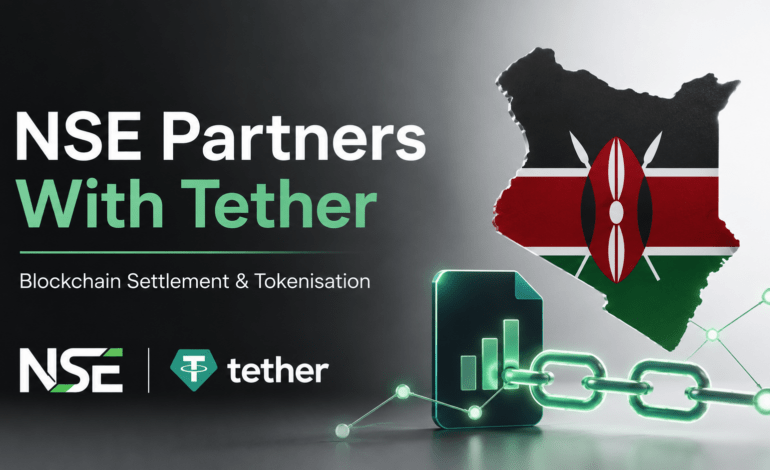
NSE Partners With Tether to Explore Blockchain Settlement and Tokenisation

Imagine buying a small portion of a Kenyan government bond, listed company share or property-backed investment through a digital platform.
Instead of waiting several days for ownership records and payments to move through different institutions, the transaction could potentially settle almost immediately on blockchain infrastructure.
That is the possibility the Nairobi Securities Exchange and Tether are now exploring.
On 28 July 2026, Tether announced that it had signed a Memorandum of Understanding with the Nairobi Securities Exchange to explore tokenised securities, blockchain-based market infrastructure, digital asset education and new settlement systems. The collaboration may also examine whether Tether’s USDT stablecoin could support securities settlement, where Kenyan regulations permit it.
The agreement does not mean NSE-listed shares have already been placed on a blockchain. It also does not confirm that Kenyan investors can currently settle stock-market transactions using USDT.
For now, the partnership is intended to study, design and potentially pilot the technology.
What Have the NSE and Tether Agreed to Explore?
The MoU covers several potential areas of cooperation between the Nairobi Securities Exchange and Tether.
These include:
- Blockchain infrastructure for tokenising securities
- Faster or instant settlement of market transactions
- Fractional access to securities for local and diaspora investors
- Digital asset and capital-markets education
- AML- and KYC-compliant investor onboarding
- The possible use of USDT as a settlement layer
- The issuance and trading of tokenised real-world assets through Tether’s Hadron platform
Tether said the proposed investor-education programme could include workshops and training sessions for NSE-listed brokers and retail investor groups.
The parties also plan to design and pilot onboarding processes suited to Kenya’s regulatory environment. These systems would seek to streamline Know Your Customer and Anti-Money Laundering checks without removing the compliance obligations expected in a regulated securities market.
The most ambitious part of the agreement involves the possible creation of blockchain-based infrastructure for issuing, trading and settling tokenised securities.
What Is Securities Tokenisation?
Securities tokenisation involves creating a blockchain-based digital representation of an investment asset.
The underlying asset could be:
- A company share
- A government or corporate bond
- A unit in an investment fund
- A commodity
- A property-backed instrument
- Another regulated financial product
The token does not necessarily replace the underlying asset. Instead, it can represent ownership or a legal claim connected to that asset.
For example, an issuer could divide a bond into many digital units. Investors might then purchase smaller portions than would be practical through conventional systems.
This is what is commonly described as fractional ownership.
The NSE and Tether say the proposed infrastructure could enable fractional access to securities for both Kenyan and diaspora investors.
In practice, the legal rights attached to a token would still depend on the structure of the product and approval from Kenya’s capital-markets regulator.
How Could Blockchain Settlement Work?
A securities transaction has two important sides.
The buyer must receive the investment asset, while the seller must receive payment.
In conventional market systems, the trade may be agreed immediately, but the final transfer of ownership and money can occur later. Several intermediaries, databases and reconciliation processes may be involved.
Blockchain infrastructure could allow the asset and payment to move through connected digital systems.
The NSE and Tether plan to explore instant and atomic settlement.
Atomic settlement generally means that both parts of a transaction happen together. Either the securities and payment are exchanged successfully, or neither side of the transaction is completed.
This could reduce the risk of one party delivering while the other party fails to meet its obligation.
It could also reduce the need for repeated reconciliation between separate institutional records, depending on how the eventual system is designed.
However, the technology would still need to work with Kenya’s existing legal, custody, payment and investor-protection requirements.
Could USDT Be Used to Settle NSE Transactions?
The MoU includes an assessment of whether USDT could serve as a digital settlement infrastructure layer.
Tether described this as a way to potentially improve liquidity and attract additional capital flows where its use is permitted.
USDT is a stablecoin designed to track the value of the US dollar. It can be transferred across supported blockchain networks without using the same payment rails as an ordinary bank transfer.
In a theoretical tokenised-securities transaction, an investor could exchange a digital settlement asset such as USDT for a token representing a security.
The asset and payment might then move simultaneously through smart-contract infrastructure.
However, Tether and the NSE have not announced that USDT has received approval for stock-market settlement in Kenya.
The wording of the announcement is deliberately conditional.
The parties will assess whether such an integration is viable and whether it would be allowed under the applicable regulations.
This distinction is important because a technical demonstration is not the same as regulatory approval for live market use.
What Is Tether’s Hadron Platform?
The partnership is expected to explore Tether’s Hadron platform for the tokenisation of real-world assets and financial instruments.
According to the announcement, Hadron could potentially support the issuance and trading of tokenised securities within the proposed NSE infrastructure.
A tokenisation platform typically provides tools for creating digital assets, defining ownership rules and managing functions such as issuance, transfers and compliance controls.
For a regulated exchange, these systems would also need to address matters such as:
- Investor identity verification
- Transfer restrictions
- Ownership records
- Corporate actions
- Asset custody
- Transaction monitoring
- Regulatory reporting
- Recovery procedures
- Cybersecurity
The MoU does not confirm which NSE securities would be considered first or which blockchain network would ultimately support the proposed system.
It also does not provide a public launch date.
The Agreement Is an MoU, Not a Completed Rollout
The partnership has sometimes been described as a tokenisation deal.
That description is technically correct, but it may create the impression that a complete trading platform has already been launched.
An MoU usually records the areas in which parties intend to cooperate. It does not necessarily amount to a final implementation contract.
The NSE and Tether announcement uses terms such as “explore,” “assess,” “design” and “pilot.”
It does not announce:
- A live tokenised-security product
- A confirmed launch date
- A completed blockchain settlement system
- Regulatory approval for USDT settlement
- A disclosed investment amount
- A list of securities selected for tokenisation
- Final technical or custody partners
The agreement should therefore be viewed as an exploratory step rather than the completion of NSE’s move to blockchain markets.
This Is Not NSE’s First Tokenisation Initiative
The Tether partnership is part of a wider NSE strategy to explore digital assets and modern market infrastructure.
The exchange previously joined the Hedera Council to accelerate initiatives involving the tokenisation of securities and real-world assets.
In that announcement, NSE said it intended to explore the eventual launch and trading of tokenised securities, subject to regulatory approval.
The NSE also indicated that it would operate a node on the Hedera network and participate in the network’s governance alongside other council members.
Separately, the exchange was involved in plans for a Kenya Digital Exchange designed to support the issuance and trading of tokenised real-world assets, including equities, debt, funds and commodities. The proposed project was described as a regulated platform that would work with Kenya’s Capital Markets Authority.
The latest Tether agreement therefore appears to extend an existing digital-market strategy rather than introduce tokenisation to the NSE for the first time.
Why Is the NSE Exploring Tokenisation?
The NSE says the collaboration supports its 2025–2029 strategic plan, which focuses on technology, increased market participation and broader access to investment opportunities.
NSE chief executive Frank Mwiti said the exchange is exploring technologies that could modernise infrastructure, improve efficiency and expand investor access while maintaining market integrity and regulatory compliance.
Several potential benefits help explain the interest.
Faster settlement
Blockchain-based settlement could shorten the period between a trade and its final completion.
Lower operational friction
Connected digital records could reduce some of the reconciliation required between separate market systems.
Fractional investment
Tokenisation could make it practical to divide certain assets into smaller investment units.
Wider investor access
Digital platforms could potentially make regulated securities easier to reach for retail and diaspora investors.
New financial products
Tokenisation may support new structures involving bonds, funds, property, commodities and other real-world assets.
Longer market availability
Some tokenised markets operate beyond traditional exchange hours, although whether that would apply to NSE products would depend on regulatory and operational decisions.
These potential benefits should not be treated as guaranteed outcomes. They depend on the final technology, legal structure and level of investor adoption.
The Role of the Capital Markets Authority
The Nairobi Securities Exchange operates under the regulatory jurisdiction of Kenya’s Capital Markets Authority.
The CMA is responsible for regulating and developing Kenya’s capital markets, promoting market integrity and protecting investor confidence.
Any live system involving tokenised NSE securities would therefore need to fit within Kenya’s capital-markets framework.
Regulatory questions could include:
- Whether the token qualifies as a security
- Who may issue and distribute it
- How ownership is legally recorded
- Which institutions may provide custody
- How investors are verified
- How client assets are protected
- Whether secondary trading is permitted
- How market manipulation is monitored
- What happens if the blockchain platform fails
- Whether stablecoins may be used for settlement
Approval would also need to account for Kenya’s emerging framework for virtual asset service providers.
The collaboration announcement acknowledges this regulatory dependency by repeatedly referring to systems designed for the Kenyan regulatory environment and settlement mechanisms permitted by law.
Frequently Asked Questions
Has the NSE started trading tokenised shares?
No. The NSE and Tether have signed an MoU to explore tokenisation and blockchain settlement. No live tokenised NSE share was announced.
Can investors currently buy NSE shares using USDT?
No such service has been confirmed. The parties will assess whether USDT could support settlement where Kenyan regulations permit it.
What is the purpose of the NSE–Tether agreement?
The partnership will explore digital asset education, tokenised securities, blockchain settlement, fractional investment, compliant onboarding and potential use of USDT in market infrastructure.
What is Hadron?
Hadron is Tether’s platform for tokenising real-world assets and financial instruments. The NSE partnership will explore whether it can support the issuance and trading of tokenised securities.
What is a tokenised security?
It is a blockchain-based digital token representing ownership or economic rights connected to a regulated financial asset such as a share, bond, fund or commodity.
Would tokenised NSE securities be regulated?
Any live securities product would be expected to comply with Kenya’s capital-markets laws and obtain the necessary regulatory approvals.
Could tokenisation lower the cost of investing?
It could make smaller investment units and more efficient settlement possible. However, the actual cost would depend on platform fees, custody, regulation and product design.
When will the system launch?
The MoU did not provide a confirmed launch date.