



Bitcoin Miners Face Growing Pressure as JPMorgan Estimates $86,000 Production Cost

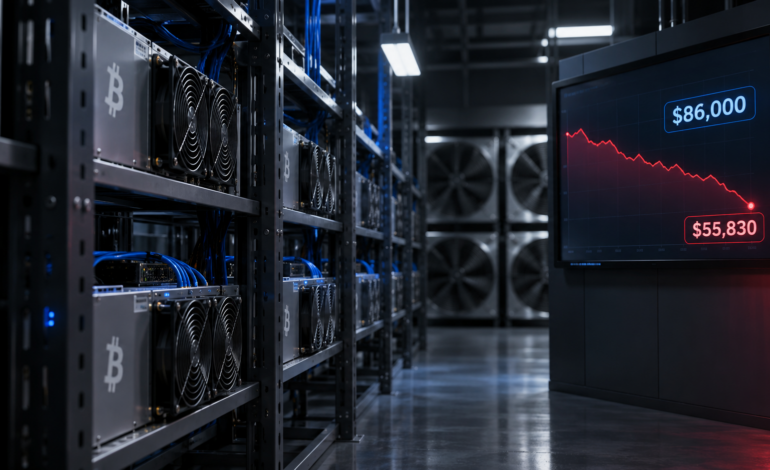
Bitcoin’s sharp price decline is creating new challenges for mining companies after JPMorgan analysts estimated that producing one Bitcoin costs approximately $86,000 under their industry model. With Bitcoin falling to around $55,830 on November 21, the gap between the market price and that estimate has widened significantly.
According to a November 20 report by The Block, JPMorgan analysts led by Nikolaos Panigirtzoglou warned that lower Bitcoin prices could put additional financial pressure on mining operators.
The bank’s research note was published on November 18, when Bitcoin was trading closer to $65,000.
Since then, the cryptocurrency has fallen further.
However, the estimated $86,000 production cost should not be confused with the actual cost paid by every Bitcoin miner.
Mining expenses differ considerably depending on electricity prices, hardware, network difficulty, and company financing arrangements.
The original JPMorgan analyst note was not publicly available for full independent examination. Its specific conclusions are therefore attributed to reporting on the research.
What Did JPMorgan Say About Bitcoin Mining?
JPMorgan analysts estimate that the industry’s central Bitcoin production cost is approximately $86,000.
This is a model-based measurement intended to capture broad mining economics.
The analysts believe that the widening difference between their estimate and Bitcoin’s market price may encourage some higher-cost miners to sell their reserves.
For example, a mining company might hold Bitcoin accumulated during earlier periods.
If operating expenses exceed available cash income, the company may sell part of those holdings to pay electricity bills, service debts, or finance other activities.
The analysts also suggested that some mining companies could redirect investment toward artificial intelligence infrastructure.
However, these are assessments of financial pressure and potential industry behaviour.
They do not prove that every mining company is currently losing money or selling Bitcoin.
What Does It Actually Cost to Mine One Bitcoin?
Bitcoin mining involves running specialized computers that compete to solve computational problems.
Successful miners add new blocks to the blockchain and receive rewards.
The process requires substantial electricity and computing equipment.
A miner’s cost structure may include:
- Electricity.
- Mining equipment.
- Cooling and maintenance.
- Staff and facilities.
- Financing and debt payments.
- Network participation and pool fees.
These costs vary between companies.
A miner using inexpensive electricity and modern equipment may operate far more efficiently than a company relying on older machines and expensive power.
For example, two facilities might use similar equipment but pay very different electricity tariffs.
The facility with cheaper power may continue operating profitably at Bitcoin prices that would cause the other facility to shut down.
That is why JPMorgan’s $86,000 figure should be presented as a central estimate rather than a universal break-even price.
How Big Is the Gap Between Cost and Price?
On November 21, Reuters reported Bitcoin trading near $55,830.
Compared with JPMorgan’s $86,000 central cost estimate, the gap was approximately $30,170.
That places the reported market price about 35% below the bank’s estimated production cost.
However, this calculation is a comparison between two different measurements.
It does not mean every mining company loses $30,170 on each Bitcoin it produces.
Some operators have lower cash costs.
Others have additional debt, depreciation, or infrastructure expenses that make their true economic costs higher.
It is also possible for a miner to remain operational during temporary periods when selling prices are below its full accounting cost.
The decision to continue mining depends partly on whether current revenue covers the expenses that can be avoided by shutting down.
Why Would Miners Sell Bitcoin Reserves?
Mining companies receive Bitcoin as part of their revenue.
Some sell the cryptocurrency soon after earning it.
Others hold a portion of their rewards in anticipation of higher future prices.
During periods of financial pressure, companies may sell more of their holdings.
For example, a mining business may need money to pay for electricity, repay loans, or purchase equipment.
Selling reserves can provide cash.
However, if many companies sell at the same time, that activity could contribute to broader market selling pressure.
JPMorgan analysts suggest that such activity may be occurring among higher-cost operators.
The available reporting does not identify a verified aggregate amount of Bitcoin sold by all miners as a direct result of the November decline.
Therefore, the claim should remain qualified.
What Happens When Mining Becomes Unprofitable?
A miner that cannot cover its operating expenses may reduce activity or shut down some equipment.
This reduces the amount of computing power contributed to the Bitcoin network.
That computing power is commonly measured using hash rate.
Hash rate represents the number of computational attempts miners make while competing to find valid blocks.
If many miners leave, the total network hash rate may decline.
However, lower hash rate does not automatically mean Bitcoin stops working.
The network has a mechanism that adjusts the difficulty of mining.
How Does Bitcoin’s Difficulty Adjustment Work?
Bitcoin is designed to produce blocks at an average interval of approximately ten minutes.
If more computing power joins the network, blocks may temporarily be found faster.
If computing power leaves, blocks may temporarily be found more slowly.
To compensate, Bitcoin periodically adjusts how difficult it is to mine a block.
According to the Bitcoin developer documentation, this adjustment occurs every 2,016 blocks.
That is approximately every two weeks under normal conditions, although the exact time can vary.
A simple example
Imagine Bitcoin’s price falls and some expensive mining facilities shut down.
The network now has less computing power.
At the next difficulty adjustment, the mining difficulty may decrease.
That makes it easier for the remaining miners to discover valid blocks relative to the previous difficulty.
Lower difficulty can improve their Bitcoin earnings relative to their computing power.
JPMorgan believes this process could help narrow the gap between the market price and estimated production costs.
However, it does not guarantee that every miner becomes profitable.
Could Bitcoin Mining Stop Completely?
A market downturn can reduce mining participation.
But Bitcoin’s network is designed to adjust to changes in computing power.
As long as miners remain willing to participate and the network continues operating, valid blocks can still be produced.
The system’s difficulty adjustment helps accommodate changes in mining activity.
However, large and sudden reductions in hash rate can temporarily slow block production until difficulty adjusts.
Mining concentration can also create security and decentralization concerns.
The important point is that mining economics affect the network, but a low Bitcoin price does not automatically cause the system to stop.
Why Are Bitcoin Mining Companies Moving Into AI?
Some mining companies have begun expanding into artificial intelligence and high-performance computing infrastructure.
Both activities require substantial access to electricity, cooling, and data-centre facilities.
This creates potential opportunities to reuse certain infrastructure.
For example, a company operating a large mining facility may have valuable power connections and access to industrial property.
It could potentially adapt parts of the site to host AI computing equipment.
However, the transition is not simple.
AI data centres often require different networking systems, processors, reliability standards, and customer contracts.
Specialized Bitcoin mining machines generally cannot simply be reprogrammed to train large AI models.
A company moving into AI may need major additional capital investment.
Therefore, the idea that every mining company can easily become an AI infrastructure provider is misleading.
What Does This Mean for African Bitcoin Miners?
Africa has attracted interest from cryptocurrency mining companies because some locations offer access to renewable electricity or underused power generation capacity.
However, the economic challenges are similar to those experienced elsewhere.
A mining company must consider its electricity costs, infrastructure reliability, equipment efficiency, and financing arrangements.
A falling Bitcoin price reduces the dollar value of its rewards.
Operators with high electricity costs may struggle.
More efficient facilities may remain viable.
For companies evaluating African mining projects, reliable power contracts and careful financial planning are therefore critical.
It would be risky to assume that Bitcoin’s price will always remain above a projected mining break-even level.
Does Mining Below Cost Mean Bitcoin Is Undervalued?
Not necessarily.
Production cost can be a useful indicator when studying the economics of mining.
However, it does not determine a guaranteed minimum Bitcoin price.
Bitcoin’s market price depends on buyers and sellers.
If demand weakens, the price can remain below the estimated production cost for an extended period.
The network may respond through changes in mining activity and difficulty.
That process does not automatically push the market price back above a particular estimate.
Investors should therefore be cautious about treating the $86,000 figure as a guaranteed price floor.
Frequently Asked Questions
Does it cost $86,000 to mine one Bitcoin?
JPMorgan estimates a central industry production cost of approximately $86,000. Actual costs differ between operators.
What happens when Bitcoin trades below mining cost?
Higher-cost miners may reduce operations, use reserves, borrow money, or shut down equipment.
Are all miners losing money?
No such conclusion follows from the estimate. Mining costs and financial arrangements vary widely.
Can Bitcoin mining difficulty decrease?
Yes. Bitcoin adjusts its mining difficulty approximately every 2,016 blocks.
Does a lower Bitcoin price stop the network?
Not automatically. The network can continue operating with participating miners.
Why are miners moving into AI?
Some companies see opportunities to use power connections, facilities, and other infrastructure for AI computing.
Can Bitcoin mining machines run AI models?
Specialized ASIC Bitcoin miners generally cannot be repurposed directly for conventional AI training.
Is $86,000 Bitcoin’s price floor?
No. The market price can trade below estimated production cost.
Key Takeaways
- JPMorgan analysts estimate Bitcoin’s central production cost at approximately $86,000.
- Bitcoin fell to approximately $55,830 on November 21.
- The gap is around $30,170, but this is not a verified per-coin loss for every miner.
- Higher-cost operators may face stronger financial pressure.
- Miners may reduce operations or sell holdings to fund expenses.
- Bitcoin’s difficulty automatically adjusts to changes in network computing power.
- Some mining companies are exploring AI infrastructure opportunities.
- Production-cost estimates do not establish a guaranteed minimum Bitcoin price.