



US Senate Passes Bill to Ban Prediction Markets on War, Assassinations and Death

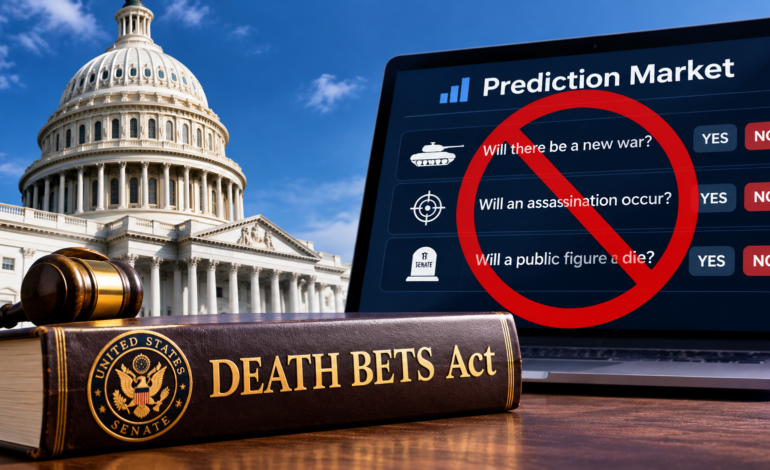
The US Senate has passed bipartisan legislation aimed at prohibiting federally regulated prediction market platforms from offering contracts tied to war, terrorism, assassinations, military operations and individual deaths. The bill, known as the DEATH BETS Act, marks an important step in efforts to establish clearer limits on what people can legally trade through prediction markets.
The Senate passed the legislation on November 19, 2026, with support from Democratic Senator Adam Schiff of California and Republican Senator John Curtis of Utah.
According to the official announcement from Senator Schiff’s office, the bill passed by unanimous consent.
The legislation would amend the Commodity Exchange Act to restrict certain contracts offered or cleared by entities registered with the Commodity Futures Trading Commission (CFTC).
However, Senate passage does not mean the bill has become law.
The legislation still requires action by the House of Representatives and the remaining steps of the federal legislative process.
What Is the DEATH BETS Act?
The DEATH BETS Act is short for the Discouraging Exploitative Assassination, Tragedy, and Harm Betting in Event Trading Systems Act.
It was introduced in March 2026 by Senators Schiff and Curtis.
The proposed law aims to prohibit federally registered prediction market entities from listing certain contracts based on violent or fatal events.
Under the amended text adopted by the Senate, the restricted categories include:
- Terrorism.
- Assassination.
- War.
- US Armed Forces military operations.
- Similar activities identified through appropriate CFTC regulations.
- Contracts principally expected to resolve based on an individual’s death.
The exact wording matters.
For example, the restriction on individual death contracts addresses whether death is the principal basis for resolving the contract.
The legislation does not simply prohibit every market involving a person’s name or every prediction about global affairs.
Why Are US Lawmakers Targeting These Markets?
Prediction markets allow people to buy and sell contracts based on future events.
Some markets cover elections, economic indicators, sports, and business outcomes.
Others have involved questions about military conflicts, political instability, or events that could cause injury or death.
Lawmakers supporting the DEATH BETS Act argue that allowing people to profit directly from fatal events creates ethical and security risks.
For example, someone with confidential information about a military operation might have an unfair advantage in a market predicting whether an attack will occur.
More seriously, legislators are concerned that markets offering financial rewards for violent outcomes could create harmful incentives.
These are the policy concerns behind the bill.
They do not establish that every trader participating in a controversial prediction market has engaged in criminal conduct.
What Is a Prediction Market?
A prediction market is a system in which participants trade contracts based on the outcomes of future events.
Imagine a market asking whether a particular economic indicator will exceed a specified level by the end of the month.
A YES contract might trade at $0.65.
Traders may interpret that price as indicating an approximately 65% market-implied probability.
If the event occurs, a winning contract may settle at $1, depending on the platform’s rules.
If it does not occur, the contract may settle at zero.
However, trading prices do not guarantee an event’s probability or outcome.
Markets can be influenced by liquidity, trader behaviour, information quality, and other factors.
Prediction market operators must also establish clear rules for determining results.
Why Would Death-Related Markets Be Different?
Some prediction markets can help aggregate information about uncertain future events.
For example, markets concerning inflation or election outcomes can reflect participants’ expectations.
But death-related markets present different concerns.
A contract based primarily on whether a person dies may create a financial incentive connected to harm.
Contracts linked to military attacks may also attract people who possess sensitive information unavailable to ordinary traders.
Supporters of the DEATH BETS Act argue that such markets should be prohibited rather than simply supervised.
However, that position does not resolve every debate about prediction markets.
Some researchers and industry participants argue that event markets can help forecast important developments.
The policy question is where the benefits of information aggregation end and unacceptable incentives or risks begin.
What Exactly Does the Senate Bill Prohibit?
The amended Senate text is more specific than some headlines suggest.
It would prohibit covered registered entities from listing or accepting for clearing certain contracts expressly referencing terrorism, assassination, war, and US military operations.
It also addresses contracts whose outcomes are reasonably expected to depend principally on an individual’s death.
The restriction is directed at registered entities operating under the relevant federal derivatives framework.
It is not written as a universal prohibition on every forecast, research project, discussion forum, or private opinion about future events.
It also does not automatically establish the legal position of every offshore prediction market.
Those questions would depend on applicable laws and the platform’s activities.
Does the Bill Ban Sports Prediction Markets?
No. The DEATH BETS Act does not itself establish a general ban on sports prediction contracts.
The Senate adopted an amendment containing a rule of construction intended to avoid changing the existing legal position of other types of event contracts.
This is particularly important because sports prediction markets are already the subject of disputes between federal regulators, states and private companies.
The sponsors explained that the legislation should not be interpreted as resolving those separate disputes.
In other words, the DEATH BETS Act deals with certain categories involving violence and death.
It does not settle whether sports event contracts are gambling products, derivatives, or otherwise permissible under federal and state law.
How Does This Affect Kalshi?
Kalshi operates a federally regulated prediction market exchange in the United States.
As a CFTC-regulated entity, it falls within the broader regulatory framework addressed by the proposed legislation.
If the bill becomes law, covered platforms would need to ensure that their listed contracts comply with the new restrictions.
However, the Senate’s passage does not establish that Kalshi has violated the proposed law.
It also does not mean Kalshi must close its entire business.
The legislation targets particular types of contracts rather than the existence of prediction markets generally.
Kalshi has separately been involved in legal disputes concerning sports-related event contracts.
Those disputes must be assessed independently.
What About Polymarket?
Polymarket operates prediction market services through different arrangements, including an international blockchain-based platform and US-regulated operations.
The DEATH BETS Act is written around entities registered under the relevant US commodities regulatory framework.
Its effect on a particular Polymarket business would depend on the legal entity, product, jurisdiction, and applicable law.
It would therefore be inaccurate to say that the Senate has banned Polymarket worldwide.
Similarly, the passage of the bill does not establish that every offshore prediction contract becomes illegal under US law.
Has the US Already Banned War Prediction Markets?
Existing US commodities law already contains restrictions allowing the CFTC to review certain event contracts, including contracts involving war, terrorism and assassination.
The DEATH BETS Act seeks to strengthen those restrictions.
According to the Senate sponsors’ explanation, the bill would establish a clearer statutory prohibition rather than leave the relevant decision entirely to the regulator’s public-interest determination.
It also explicitly addresses contracts involving an individual’s death.
That is an important addition because the existing statutory wording does not identify individual death in the same way.
The bill is therefore better understood as an attempt to make certain restrictions more explicit.
It is not the first time US regulators or lawmakers have considered whether violent-event contracts should be prohibited.
What Happens After Senate Passage?
The bill must still progress through the remaining legislative process.
The House of Representatives would need to approve compatible legislation.
If the two chambers pass different versions, they must resolve those differences.
The resulting legislation would then require the appropriate final steps before taking effect as law.
As of November 21, the DEATH BETS Act has passed the Senate but has not been confirmed as enacted federal law.
This distinction is essential.
A bill that passes one chamber is a major legislative development, but it does not automatically create new binding restrictions.
Could Other Countries Adopt Similar Rules?
Possibly.
The US debate illustrates the difficulty of regulating prediction markets.
Some products resemble financial derivatives.
Others resemble sports betting or gambling.
The way a platform is regulated depends on its products and the jurisdiction in which it operates.
Countries considering prediction market frameworks may need to decide which event categories are permitted and which should be restricted.
For example, regulators could distinguish contracts based on financial indicators from contracts involving violence or death.
However, there is no universal global rule requiring every country to copy the US approach.
Each jurisdiction must apply its own laws.
What Does This Mean for Kenya?
A prediction market operating in Kenya would need to consider the relevant local legal framework.
Depending on the product design, activities could raise questions involving gambling, financial derivatives, consumer protection, payments and financial crime.
Using cryptocurrency does not automatically remove those obligations.
A platform could also face rules concerning customer identity verification, market manipulation, settlement disputes, and the protection of customer funds.
The DEATH BETS Act is useful as an international policy example.
It demonstrates that regulators may distinguish between the general concept of prediction markets and the specific events on which people are allowed to trade.
But the US Senate’s decision does not directly change Kenyan law.
Blockwisely Take: Prediction Markets Need Limits, Not Just More Trading Volume
Prediction markets have become a fast-growing part of the financial technology industry.
They are attracting investors, technology companies, and traders who want to express views about future events.
But growth creates difficult questions.
Should every event be turned into a financial contract?
Is a market useful simply because people are willing to trade it?
And what happens when someone stands to profit from a harmful outcome?
The DEATH BETS Act is an attempt to draw a clear boundary.
Its supporters believe markets involving war, terrorism, assassination and individual death create risks that outweigh their possible informational value.
The bill does not answer every regulatory question facing prediction markets.
Sports contracts remain disputed.
Insider trading and market manipulation raise separate concerns.
Different countries also have different legal frameworks.
For African founders building prediction markets, the lesson is important.
The long-term success of a platform depends on more than liquidity and trading volume.
It also depends on which markets are offered, how they are resolved, whether users are protected, and whether the business operates within the law.
Not every event that can be predicted should necessarily be turned into a market.
Frequently Asked Questions
What is the DEATH BETS Act?
It is proposed US legislation aimed at prohibiting certain prediction market contracts involving war, terrorism, assassination, military operations and individual death.
Has the DEATH BETS Act passed?
It passed the US Senate on November 19, 2026.
Is the bill already law?
No. Senate passage alone does not make it federal law.
Does it ban all prediction markets?
No. It targets specified categories of contracts offered or cleared by covered registered entities.
Does it ban sports prediction markets?
No. The bill does not itself establish a general ban or approval for sports contracts.
Does it ban Kalshi?
No. The legislation addresses particular contracts, not the entire Kalshi platform.
Does it ban Polymarket worldwide?
No. Its direct legal scope concerns covered entities under US law.
Who introduced the bill?
US Senators Adam Schiff and John Curtis sponsored the bipartisan legislation.
Would the bill affect Kenyan prediction markets?
It does not directly change Kenyan law. Kenyan platforms must comply with the laws applicable to their own activities.
Key Takeaways
- The US Senate passed the DEATH BETS Act on November 19, 2026.
- The legislation was sponsored by Senators Adam Schiff and John Curtis.
- It targets certain contracts involving terrorism, assassination, war, US military operations and individual death.
- The amended text applies to covered registered entities.
- It does not create a blanket ban on all prediction markets.
- It does not settle separate legal disputes over sports contracts.
- House action and further legislative steps are still required.
- The development highlights increasing regulatory scrutiny of prediction market design and ethics.