









Can Someone Claim Satoshi’s Bitcoin in Court? A $293 Billion Lawsuit Says Yes

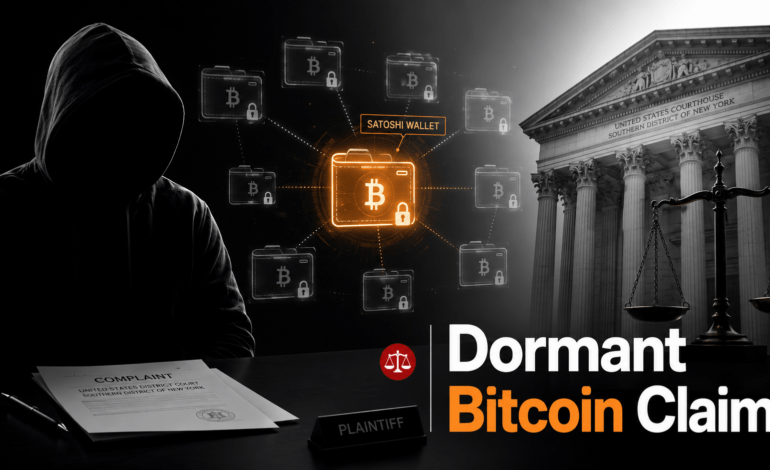
An anonymous plaintiff has filed one of the strangest Bitcoin lawsuits ever seen.
A plaintiff is the person or organization that starts a lawsuit. They are the one who brings a legal complaint to court and asks a judge to make a decision.
The person, using the name Noah Doe, wants a New York court to recognize him and two unnamed companies as the legal owners of thousands of dormant Bitcoin wallets.
The wallets reportedly hold more than 3.7 million BTC.
At recent prices, that is worth around $293 billion.
The most shocking part is not just the size of the claim. It is who some of the wallets may be linked to.
Reports say the list includes early Bitcoin addresses connected to Satoshi Nakamoto, the mysterious creator of Bitcoin. It also reportedly includes wallets linked to major historical events in Bitcoin, including the Mt. Gox hack and other long-inactive addresses.
But there is one very important detail.
The plaintiff does not appear to have the private keys.
That means he cannot move the Bitcoin on-chain.
So the big question is simple:
Can a court give someone legal ownership of Bitcoin they cannot actually access?
What Is This Bitcoin Lawsuit About?
The lawsuit was filed in the Supreme Court of the State of New York.
The plaintiff is identified as Noah Doe, together with two unnamed Wyoming companies referred to as ABC Company and XYZ Company.
According to reports, Doe claims he used an algorithm to identify thousands of Bitcoin wallets that had been inactive for years.
He then reportedly delivered records of those wallets to the NYPD as “found property.”
The lawsuit argues that the wallets should be treated as abandoned property under New York lost-property law.
In simple terms, Doe is saying:
“I found these dormant Bitcoin wallets, I reported them, nobody claimed them, so the law should now recognize me as the owner.”
That is the heart of the case.
How Much Bitcoin Is Involved?
Reports say the lawsuit targets 39,069 dormant Bitcoin addresses.
Those addresses are estimated to hold about 3.7 million to 3.79 million BTC.
Depending on Bitcoin’s market price, that puts the value somewhere around $285 billion to $293 billion.
That would make this one of the largest property claims in crypto history.
For context, this is not a small forgotten wallet with a few coins inside. This is a legal claim touching a huge portion of Bitcoin’s total supply.
That is why the story has attracted so much attention.
Why Are Satoshi’s Wallets Being Mentioned?
Some of the addresses in the lawsuit are reportedly linked to very early Bitcoin mining activity.
That has led analysts to connect parts of the list to Satoshi-era Bitcoin wallets.
Satoshi Nakamoto is believed to have mined a large amount of Bitcoin in the early days of the network. Many of those coins have never moved.
This is part of what makes Bitcoin’s history so fascinating.
If coins remain untouched for more than a decade, people start asking questions:
- Were the keys lost?
- Is the owner dead?
- Is the owner choosing not to move them?
- Are they part of Satoshi’s original holdings?
But inactivity alone does not prove abandonment.
That is where this lawsuit becomes controversial.
Why the Case Is So Controversial
Bitcoin is built around private keys.
A private key is the secret code that allows someone to move Bitcoin from a wallet.
If you control the private key, you can spend the Bitcoin.
If you do not control the private key, you cannot move the Bitcoin.
This is why Bitcoin users often say:
“Not your keys, not your coins.”
Noah Doe’s lawsuit challenges that idea from a legal angle.
He is not claiming that he has the private keys. Instead, he is asking a court to recognize legal ownership based on abandoned property law.
That creates a strange situation.
A court could theoretically issue a legal ruling. But the Bitcoin network itself would not care.
Bitcoin does not check court orders. It checks digital signatures.
Without the private keys, the coins cannot move.
Can a Court Move Bitcoin?
No.
A court cannot directly move Bitcoin from one wallet to another.
Bitcoin is not controlled by a bank, exchange, company, or government database. It is controlled by a decentralized network.
To move coins from a Bitcoin address, a valid transaction must be signed using the correct private key.
A judge can declare that someone has a legal claim.
A judge can order a person or company to transfer assets.
But if nobody has the private key, there is no simple way to force the Bitcoin network to move those coins.
That is why this case is so unusual.
Even if the plaintiff won a legal declaration, the practical question would remain:
How do you access Bitcoin without the keys?
Why the “Abandoned Property” Argument Is Difficult
The lawsuit relies on the idea that dormant Bitcoin wallets can be treated like lost or abandoned property.
That may sound simple at first, but Bitcoin makes it complicated.
With normal lost property, there is usually a physical item. For example, someone may find a wallet, jewelry, cash, or a forgotten bank document.
Bitcoin is different.
A Bitcoin address is public information.
Anyone can see it on the blockchain.
But seeing an address does not mean finding the property in the traditional sense.
It is more like seeing a locked safe through a glass wall. You know it exists, but you cannot open it.
There is also another problem.
A wallet being inactive does not prove the owner has abandoned it.
The owner may be holding long term.
The owner may be dead.
The owner may have lost the keys.
The owner may be Satoshi.
The owner may simply not want to move the coins.
Bitcoin does not require users to keep proving ownership by making transactions.
Why Analysts Are Skeptical
Crypto analysts have criticized the lawsuit for several reasons.
One major criticism is the valuation argument.
Reports say the lawsuit tries to treat the listed wallet addresses as low-value property for legal purposes, even though the Bitcoin connected to them is worth hundreds of billions of dollars.
Analysts also point out that some addresses on the list may create serious legal and technical problems.
For example, if the list includes coins linked to hacks, burn addresses, or Satoshi-era wallets, the ownership question becomes even more complicated.
A burn address is especially important. A burn address is usually designed so that nobody can spend the funds. If coins are sent there, they are effectively removed from circulation.
Claiming ownership of such addresses would not mean the coins can actually be recovered.
Could This Set a Legal Precedent?
Possibly, but only if the case goes far enough.
The lawsuit raises a serious question that courts may need to answer more often in the future:
Can digital assets be treated as abandoned property if they have not moved for years?
If a court says yes, it could encourage more claims against dormant crypto wallets.
If a court says no, it would strengthen the idea that blockchain inactivity does not equal abandonment.
Either way, this case could become an important legal reference in future crypto disputes.
But for now, it is too early to treat the case as a major legal breakthrough.
No ruling has confirmed the plaintiff’s claim.
FAQ
Who is Noah Doe?
Noah Doe is the name used by the anonymous plaintiff in the New York lawsuit. The person is trying to claim legal ownership of thousands of dormant Bitcoin wallets.
Is Noah Doe claiming Satoshi’s Bitcoin?
Reports say the lawsuit includes addresses believed to be linked to early Bitcoin mining and possibly Satoshi-era wallets. However, that does not prove the plaintiff can access or move those coins.
Does Noah Doe have the private keys?
Based on available reports, no. The plaintiff reportedly does not claim to have the private keys.
Can a court give someone Satoshi’s Bitcoin?
A court can make legal rulings, but Bitcoin cannot be moved without the correct private keys. A court order alone cannot force the Bitcoin network to transfer coins.
Does inactivity mean a Bitcoin wallet is abandoned?
Not necessarily. A Bitcoin wallet can remain inactive for many reasons. The owner may be holding long term, may have lost the keys, may be dead, or may simply choose not to move the coins.
Why is this lawsuit important?
It could test how traditional property law applies to dormant crypto wallets. It also highlights the difference between legal ownership and technical control in Bitcoin.