


Sudan’s Cashi Secures $660,000 Investment to Keep Digital Payments Working During Crisis

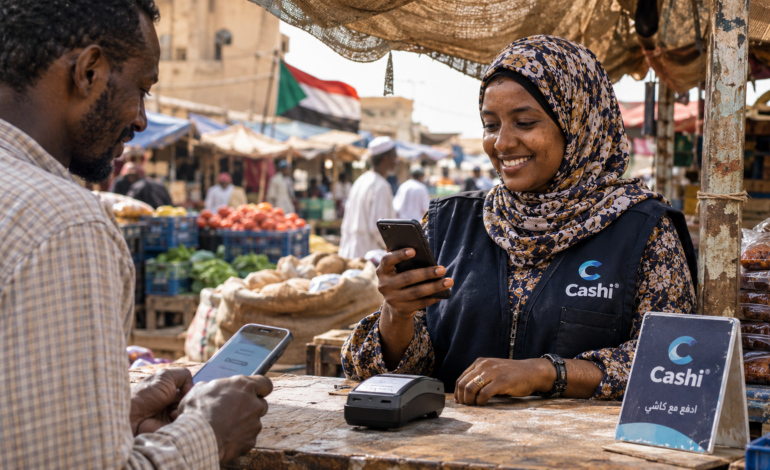
Sudanese fintech company Cashi has secured €600,000, approximately $660,000, from French development finance institution Proparco to expand digital payment services in a country where conflict, banking disruptions, and unreliable internet access have made everyday financial transactions increasingly difficult.
According to Proparco’s official announcement, the funding will support Cashi’s operations in Sudan and other underserved markets.
It is Proparco’s first financing operation in Sudan.
Cashi has developed payment services that do not always require a smartphone application or a continuous internet connection.
Its MyCashi wallet has reached approximately 2.2 million registered users, according to Proparco.
That is particularly important in Sudan, where years of conflict have disrupted banking services, telecommunications networks, and access to cash.
But how can a digital payment company keep operating when the internet is unreliable and traditional banks are struggling?
What Has Cashi Announced?
Cashi has received a €600,000 equity investment from Proparco, the private-sector financing arm of the French Development Agency Group.
An equity investment generally means an investor provides capital in exchange for an ownership interest in a business.
It is different from an ordinary bank loan that must be repaid according to a fixed repayment schedule.
Proparco says the investment is intended to strengthen Cashi’s ability to provide reliable and accessible financial services.
The development institution has identified Sudan as a particularly challenging environment for financial services because of conflict and economic instability.
The investment is notable because international financiers often face considerable risks when operating in countries affected by war.
According to Proparco, this is its first financing operation in Sudan.
The company has not publicly disclosed every commercial detail of the transaction, including its ownership percentage or Cashi’s resulting valuation.
Key figures
| Metric | Confirmed or reported figure |
|---|---|
| Investment | €600,000 |
| Approximate dollar equivalent | $660,000 |
| Investor | Proparco |
| Company | Cashi |
| Founded | 2022 |
| Registered MyCashi users | 2.2 million |
| Original announcement | November 9, 2026 |
| Investment structure | Equity investment |
The user count comes from Proparco’s company announcement. It measures registered users, not necessarily people who actively transact every month.
What Is Cashi?
Cashi is a Sudanese fintech business founded in 2022.
The company develops payment technology intended to help individuals and businesses access financial services even where traditional banking infrastructure is limited.
It grew out of experience associated with alsoug.com, a Sudanese online marketplace.
That background helped the company identify a common problem.
People may be willing to buy and sell goods, but payments become difficult when cash is scarce, banking services are interrupted, or internet access is unreliable.
Cashi is trying to address that problem through a combination of digital wallets, local merchants, and alternative payment channels.
Its services allow customers to perform activities including depositing and withdrawing cash, transferring money, and paying bills.
Rather than depending exclusively on banking branches, Cashi works with a network of merchants who help customers access payment services.
How Can Cashi Work Without Reliable Internet?
One of Cashi’s most interesting features is its support for different payment channels.
Many modern financial applications assume customers have smartphones and reliable internet connections.
That assumption does not always reflect reality.
In areas affected by conflict, internet connections can fail, electricity may be unavailable, and smartphones may be difficult to charge or replace.
Cashi has developed services involving USSD, SMS, and offline card technology to reduce dependence on conventional smartphone applications.
What is USSD?
USSD stands for Unstructured Supplementary Service Data.
It is a mobile telecommunications technology that allows users to interact with a service through short codes.
For example, someone might dial a short code on a basic mobile phone and receive a menu with different financial options.
The technology is familiar to many people in African markets.
Unlike a conventional mobile app, USSD does not require an ordinary mobile internet data connection.
However, it still depends on functioning mobile network infrastructure.
That is an important distinction.
A service using USSD may be accessible without internet data, but it cannot operate if the relevant telecommunications network is completely unavailable.
What about SMS payments?
SMS-based services use text messages to communicate instructions, notifications, or transaction information.
These can be useful where mobile data is unreliable but basic telecommunications services remain operational.
However, SMS also depends on connectivity and requires appropriate security controls.
How do offline cards work?
Offline card-based systems can support certain payment interactions without requiring every step to use a live internet connection.
The exact process depends on the technology, merchant equipment, and settlement arrangements.
Offline payment systems still need safeguards against duplicate transactions, fraud, and synchronization problems.
Cashi has not publicly disclosed every technical detail of its offline payment architecture.
The important point is that the company is developing multiple ways for people to access financial services rather than relying exclusively on conventional smartphone apps.
How Many People Use Cashi?
Proparco reports that MyCashi has reached 2.2 million registered users.
That is an important milestone for a fintech operating in difficult conditions.
However, registered users and active users are different measurements.
A registered user is someone who has created or been assigned an account.
A monthly active user is someone who uses the service during a particular month.
The Proparco announcement does not provide a verified number of monthly active users or disclose the exact number of transactions processed through MyCashi.
It also does not publish Cashi’s current revenue, profit, or total transaction value.
Therefore, the 2.2 million figure should not be presented as evidence that 2.2 million people use the wallet every day.
Could Cashi Help Humanitarian Organizations?
Potentially.
Humanitarian organizations frequently need to transfer money to people affected by conflict and displacement.
Cash assistance can help households purchase food, medicine, transport, and other essential items.
However, delivering that assistance may be difficult when banks and telecommunications infrastructure are unreliable.
Proparco says Cashi’s payment technology is designed to help facilitate financial transactions and the distribution of humanitarian assistance.
A system with multiple payment methods and a local merchant network could support some of those needs.
However, the announcement does not establish that every humanitarian organization in Sudan uses Cashi.
Nor does it independently demonstrate how many aid payments have been delivered through its infrastructure.
Those outcomes would require additional operating data.
Why Would Proparco Invest in Sudan?
Proparco supports private-sector projects intended to contribute to economic development.
Its investment in Cashi is consistent with that mandate.
The institution says accessible financial services are especially important in fragile and conflict-affected markets.
A payment service that helps people receive money, pay bills, and support local commerce can have value beyond ordinary business growth.
For example, reliable payment access can help small businesses continue operating and allow families to manage essential expenses.
But investing in Sudan involves substantial risks.
These include insecurity, infrastructure disruptions, economic volatility, and operational uncertainty.
Proparco’s announcement confirms the investment decision, not that these risks have disappeared.
What Happens Next for Cashi?
The €600,000 investment is expected to help Cashi strengthen its operations and expand access to financial services.
Proparco has not published a detailed timetable identifying every new location or product that will receive funding.
The investment also does not guarantee that Cashi will reach a specific future user count.
Important indicators to monitor include the number of active users, the reliability of its services, the size of its merchant network, and whether customers can access their money consistently.
Its ability to operate through further disruptions will also matter.
Frequently Asked Questions
How much funding did Cashi receive?
Proparco announced a €600,000 equity investment, reported as approximately $660,000.
Who invested in Cashi?
Proparco, the private-sector financing arm of the French Development Agency Group.
When was the investment announced?
Proparco published its announcement on November 9, 2026.
What does Cashi do?
Cashi provides digital wallet and merchant-assisted payment services, including cash deposits, withdrawals, bill payments, and money transfers.
How many users does Cashi have?
Proparco reports that its MyCashi wallet has 2.2 million registered users.
Does Cashi work without internet?
The company supports alternative channels such as USSD, SMS, and offline card services. Their functionality still depends on the relevant underlying infrastructure.
Why is the investment important?
It supports financial services in Sudan during a period of significant humanitarian and economic disruption and represents Proparco’s first financing operation in the country.
Key Takeaways
- Proparco announced a €600,000 equity investment in Cashi.
- The transaction is approximately equivalent to $660,000.
- Cashi is a Sudanese fintech founded in 2022.
- Its MyCashi wallet has 2.2 million registered users, according to Proparco.
- The business supports merchant-assisted payments, USSD, SMS, and offline card services.
- The investment is Proparco’s first financing operation in Sudan.
- The financing is intended to improve access to essential financial services.
- Future commercial and humanitarian outcomes have not been guaranteed.