


From Africa to Brazil: Yellow Card Makes Its Next Big Stablecoin Move

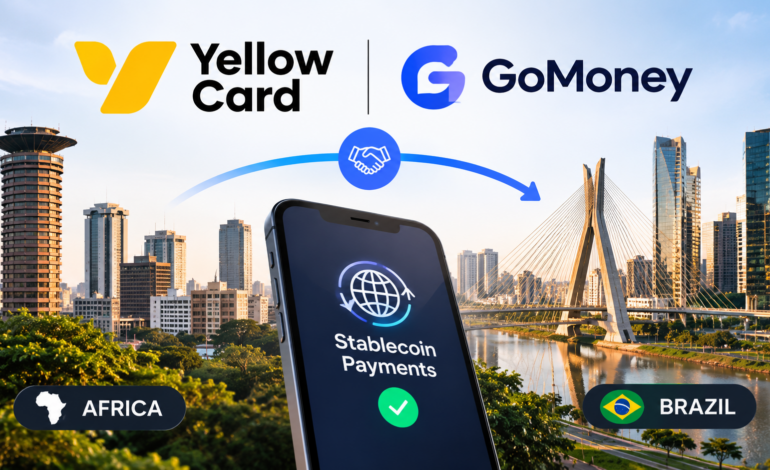
Yellow Card, a stablecoin payments company that built much of its business across Africa, has acquired Brazilian fintech GoMoney as it expands into Latin America. The deal gives Yellow Card direct operations in Brazil and strengthens its ambition to build payment infrastructure connecting businesses across international markets.
The acquisition was completed in October 2026 and officially announced on November 4.
According to Yellow Card’s official announcement, GoMoney will become a wholly owned subsidiary of Yellow Card, while its founders will continue managing the business.
The companies did not disclose how much Yellow Card paid for the acquisition.
The move comes just three months after Yellow Card secured $40 million in funding from investors including Standard Chartered’s venture investment arm, Sony Innovation Fund, Polychain Capital, and Blockchain Capital.
But why is a company that became known for cryptocurrency services in Africa now buying a business in Brazil?
The answer has a lot to do with stablecoins, international payments, and the growing demand for alternatives to traditional cross-border banking.
What Has Yellow Card Announced?
Yellow Card has completed the acquisition of GoMoney, a Brazilian virtual asset service provider headquartered in São Paulo.
GoMoney was established in 2018 and focuses on helping businesses receive payments in Brazil and settle transactions using digital assets.
The acquisition provides Yellow Card with a locally established business that understands Brazil’s payment infrastructure, banking relationships, and regulatory environment.
For Yellow Card, that local presence is important.
Moving money between countries involves more than transferring cryptocurrency over a blockchain.
Businesses also need ways to collect local currencies, convert funds, manage liquidity, and pay recipients through domestic banking and payment systems.
GoMoney provides experience and infrastructure in these areas.
Following the acquisition, Yellow Card says its business customers can access local collections and payouts in Brazilian reais, including through Pix, alongside stablecoin settlement services.
The acquisition has been completed, but not every proposed future service or expansion is guaranteed.
What Is GoMoney, and Why Did Yellow Card Buy It?
GoMoney is a Brazilian virtual asset service provider founded in 2018.
Its main business involves helping companies accept payments from Brazilian customers and settle transactions using digital assets.
For example, an international company selling services in Brazil may want to receive payments in Brazilian reais without maintaining complicated payment arrangements across multiple countries.
GoMoney’s infrastructure can help businesses access local payment channels while using stablecoins for parts of their settlement processes.
That makes it a natural fit for Yellow Card’s business.
Yellow Card already provides stablecoin payment, treasury, and liquidity services to financial institutions, fintech companies, and multinational businesses.
By acquiring GoMoney, it can combine those services with an established Brazilian operation.
Yellow Card co-founder and CEO Chris Maurice said in the company’s November 4 announcement that building global financial infrastructure requires local expertise, regulatory compliance, and access to domestic payment systems.
In simple terms, Yellow Card is not just buying another cryptocurrency company.
It is acquiring infrastructure and expertise that could help international businesses move money into and out of Brazil.
What Is Pix, and Why Does It Matter?
One of the most interesting aspects of the deal is access to Brazil’s Pix payment system.
Pix is an instant payment method developed by the Central Bank of Brazil.
It allows individuals and businesses to transfer money between supported accounts within seconds, including during weekends and public holidays.
According to the Central Bank of Brazil’s official explanation, Pix was designed to make payments faster, more convenient, and less expensive.
For Kenyan readers, the easiest comparison is M-Pesa.
Both systems have made digital payments more convenient, although they operate differently.
M-Pesa is a mobile money service, while Pix is a payment system connecting participating Brazilian financial institutions and payment providers.
Why combine Pix with stablecoins?
Pix is useful for moving Brazilian reais within Brazil.
Stablecoins can help transfer value between financial service providers across international markets.
Combining the two could allow businesses to collect payments locally and settle internationally.
Imagine a business in Kenya selling software services to a company in Brazil.
The Brazilian customer might pay in reais using Pix.
A payment provider could then convert that value into a supported stablecoin and arrange settlement to the Kenyan business.
The Kenyan recipient could potentially receive the value in a supported currency through another local payment provider.
This is an illustration of how the infrastructure could work, not confirmation that Yellow Card currently offers this exact Kenya-to-Brazil payment route.
The actual availability, fees, currencies, and processing times would depend on the services supported in each market.
Why Is Brazil Important to Yellow Card?
Brazil is one of the world’s most significant cryptocurrency markets.
According to Chainalysis’ September 2026 research on Latin America, Brazil recorded approximately $252.5 billion in cryptocurrency activity between July 2025 and June 2026.
That made it the largest cryptocurrency market in Latin America during the reporting period.
It was followed by Argentina and Mexico.
The research also found that stablecoin activity in Brazil grew by 495% across its 2024 to 2026 comparison period.
That is a striking increase.
However, the figure measures growth across the study’s specified period. It does not mean stablecoin activity increased 495% in a single year.
Chainalysis attributes part of the growth to businesses using stablecoins for cross-border payments and liquidity management.
Brazil’s cryptocurrency market
| Metric | Chainalysis estimate |
|---|---|
| Crypto activity, July 2025 to June 2026 | $252.5 billion |
| Stablecoin activity growth, 2024–2026 comparison | 495% |
| Regional position by crypto activity | Largest in Latin America |
| Latin American crypto activity overall | $593.8 billion |
These estimates measure cryptocurrency transaction activity rather than new investment or business revenue.
They help explain why an international stablecoin infrastructure provider would want a direct presence in Brazil.
The opportunity is not limited to speculative cryptocurrency trading.
Businesses increasingly need reliable ways to manage cross-border payments and access foreign currencies.
Yellow Card Raised $40 Million Before the Acquisition
The GoMoney acquisition follows a major fundraising announcement earlier this year.
On August 4, 2026, Yellow Card announced that it had raised $40 million in strategic funding.
The investors included SC Ventures, Sony Innovation Fund, Polychain Capital, Blockchain Capital, and other strategic investors.
The funding brought Yellow Card’s total equity financing to more than $120 million, according to the company.
Yellow Card said the investment would support international expansion, its Global USD Accounts product, and stablecoin payment infrastructure.
The Brazil acquisition is consistent with those ambitions.
However, the company has not disclosed how much it spent on GoMoney or whether the purchase was directly financed using proceeds from the August fundraising round.
It would therefore be inaccurate to claim that the entire $40 million was used to acquire GoMoney.
How Yellow Card Has Changed Its Business
Yellow Card began as a cryptocurrency-focused company serving African markets.
Its earlier services made it possible for customers to buy and sell digital assets using local currencies.
Over time, the company increasingly focused on providing infrastructure to businesses rather than operating only as a retail cryptocurrency platform.
Its services now target financial institutions, fintech companies, and other businesses that need to move money internationally.
These services include stablecoin settlements, local currency payments, treasury management, and access to dollar-denominated financial infrastructure.
The company ended its retail trading operations in late 2025 as part of its transition toward business-focused services.
That shift matters because it changes how Yellow Card makes money and which customers it serves.
Instead of competing mainly for individual cryptocurrency traders, the company is building payment infrastructure that other businesses can use.
The GoMoney acquisition supports this direction.
It expands the local infrastructure available to Yellow Card’s business customers in a major international market.
Has GoMoney Received a Full Cryptocurrency Licence in Brazil?
Not yet.
This is an important distinction in Yellow Card’s announcement.
GoMoney has submitted an application to the Central Bank of Brazil to operate as an authorized virtual asset service provider.
The application falls under Brazil’s Law No. 14,478/2022 and Central Bank Resolution No. 519/2025.
According to Yellow Card, GoMoney continues operating under Brazil’s transitional regulatory regime while its application undergoes review.
That means the acquisition is completed, but full regulatory authorization is still pending.
Why does regulatory approval matter?
Companies handling cryptocurrency and digital asset payments may be required to meet rules concerning financial crime prevention, customer identification, governance, operational security, and risk management.
In some countries, businesses can continue certain activities under transitional arrangements while regulators process licence applications.
However, transitional arrangements should not be confused with permanent authorization.
For Yellow Card, obtaining the necessary approvals will be important as it develops its Brazilian operations.
The company has not announced that GoMoney’s application has been fully approved.
Could This Connect African and Brazilian Businesses?
Potentially.
Africa and Brazil have commercial relationships involving industries such as agriculture, manufacturing, energy, technology, and professional services.
Businesses operating between the regions may need to make international payments, manage currencies, or settle transactions with suppliers.
Traditional payment arrangements can involve correspondent banks, foreign exchange conversions, and processing delays.
Stablecoin infrastructure may provide another way to settle certain transactions.
Consider an African business importing equipment from Brazil.
A payment provider could potentially receive funds in an African currency, convert the value into a stablecoin, and coordinate settlement with a Brazilian payment provider.
The Brazilian supplier could then receive reais through a supported local payment system.
Yellow Card’s existing African presence and GoMoney’s Brazilian operations could help support such arrangements.
However, the acquisition announcement does not establish that all Africa-to-Brazil payment corridors are operational.
It also does not guarantee faster transfers or lower costs for every customer.
Those benefits would depend on local partnerships, regulatory approvals, liquidity, pricing, and the actual services launched.
Why Are Businesses Interested in Stablecoin Payments?
Stablecoins are cryptocurrencies designed to maintain a relatively stable value.
The most widely used examples, USDT and USDC, are designed to track the US dollar.
This makes them different from cryptocurrencies such as Bitcoin, whose prices can change significantly.
For international businesses, dollar-backed stablecoins can provide a digital way to transfer and hold dollar-denominated value.
A simple example
Imagine a business needs to pay an overseas supplier $10,000.
Using traditional banking, the transfer might involve several institutions and currency conversions.
With a stablecoin-based payment provider, the business could potentially send the equivalent amount through supported blockchain infrastructure.
The supplier’s payment provider could then convert the stablecoin into a local currency.
However, blockchain settlement is only one part of the process.
The provider must still manage compliance, liquidity, local payment systems, and customer support.
A blockchain transaction taking seconds does not mean the entire international payment will always finish in seconds.
Stablecoins also carry risks involving issuers, reserves, redemption, wallet security, and regulations.
What Does This Acquisition Mean for African Fintech?
Yellow Card’s move into Brazil is an example of a company with a strong African business foundation pursuing opportunities beyond the continent.
Historically, many African financial technology companies have depended on international infrastructure providers to access global markets.
Yellow Card is pursuing the opposite opportunity: using capabilities developed around emerging-market payment challenges to build a broader international service.
That could have implications for African fintech companies providing payments, currency conversion, and treasury services.
It may also encourage more partnerships between African and Latin American financial businesses.
However, there are important commercial questions.
Will Yellow Card attract enough international customers to justify its acquisition?
Can it manage regulatory obligations across several jurisdictions?
Will stablecoin-based settlement provide measurable cost or efficiency improvements over existing payment methods?
And can the company maintain reliable local currency liquidity as it enters new markets?
The answers will determine whether the Brazilian expansion produces lasting business growth.
What Happens Next for Yellow Card?
Yellow Card says it will continue developing its presence in strategic international markets.
The company plans to expand its services, strengthen partnerships, and improve its financial infrastructure products.
GoMoney will continue operating as a wholly owned subsidiary under its existing founders.
One important milestone will be the outcome of GoMoney’s application for full authorization from Brazil’s central bank.
Another will be evidence of commercial adoption.
For example, announcements involving payment volumes, additional customers, functioning regional corridors, or new financial institution partnerships would provide a clearer picture of how the acquisition is performing.
Until such information becomes available, claims about its future revenue or market impact remain projections.
Blockwisely Take: Africa Is Becoming a Builder of Global Financial Infrastructure
Yellow Card’s acquisition of GoMoney represents more than another cryptocurrency company expanding into a new country.
It reflects a change in how some African-focused fintech businesses are approaching global finance.
For years, many African companies built services around payment problems that were not adequately addressed by traditional international banking infrastructure.
These problems included slow cross-border transfers, limited access to foreign currencies, expensive conversions, and fragmented local payment systems.
Stablecoins offered another possible way to move value between financial institutions and markets.
Yellow Card has spent years developing infrastructure around these challenges.
Now it is taking that experience into Brazil, another market where businesses have significant demand for alternative international payment services.
The acquisition is also a reminder that stablecoin payments require more than blockchain technology.
Local payment systems such as Pix, regulatory approvals, reliable banking relationships, and liquidity management are equally important.
For Africa, the bigger story is the possibility of fintech businesses developing useful financial infrastructure locally and then expanding it globally.
However, success will depend on execution.
Buying a Brazilian company establishes a presence in the market, but it does not automatically create a seamless Africa-to-Brazil payment network.
The most important development to watch is whether Yellow Card can turn its expanded infrastructure into affordable, reliable, and compliant payment services that businesses actually use.
The acquisition is complete. The bigger opportunity is still being built.
Frequently Asked Questions
Did Yellow Card acquire GoMoney?
Yes. Yellow Card completed its acquisition of Brazilian virtual asset service provider GoMoney in October 2026 and announced the deal on November 4.
How much did Yellow Card pay for GoMoney?
The companies have not publicly disclosed the purchase price.
What does GoMoney do?
GoMoney provides virtual asset and payment infrastructure services that help international businesses receive payments in Brazil and settle transactions using digital assets.
What is Pix?
Pix is Brazil’s instant payment system, developed by the country’s central bank. It allows participating users and businesses to send and receive money in seconds.
Can Yellow Card now send money directly from Kenya to Brazil?
The acquisition adds Brazilian local payment and stablecoin settlement capabilities. However, the announcement does not confirm that every specific Africa-to-Brazil payment route is already commercially available.
Has GoMoney received full regulatory approval in Brazil?
No. Its application for full virtual asset service provider authorization remains under review. The company operates under Brazil’s transitional regime.
Did Yellow Card raise $40 million?
Yes. Yellow Card announced a $40 million strategic funding round in August 2026.
Is Yellow Card still a retail cryptocurrency exchange?
Yellow Card has shifted its focus toward business-to-business stablecoin payment and treasury infrastructure rather than its previous retail trading services.
Why did Yellow Card choose Brazil?
Brazil is Latin America’s largest cryptocurrency market by transaction value, according to Chainalysis’ 2026 research, and has a significant market for stablecoin-based business services.
Does the acquisition mean stablecoin payments will become cheaper?
Not automatically. Costs will depend on the payment corridors, fees, exchange rates, liquidity, providers, and regulations involved.
Key Takeaways
- Yellow Card acquired Brazilian fintech GoMoney in October 2026.
- The acquisition was announced on November 4.
- GoMoney will operate as a wholly owned Yellow Card subsidiary.
- The deal adds local Brazilian real collections, payouts, and stablecoin settlement capabilities, including through Pix.
- GoMoney’s full regulatory authorization remains pending.
- Brazil recorded approximately $252.5 billion in cryptocurrency activity during the year ending June 2026, according to Chainalysis.
- Yellow Card raised $40 million in strategic funding in August 2026.
- The acquisition supports Yellow Card’s international business payment strategy, but future commercial outcomes remain uncertain.