








Hyperbridge Updates Exploit Losses to $2.5M as Recovery Efforts Begin

In the fast-evolving world of cross-chain infrastructure, security incidents often reveal both the strengths and weaknesses of protocol design.
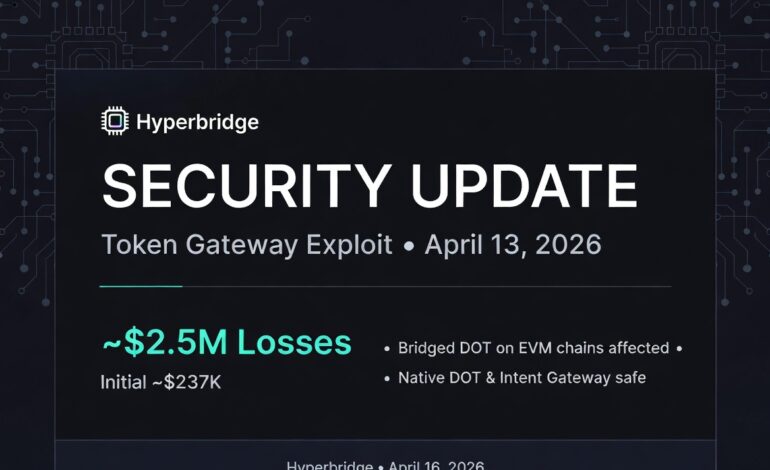
On April 16, 2026, Hyperbridge released a detailed update on its April 13 Token Gateway exploit revising initial loss estimates from approximately $237,000 to around $2.5 million.
The increase stems from additional drains across incentive liquidity pools on multiple EVM-compatible chains, offering a more complete picture of the exploit’s true impact.
What Actually Happened
The attack unfolded in multiple stages, highlighting both technical precision and systemic vulnerabilities.
Step 1: Initial Drain
The attacker first extracted approximately 245 ETH from a related Token Gateway contract.
Step 2: Forged Cross-Chain Message
Roughly an hour later, the attacker exploited a flaw in Hyperbridge’s Merkle Mountain Range (MMR) verification logic.
This allowed a forged cross-chain message to bypass validation effectively tricking the system into accepting a malicious request as legitimate.
Step 3: Admin Takeover and Mass Mint
With the forged message accepted, the attacker gained unauthorized control over the bridged DOT contract and:
- Minted 1 billion bridged DOT tokens
- Deployed them across multiple chains
- Began liquidating into available liquidity pools
Step 4: Multi-Chain Liquidity Drain
The attacker then dumped the tokens across:
- Ethereum
- Base
- BNB Chain
- Arbitrum
While early reports suggested profits of only ~108 ETH (~$237K) due to slippage, the updated figure accounts for liquidity pool drains and incentive losses across all affected chains, bringing total damage to ~$2.5M.
Root Cause: A Subtle but Critical Flaw
The vulnerability has been traced to the Solidity implementation of MMR proof verification.
More specifically:
- Weak proof-to-request binding
- Insufficient validation of input data
This allowed replay or forgery of consensus proofs, ultimately enabling unauthorized state changes including admin control over token contracts.
It’s a reminder that even systems built on strong cryptographic foundations can fail if implementation details are not airtight.
What Was Affected (And What Wasn’t)
Hyperbridge emphasized that the exploit was strictly contained.
Affected
- Token Gateway contracts
- Bridged DOT on:
- Ethereum
- Base
- BNB Chain
- Arbitrum
Unaffected
- Native DOT on Polkadot
- Assets bridged via other protocols
- Hyperbridge’s Intent Gateway and related products
Response and Recovery Efforts
To its credit, Hyperbridge responded quickly and transparently:
- All affected contracts paused
- Funds traced on-chain, with a portion linked to Binance
- Ongoing collaboration with compliance teams and law enforcement
Due to the complexity of cross-chain exploits, full recovery may take months or even up to a year.
User Compensation Plan
If full recovery isn’t achieved, Hyperbridge has proposed:
- A structured compensation plan using BRIDGE tokens
- Distribution timeline set for April 13, 2027
- Designed to avoid immediate market disruption
What Happens Next
The team is currently:
- Deploying a patch for MMR verification logic
- Conducting comprehensive audits
- Expanding safeguards against similar exploit classes
Bridging will only resume after:
- Fixes are implemented
- Independent audits are completed
- Results are made public
Why This Matters
Hyperbridge was built to avoid the very risks that have plagued traditional bridges particularly reliance on multisigs and trusted intermediaries.
And to an extent, it succeeded.
But this incident highlights a deeper reality:
Cryptographic security is only as strong as its implementation.
Even proof-based systems are vulnerable if:
- Validation logic is incomplete
- Edge cases are overlooked
- Assumptions aren’t rigorously tested
Industry Context
Hyperbridge noted that over $2.8 billion has been lost to bridge exploits in recent years, most due to compromised signers.
This exploit is different:
- No multisig compromise
- No validator failure
- Just a single flaw in verification logic
That distinction matters and will likely shape future bridge design standards.
Here’s What I think
Community reaction has been mixed, with some users raising concerns about trust, while others have acknowledged the team’s transparency and structured response.
Incidents like this don’t just test code they test how protocols respond under pressure.
For users, the takeaway is simple:
- Stay updated via official channels
- Avoid interacting with affected assets
- Be cautious of unsolicited recovery offers
For builders, the message is clearer:
Interoperability is powerful but unforgiving.
Stay informed. Bridge carefully.