









Bitcoin’s Quantum Dilemma: Should Millions of Dormant Coins Be Frozen to Save the Network?

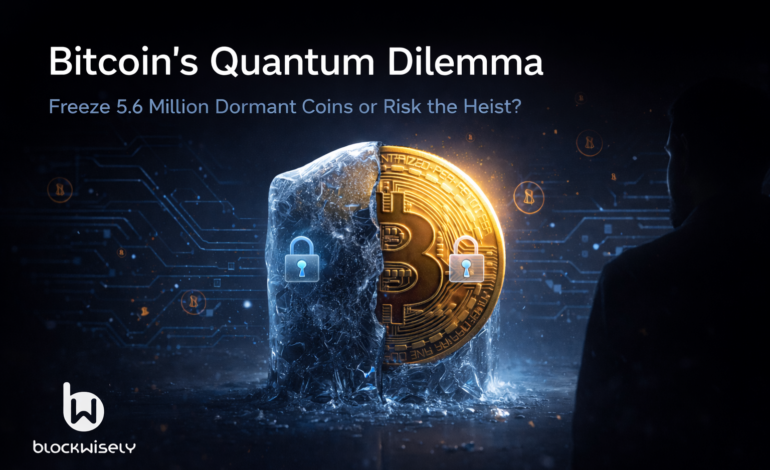
The Bitcoin Quantum Dilemma is raising one of the biggest questions in crypto today: should millions of dormant coins be frozen to protect the network from future threats?
Bitcoin was built on a simple but powerful idea:
👉 No one is in control.
👉 No one can change the rules.
But what happens when future technology threatens that very foundation?
That’s the question now shaking the Bitcoin community.
A New Threat from the Future
Prominent developer Jameson Lopp has reignited a controversial debate:
Should Bitcoin proactively freeze vulnerable coins…
before a future attacker steals them?
At the center of this discussion is a new proposal:
👉 BIP-361 — “Post-Quantum Migration and Legacy Signature Sunset”
It suggests a gradual transition toward quantum-resistant cryptography while eventually disabling older, vulnerable formats.
Why This Even Matters
Right now, Bitcoin is secure.
But in the future?
Quantum computers could change everything.
These machines, using something called Shor’s algorithm, could theoretically:
👉 Extract private keys from public keys
👉 Gain access to wallets that were once considered safe
The Real Risk: Dormant Bitcoin
Not all Bitcoin is equally protected.
Early Bitcoin addresses especially P2PK (Pay-to-Public-Key) expose public keys directly on-chain.
That makes them vulnerable.
📊 Estimated Exposure:
- ~1.7 million BTC in early formats
- Up to 5–6 million BTC potentially at risk
And yes…
👉 This includes coins believed to belong to Satoshi Nakamoto
Coins that have never moved.
Coins worth tens of billions of dollars.
The Core Argument: Freeze or Risk a Heist?
Lopp’s position is simple but controversial:
It’s better to lock vulnerable coins forever
than risk a massive quantum-powered theft.
Because if an attacker succeeds?
- Billions of dollars could flood the market
- Bitcoin’s scarcity could be questioned
- Trust in the network could collapse
What BIP-361 Proposes
The plan isn’t immediate.
It’s gradual.
🧩 Phase A (After ~3 Years)
- Stop allowing new transactions to vulnerable address types
🧩 Phase B (After ~5 Years)
- Legacy signatures become invalid
- Unmigrated coins become unspendable (frozen)
🧩 Long-Term
- Full transition to quantum-resistant cryptography
👉 Timeline: 5–10 years
No panic. Just preparation.
Bitcoin Quantum Dilemma: Security vs. Principles
This is where things get intense.
✅ Arguments FOR Freezing Coins
- Prevents a catastrophic market event
- Protects Bitcoin’s long-term credibility
- Lost coins are already effectively “gone”
- Secures the entire network, not just individuals
❌ Arguments AGAINST It
- Violates Bitcoin’s core principle: immutability
- Sets a dangerous precedent (who decides next?)
- Quantum threat is still theoretical
- Punishes long-term holders who haven’t moved funds
For many, this crosses a line.
Bitcoin was designed to be:
👉 Neutral
👉 Unstoppable
👉 Unchangeable
So the question becomes:
Are we protecting Bitcoin…
or changing what it fundamentally is?
Why This Debate Is Happening Now
Bitcoin is no longer an experiment.
It’s a global financial asset.
With:
- Institutional adoption
- Trillions in value
- Growing real-world usage
The stakes are higher than ever.
Even a future risk is now taken seriously.
What the Bitcoin Quantum Dilemma Means for Users
You don’t need to panic.
But you should be aware.
👉 If you hold Bitcoin:
- Use modern wallet formats
- Stay updated on protocol changes
- Be ready to migrate if needed
This isn’t about fear.
It’s about being prepared.
Final Thought
Bitcoin has faced major challenges before.
- Block size wars
- Scaling debates
- Taproot upgrades
Each time, the network evolved carefully.
This time, the challenge is different.
It’s not political.
It’s technological.
So the real question is:
Should Bitcoin freeze part of its past…
to protect its future?
Or stay true to its principles no matter the risk?